Kids interview Hammurabi
by Charactorium · Hammurabi (1809 av. J.-C. — 1749 av. J.-C.) · Politics · 5 min read
That morning, two young visitors on a school trip stopped in front of a tall black stone at the museum. An old king with a curly beard seemed to be waiting for them. He smiled, pleased that someone still cared about him after nearly four thousand years.
—What was your day like when you woke up in the palace?
You know, my child, I got up before the sun, in rooms with walls of mudbrick. Imagine walls so thick that the heat outside couldn't get through. I washed, then prayed to Shamash, the god of the sun and justice. Then a light meal: barley cakes and a few dates, nothing more. And already my advisors arrived, their arms full of problems! A blocked canal here, a harvest in danger there. Being a king is not about wearing a fine robe. It's about getting up when others are still asleep.
Being a king is not about wearing a fine robe. It's about getting up when others are still asleep.
—What did you eat in the evening? Were there parties?
Oh yes, sometimes! In the evening, barley beer was served in large cups. Imagine a hall where musicians played the lyre, that stringed instrument plucked with the fingers. Meats were grilled, figs and pomegranates were brought. But don't think I feasted every night. Often, I called the priest-diviners. They sacrificed an animal and looked at its entrails to read omens. In my time, we believed the gods spoke to us that way. Before every major decision, I wanted to know if heaven agreed.
Before every major decision, I wanted to know if heaven agreed.
—Which king were you friends with when you became king?
My best ally was Zimri-Lim. He ruled over Mari, a rich city on the Euphrates, north of me. Together we fought the Elamites, a very powerful neighboring people. You know, I inherited a small kingdom surrounded by wolves. Without friends, I wouldn't have survived. So I shook hands, signed agreements, smiled. Imagine a child surrounded by bigger ones in a schoolyard: he has to be clever before he can be strong. That's what I was, at first. A very clever little king.
I inherited a small kingdom surrounded by wolves.
—But later you destroyed your friend's city? That's mean!
You're right, my child. And I understand that shocks you. Around 1761 BCE, once my kingdom was strong enough, I turned against Zimri-Lim and destroyed Mari. Before him, I had already defeated Rim-Sin, the king of Larsa, to the south. Little by little, all of Mesopotamia became mine, from Mari to Ur. Was it just? In my time, a king who did not grow was a king who would be devoured. But I won't lie to you: betraying a friend leaves a mark. You gain an empire, and you lose something inside.
You gain an empire, and you lose something inside.
—Why was your city of Babylon so important to you?
Because Babylon was my home, my heart, my pride! It stood on the river Euphrates. When I became king, it was just one city among many. I wanted to make it the greatest. So I restored the temples, especially the Esagil, the great sanctuary of Marduk, the city's protector god. Imagine decorating your house so that everyone finds it the most beautiful in the neighborhood. That's what I did, but with temples and gods. The more powerful Marduk was, the more powerful Babylon was.
The more powerful my god was, the more powerful my city was.
—Did you have canals dug? What were they for?
Ah, the canals! They were vital, my child. In our land, it rained very little. Without water in the fields, no barley; without barley, no bread or beer. So I had large ditches dug to bring water from the river to the crops. I even made one that I called "Hammurabi-is-the-abundance-of-the-people". Nice name, right? I chose it on purpose. A king feeds his people, otherwise he is nothing. I constantly wrote to my governors to have those canals dredged, to remove the mud. Flowing water was my true wealth.
A king feeds his people, otherwise he is nothing.
—How did it work when someone had a problem to solve?
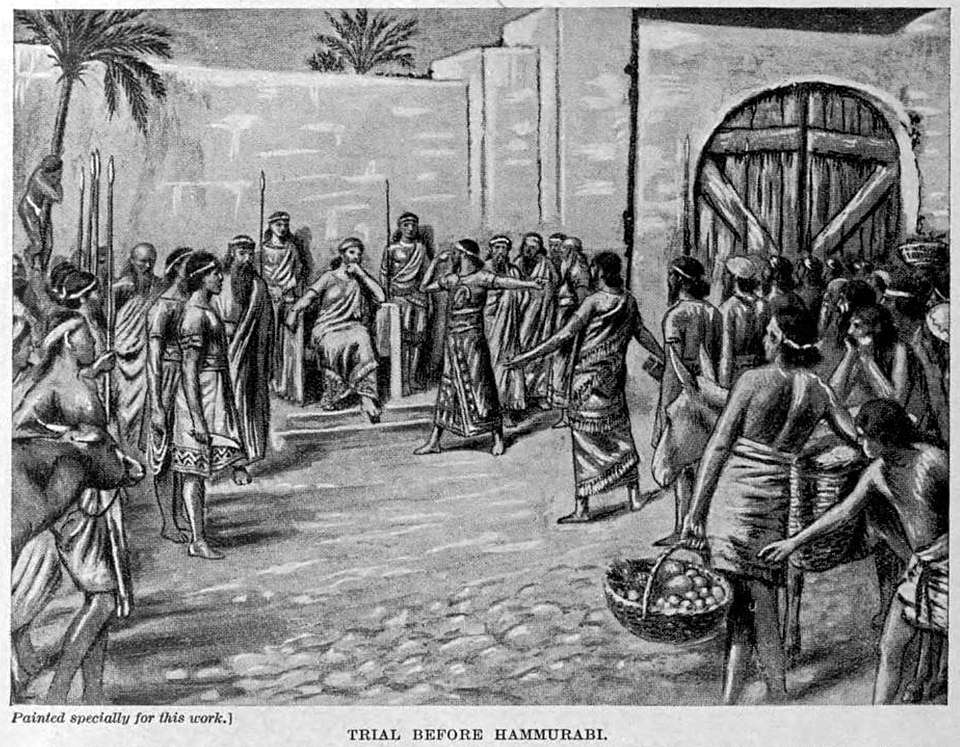
In the afternoon, my child, I listened to the complaints of my subjects. A farmer would come saying, "My field has been stolen!" And I, the king, would decide. But I couldn't be everywhere. So I wrote. Clay tablets, hundreds of them, dictated to my scribes. Once, I ordered a governor to have the Damanu canal dredged before the end of the month, so that the fields would receive water. Imagine a king taking care of a clogged ditch himself! You see, justice also hides in the little things of daily life.
Justice also hides in the little things of daily life.
—How did you write if there were no pens or paper?
Good question! In our land, no paper. We wrote on soft clay. My scribes took a calamus, a pointed reed, and pressed it into the clay to make small wedge-shaped signs. We call it cuneiform writing, from the word for "wedge." Once dry, the tablet lasted for centuries — proof is, you can still read them today! To sign, I rolled my cylinder seal, a small engraved cylinder, over the clay. It left my mark. That was my way of saying, "The king commands it."
Dry clay lasts for centuries: that's why you can still read me.

—Did you write all the laws on the big black stone?
Yes, my child, this stone before you! It's a diorite stele, a very hard rock, as tall as one and a half men. I had 282 articles of laws engraved on it. Everything was there: theft, marriages, wages, houses. Look at the top: you see me standing before Shamash, the god of justice, who hands me the insignia of power. Why? So that everyone understood that my laws came from the gods, not just from me. That way, no one dared say they were unjust. The stone spoke for me.
I put my laws in stone so that no one could erase them.
—Is it true it said "an eye for an eye"? That's scary!
Yes, and I understand that frightens you. One of my laws said: if a man destroys another's eye, they shall destroy his eye. This is called talion: the punishment must resemble the harm done. But listen carefully, it wasn't the same for everyone. An awilum, a free man, was better protected than a mushkenum, a man of lower rank, or a wardum, a slave. For them, sometimes money was paid instead of the injury. It wasn't equal, no. But before me, everyone took revenge without rules. At least now, there was a limit.
Before the law, everyone took revenge without limit. I set a limit.
—And today, what would you like people to remember about you?
You know, my stele has traveled far. An enemy king carried it off as booty, and it was found much later at Susa, far from home. Today, children like you come to look at it. That touches me deeply. I don't ask you to love me — I made war, I betrayed, I was harsh. But remember one thing: I wanted the rules to be written, visible, the same for all to read. A hidden law is the weapon of the powerful. A law engraved, displayed, is already a small step toward justice.
A hidden law is the weapon of the powerful; an engraved law belongs to everyone.
Read further
This imaginary interview was generated by artificial intelligence from sources documented in Hammurabi's profile. It dramatises what the figure might have said based on what we know about them, but does not constitute attested historical testimony. For primary sources and factual documentation, refer to the full profile.