Imaginary dialogue between Zimri-Lim and Hammurabi
by Charactorium · Hammurabi (1809 av. J.-C. — 1749 av. J.-C.) · Politics · 6 min read
It is in the great courtyard of the palace of Babylon, under the cool shade of mudbrick walls, that Zimri-Lim, king of Mari, meets his ally Hammurabi in this year 1770 BC. A lyre resounds in the distance, the air smells of roasted barley and bitumen from the floors. The two sovereigns have been allied for five years against Elam and Eshnunna, and Zimri-Lim, who knows the value of a threatened throne, comes to sound out the man whose power is growing too fast for his liking. He sits down, accepts a cup of beer, and observes his host with the cautious respect of an equal.
—They say in Mari that you are gathering your judgments to engrave them in stone. Why freeze sentences that every king already renders?
You hit the mark, Zimri-Lim, for you too judge your subjects every morning. But a spoken sentence fades like canal water, and the poor man has nothing to oppose the powerful man who lies about custom. I am having my verdicts compiled — already nearly three hundred articles — on theft, wages, marriages, field rents. My design is to have them carved on a stele of black diorite, set up in sight of all, so that the wronged man may come and read his right with his own eyes. A king passes; his engraved law remains. That is what I want to bequeath to my people: not a whim, but a fixed measure.
A spoken sentence fades like canal water; an engraved law remains.
—So you receive complaints in person? I myself delegate so much to my governors. Is it not demeaning for a king to listen to shepherds' quarrels?
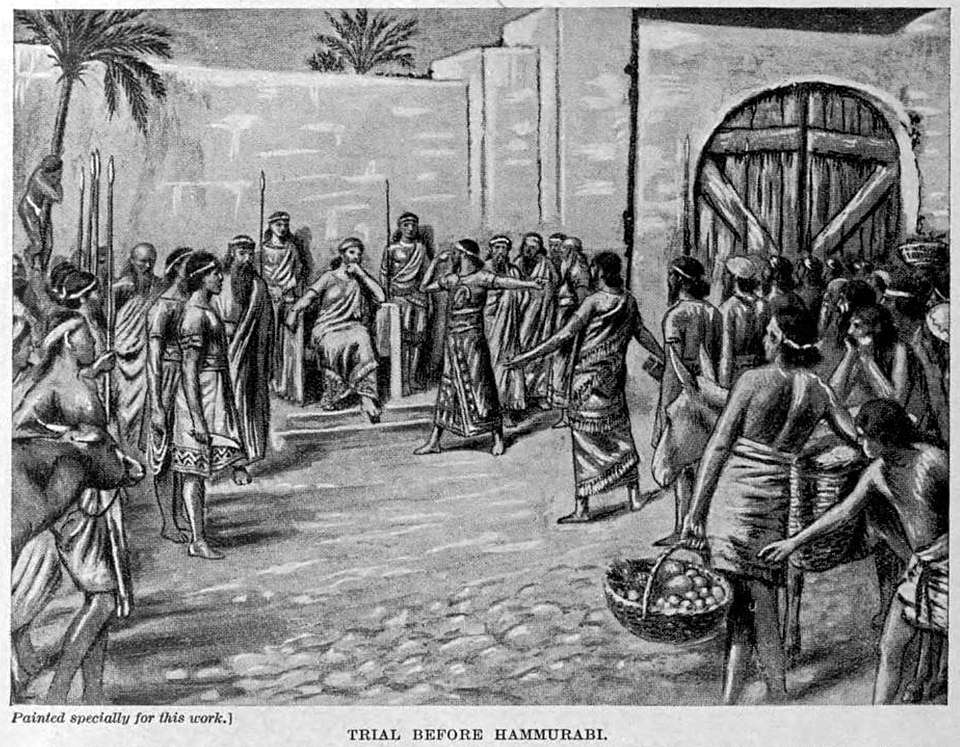
I do not think so, my brother. In the afternoon, when the heat subsides, I sit in the audience hall and listen: a poorly surveyed field, a disputed debt, a disinherited son. It is there, in these small affairs, that the truth of a reign is judged. If the weak man despairs of being heard by the king, then the kingdom cracks from within, more surely than under Elamite blows. Shamash has entrusted me with justice, not to keep it in my palace, but to dispense it. You who govern a city of shrewd merchants know how a single unjust judgment breeds ten grudges. I prefer to lose an hour than to lose a subject's trust.
It is in small affairs that the truth of a reign is judged.
—But your law, I am told, does not weigh equally on all: the eye of an awilum is worth more than that of a mushkenum. Is that your justice?
That is the order of things, Zimri-Lim, and you know it as well as I. A full free man, the awilum, enjoys full protection: whoever gouges out his eye shall have his eye gouged out, whoever breaks his bone shall have his bone broken. But strike a mushkenum, and you shall pay a mina of silver; touch the wardum, the slave, and it is his master who is compensated. Each receives according to his rank, and no one receives nothing. The talion is not blind vengeance: it limits retaliation, it forbids killing for a tooth. Before this measure, the strong crushed without counting. Henceforth the penalty is known in advance, written, equal for all men of the same rank. That is my law: not equality of conditions, but certainty of right.
The talion is not blind vengeance: it limits retaliation.
—You want to have your image carved at the top of this stele, receiving the insignia from Shamash. Is that not claiming divine favor a bit too quickly?
It is not claiming, it is recalling where my power comes from. At the top of the stone, I will be standing, and Shamash, god of the sun and justice, will hand me the ring and the measuring rod. Let the passerby understand at once: these laws do not come from my royal mood, they descend from heaven through my hand. You who must hold Mari between Elam and the nomads know that a throne without divine legitimacy is but a chair to be overturned. I do not make myself a god — I make myself the servant of Shamash, the shepherd whom the gods have appointed to make justice shine upon the land. The stone will say that better than a thousand heralds shouting in the squares.
I do not make myself a god; I make myself the servant of Shamash.
—Coming here, I walked along your canals: water runs everywhere, the fields are rich. How does a single king maintain such a network?
Water, Zimri-Lim, is the true wealth of Sumer and Akkad — far more than temple gold. I have had great canals dug and dredged, and one of them bears a name I am proud of: Hammurabi-is-the-abundance-of-the-people. As long as it flows, barley rises, beer foams, granaries fill, and no one rebels with a full belly. But a neglected canal silts up in one season, and that brings famine. So I leave it to no one: I write myself to my governors to order dredging before the floods. You have seen Mari prosper by the Euphrates; our two kingdoms live and die by this water. He who masters the canals feeds his people; he who lets them die loses his throne.
He who masters the canals feeds his people; he who lets them die loses his throne.
—It is whispered that you write to Sin-Iddinam, your governor of Larsa, even about the details of a ditch. Does a great king really concern himself with mud and reeds?
Yes, and I claim it. I have dictated very precise letters to my scribes: let such a canal, the Damanu, be dredged before the month ends, so that the fields receive water on time. I also settle boundary disputes, overdue taxes, poorly supplied garrisons in writing. People think an empire is held together by great battles; it is held together in truth by a thousand details that no one sees. If I leave a governor to decide alone, tomorrow he decides against me. My tablets travel through the kingdom like veins: through them, my will reaches the last ditch of Larsa. You who keep your archives in Mari know that power — the power of clay that speaks farther than the king's voice.
An empire is not held together by great battles, but by a thousand details that no one sees.
—I see the scaffolding on the temple of Marduk. You spend so much on a god who, until recently, barely counted among the great ones. Why elevate him so high?
Because Marduk is the god of Babylon, and Babylon, under my hand, is no longer the city of yesterday. I am restoring the Esagil, his great temple, raising its walls, making his cult more splendid than all others. By elevating the god, I elevate the city; by elevating the city, I elevate the kingdom. The gods follow the fortune of men, Zimri-Lim: when a people grows, its god rises with it among the powers of heaven. I do not deny Enlil or Anu, the ancient lords — but I say that to Marduk they have entrusted the governance of men. The temple I build is not just stone and bitumen: it is the announcement that Babylon now speaks as an equal with the old cities.
The gods follow the fortune of men: when a people grows, its god rises with it.

—You have it proclaimed that the great gods entrusted mankind to Marduk, and named Babylon "mighty among the four quarters". Is that not saying you already dominate the world?
It is saying what I believe to be true, and what I want to make true. When Anu and Enlil had given to Marduk the governance of all mankind, they named Babylon with its sublime name and made it mighty among the four quarters — those are the words I have inscribed at the head of my laws. It is not an evening's vanity, my brother: it is the program of my entire reign. A city that calls itself the center of the world must then deserve that title through justice and abundance, otherwise the gods bring it low. I do not proclaim my domination out of pride; I inscribe it to bind myself. The king who writes his greatness in stone condemns himself to defend it every day of his life.
I do not inscribe my greatness out of pride; I inscribe it to bind myself.
—Remember: five years ago, we united our armies against Elam and Eshnunna. But today your power swells. Should I still sleep peacefully in Mari?
You ask the question of a wise king, and I do not blame you. Yes, since our alliance, I have taken Isin, Uruk, and soon Larsa will bend. Lower Mesopotamia is gathering under a single hand, and that hand is mine. But remember who marched at my side when Elam threatened to swallow us both: it was you, Zimri-Lim, and your archers from Mari. I do not forget an ally as long as he remains an ally. Our strength, until now, was to hold together against a stronger foe. You ask if you can sleep peacefully: as long as our interests march in step, your sleep has nothing to fear from Babylon. A king measures his friendships by what they bring him — and yours, to this day, has brought me much.
I do not forget an ally as long as he remains an ally.
—'As long as our interests march in step'... That is a cold friendship, Hammurabi. And the day those steps diverge?
Do not make me say what I did not say, Zimri-Lim. Between two kings, there is no friendship without interest — yours toward me is no different, and that is perfectly fine. We are not two shepherds exchanging oaths under a palm tree, but two thrones weighing their strengths. Today, the Euphrates binds us: your archives, my canals, our common enemies. As long as that lasts, you will find Babylon loyal and the beer on my table always cool for you. For the rest, the future belongs to the gods and the edge of things. I will only tell you this, as an equal: never let your trust run faster than your caution. That is advice I apply to myself every morning, and it has kept me alive on this throne.
Never let your trust run faster than your caution.
Read further
This imaginary interview was generated by artificial intelligence from sources documented in Hammurabi's profile. It dramatises what the figure might have said based on what we know about them, but does not constitute attested historical testimony. For primary sources and factual documentation, refer to the full profile.