Imaginary interview with Hammurabi
by Charactorium · Hammurabi (1809 av. J.-C. — 1749 av. J.-C.) · Politics · 6 min read
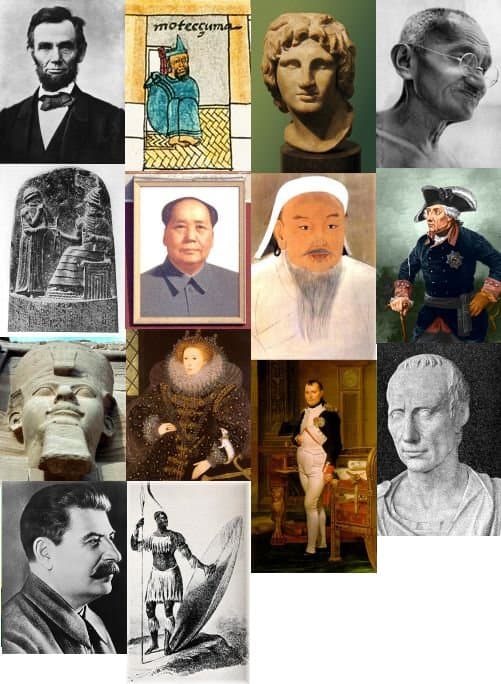
Babylon, end of reign. In an audience hall of mud-brick walls thickened by the heat, the king receives, a cup of barley beer within reach. Before him, erected, the tall black diorite stele that the scribes have just finished. He agrees to speak of justice, canals, and the gods.
—Why did you want to have your laws engraved in a stone as hard as diorite, rather than on the clay that your scribes knead every day?
Clay breaks, clay is rewritten. A merchant can erase a contract with a moist thumb. But this black stone you see standing there, more than two cubits above my head, no man will correct it after me. I have had two hundred and eighty-two articles inscribed: theft, the mason's wage, the fate of the repudiated wife, the hand of the trembling surgeon. At the top, I had Shamash, the sun god, carved, handing me the insignia of command. Let whoever comes to complain raise his eyes and understand: these words are not mine, they descend from the god of justice. A law that can be scratched is but a scribe's whim; a law in diorite becomes a mountain.
A law that can be scratched is but a scribe's whim; a law in diorite becomes a mountain.
—Your articles provide that the eye of him who has gouged out an eye be gouged out. Isn't that too brutal a justice?
Brutal? Rather ask the one who has lost his eye what he calls just. Before me, vengeance had no measure: for an eye, one would kill an entire household. I set the measure. If a man has gouged out the eye of a free man, they shall gouge out his eye — no more. But look closely at what I had engraved next: for the eye of a mushkenum, one pays in silver; for that of a wardum, something else again. Retaliation is not rage, it is the boundary post planted so that rage stops. And when the mason builds a house that collapses on its owner, he dies in turn: let the one who takes the trowel know that the life of another weighs on his shoulders.
Retaliation is not rage, it is the boundary post planted so that rage stops.
—They say you personally attended to the digging of canals. Shouldn't a king leave such details to his governors?
What other work better deserves the king's hand? Without water, barley does not sprout; without barley, no bread, no beer, no soldiers. I wrote to Sin-Iddinam, my man in Larsa, about a canal that mud was choking: let him dredge it, and let it be done before the end of the current moon. One does not argue with the flood. I even gave my name to one of them — the canal called « the abundance of the people » — for a king is measured by the water he makes flow in the fields as much as by the cities he takes. My governors sometimes think I am far away; my tablets remind them that I see to the bottom of their ditches.
One does not argue with the flood.
—Did you ever personally settle quarrels as humble as a dispute between two peasants over a field?
Often, and I do not hide it. Every other morning, after my prayer to Shamash and my barley cakes, these cases are brought to me: a field whose boundary stone has shifted, a rent that one denies having received, a poorly maintained dike that has drowned the neighbor's harvest. My scribes take notes, I dictate, and the letter goes out the same day to the province. Some laugh that a king of the Euphrates stoops to counting furrows. But an empire does not hold by its walls, it holds by the trust of the farmer who knows he will be heard. The day the least of Babylon doubts my justice, my victories will be worth no more than a handful of clay.
An empire does not hold by its walls, it holds by the trust of the farmer.
—You were the ally of Zimri-Lim of Mari before destroying his city. How do you live with this reversal?
Zimri-Lim was my ally when Elam threatened both our thrones; our messengers wore out the roads between Mari and Babylon, and we fought the same enemies. I do not deny it. But an alliance is a yoke: as long as the oxen pull in the same direction, you advance; the day one becomes too strong for the yoke, the other must choose. Mari held the middle Euphrates, its granaries, its archives, its trade — too much for a neighbor. Around the eleventh year after my great victory, I tore down its walls. They will call me cruel. I answer that I was first patient: I waited until I was strong enough for the blow to be single and without return. A king who strikes twice is a king who struck too soon.
A king who strikes twice is a king who struck too soon.
—How did you manage to unite under your sole name cities as ancient and proud as Larsa or Ur?
Through patience, then through lightning. When I ascended the throne, Babylon was only a kingdom of a few days' march, surrounded by older and richer kings. I tied alliances, I untied them, I let my rivals exhaust each other. Then, the year Rim-Sin of Larsa still thought himself master of the South, I came down upon him and took his city. From Mari in the north to Ur, near the southern marshes, the water of the Euphrates now bathes lands that obey a single name. I did not conquer for the pleasure of arms: I conquered so that one law, one measure of grain, one justice might run from one end of the river to the other.
Through patience, then through lightning.
—Why did you work so much for the god Marduk and his temple, even raising him above the other deities?
Because a city without a great god is but a pile of bricks. I raised the Esagil, the temple of Marduk, I adorned it as one adorns a bride, for the greatness of the city is the greatness of its god. In the prologue I had engraved, I recall that Anu and Enlil entrusted Marduk with the governance of men and named Babylon « in the four quarters of the world ». Understand: if the god of my city receives the empire of heaven, then the king of that city receives the empire of earth. I did not invent the gods; I only showed that mine now marched at the head of the procession. The rest — the walls, the canals, the laws — is but its shadow cast.
A city without a great god is but a pile of bricks.

—Before an important decision, they say you consulted diviners. What do you seek in omens?
The will of those who see farther than I. Before a campaign, before laying the first brick of a temple, I summon the priests who read the livers of sacrificed animals and the signs of the sky. A king who decides alone decides blindly. The gods do not write on diorite, they write in entrails, in the flight of birds, in the color of oil on water. My role is to know how to read those letters as much as those of my scribes. When the omen is dark, I wait, even an entire season. Stone taught me patience, and the gods taught it to me before it. No army marches if Shamash turns away his gaze.
A king who decides alone decides blindly.
—What does an ordinary day in your palace of Babylon look like?
I rise with the sun, in rooms with walls thick enough to keep the heat out. Ablutions, prayer to Shamash, then some barley cakes and dates — a king who eats heavily in the morning judges poorly at noon. Then come the counselors, news from the provinces, disputes. In the afternoon, I dispense justice and dictate my letters; the stylus runs over the fresh clay while I speak. In the evening, sometimes, a banquet: barley beer is poured into cups, mutton is roasted, a lyre player covers the noise of conversations. I wear my woolen robe draped over the shoulder and the straight cap that tells strangers, without a word, who commands here. A king's day is water, grain, and judgments — always in that order.
A king's day is water, grain, and judgments — always in that order.
—At the end of your reign, what would you like to be remembered for?
Not my battles — kings who only know how to conquer are forgotten as soon as their sons weaken. I had engraved, at the end of my stele, that I am the king to whom the god of justice granted truth, and that the sovereign who comes after me should observe my words. That is what I want: to be read. If, in ten generations, a man from the depths of the fields comes to touch this black diorite and finds there a measure for his dispute, then Hammurabi will still live, when Babylon itself is but dust. Canals silt up, walls crumble, gods change faces. A well-set law, it crosses centuries as the Euphrates crosses the plain.
A well-set law crosses centuries as the Euphrates crosses the plain.
Read further
This imaginary interview was generated by artificial intelligence from sources documented in Hammurabi's profile. It dramatises what the figure might have said based on what we know about them, but does not constitute attested historical testimony. For primary sources and factual documentation, refer to the full profile.