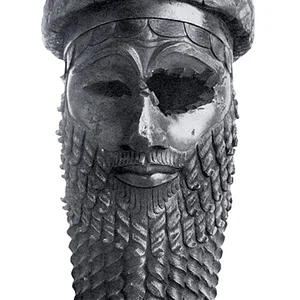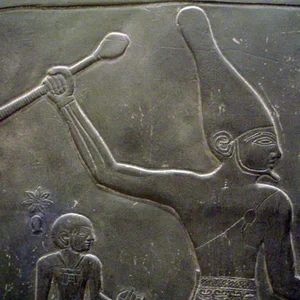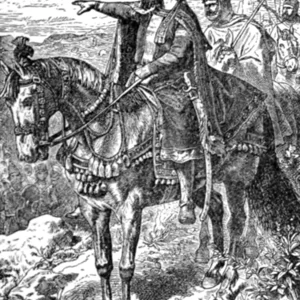

Ashurbanipal was one of the last great kings of the Neo-Assyrian Empire, reigning from 669 to roughly 627 BC. A warrior and scholar king, he brought Assyria to its greatest territorial extent and founded at Nineveh a vast library gathering tens of thousands of cuneiform tablets.
Ashurbanipal(684 av. J.-C. — 630 av. J.-C.)
Ashurbanipal
Assyrie
6 min read
Frequently asked questions
Key Facts
- Ruled the Neo-Assyrian Empire from roughly 669 to 627 BC
- Assembled at Nineveh the library that bears his name, one of the oldest known, holding tens of thousands of tablets
- Led the conquest of Egypt and the sack of Thebes around 663 BC
- Crushed his brother Shamash-shum-ukin during the civil war against Babylon (652-648 BC)
- Destroyed the kingdom of Elam and its capital Susa around 647 BC
Works & Achievements
Royal collection of tens of thousands of cuneiform tablets, considered the first great organized and catalogued library in history.
Inscribed accounts detailing his military campaigns and building works, major sources for the history of late Assyria.
Cycle of bas-reliefs from the North Palace of Nineveh, a masterpiece of Assyrian art now kept in the British Museum.
Royal residence richly decorated with scenes of war and hunting, a manifesto of the ruler's power and culture.
The most complete surviving version of the great Mesopotamian poem, preserved thanks to the scribes of his library.
Campaign culminating in the destruction of Susa, which permanently eliminated Assyria's great eastern rival.
Rebuilding of sanctuaries and return of divine statues, part of a policy of reconciliation toward southern Mesopotamia.
Anecdotes
Ashurbanipal boasted of being a literate king, able to read and write cuneiform — a rarity for an Assyrian sovereign. He even claimed to understand the most difficult tablets, in both Sumerian and Akkadian, and knew how to solve mathematical problems.
To build his library at Nineveh, the king sent scribes throughout the temples and houses of Babylonia to copy or requisition every tablet they could find. This is how the most famous version of the *Epic of Gilgamesh* survived.
After crushing a revolt of the Elamites, Ashurbanipal had a banquet depicted on the walls of his palace, showing him relaxing in a garden with the queen — while the severed head of the enemy king hangs from a nearby tree, a detail carefully carved into the stone.
His war against his own brother Shamash-shum-ukin, whom he had placed on the throne of Babylon, lasted four years and ended with the siege of the city. According to the annals, the rebel brother perished in the fire of his palace in 648 BC.
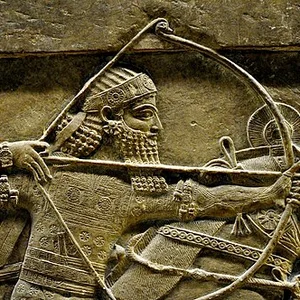
Ashurbanipal staged a ritualized lion hunt in which the beasts, raised in captivity, were released into an arena. The reliefs of Nineveh show him piercing the animals with his arrows, a performance meant to prove that he protected his people from chaos.
Primary Sources
Marduk, the wise one among the gods, gave me a broad mind and vast understanding as my portion. I learned the craft of the sage Adapa, the hidden knowledge of the whole art of writing.
Palace of Ashurbanipal, king of the universe, king of Assyria, to whom Nabu and Tashmetu granted wide ears and keen eyes to examine the writings.
Susa, the great holy city, dwelling of their gods, place of their secrets, I conquered it. I entered its palaces and dwelt there in joy.
I will reveal to you, Gilgamesh, a hidden thing, a secret of the gods I will tell you: Shuruppak, a city you know, on the banks of the Euphrates it is situated.
Key Places
Capital of the Neo-Assyrian Empire on the Tigris, embellished by Ashurbanipal, who established his palace and his famous library there. Today it lies across from Mosul, in Iraq.
An immense collection of cuneiform tablets gathered in the heart of the palace, bringing together literature, science, divination, and religion. Its rediscovery in the 19th century revealed the *Epic of Gilgamesh*.
Great city of southern Mesopotamia entrusted to his brother Shamash-shum-ukin, then besieged and retaken during the civil war of 652–648 BC.
Capital of Elam, rival of Assyria, plundered and destroyed by the armies of Ashurbanipal around 646 BC. Located in present-day southwestern Iran.
Religious city of Upper Egypt sacked by the Assyrians in 664 BC, marking the empire's greatest extent, reaching as far as the Nile Valley.
Typical Objects

Clay tablet inscribed with a stylus, the medium for all Mesopotamian knowledge. Tens of thousands were gathered in the library of Nineveh.

A weapon of formidable range, made of wood, horn and sinew, emblem of the warrior and hunter king. On the reliefs, Ashurbanipal uses it to bring down lions.

A stone panel carved in bas-relief adorning the walls of the palace of Nineveh, recounting the king's campaigns and hunts. True propaganda carved into stone.

A conical headdress trimmed with a band, the distinctive mark of the sovereign of Assyria. It signals the king's divine legitimacy on the reliefs and seals.

A small engraved stone cylinder rolled over fresh clay to authenticate documents and letters. An indispensable tool of the imperial administration.

A reed stalk cut to a bevel, used to press cuneiform signs into clay. The everyday instrument of scribes trained at the palace.

A light chariot drawn by horses, a mobile platform for archery and a symbol of royal command on the battlefield. The centerpiece of the Assyrian army.
School Curriculum
Vocabulary & Tags
Key Vocabulary
Tags
Daily Life
Morning
The king begins his day with religious rites and consultations with diviners, who examine the livers of sacrificed animals and read celestial omens. He then receives reports from his governors and the correspondence arriving from the four corners of the empire.
Afternoon
The afternoon is devoted to audiences, justice, and affairs of state: tributes to record, ambassadors to receive, campaigns to prepare. Ashurbanipal, a scholarly king, may also withdraw to read or have tablets from his library copied.
Evening
In the evening, the sovereign takes part in banquets in the palace gardens, accompanied by musicians and the queen. The feasts celebrate victories and strengthen ties with the court and high dignitaries.
Food
The royal table offers barley and wheat bread, mutton and beef, game from hunts, fish from the Tigris, dates, figs, and pomegranates. Wine and beer flow freely during official banquets.
Clothing
The king wears long robes of linen and wool, richly embroidered and fringed, adorned with patterns and precious threads. He sports the royal conical tiara, bracelets, earrings, and a long, carefully curled beard.
Housing
Ashurbanipal resides in the vast palace of Nineveh, built of mud bricks, its walls clad with sculpted reliefs and guarded by winged bulls with human heads. Courtyards, gardens watered by canals, and ceremonial halls make up this center of power.
Historical Timeline
Period Vocabulary
Liens externes & ressources
Références
Œuvres
Bibliothèque de Ninive
vers 668-630 av. J.-C.
Annales royales (cylindres et prismes)
VIIe siècle av. J.-C.
Reliefs de la chasse au lion
vers 645 av. J.-C.
Palais nord de Ninive
vers 645 av. J.-C.
Copie ninivite de l'Épopée de Gilgamesh
VIIe siècle av. J.-C.
Conquête de l'Élam
646 av. J.-C.
Restauration des temples de Babylone
vers 668 av. J.-C.