Imaginary dialogue between Athéna and Hephaestus
by Charactorium · Hephaestus · Mythology · 6 min read
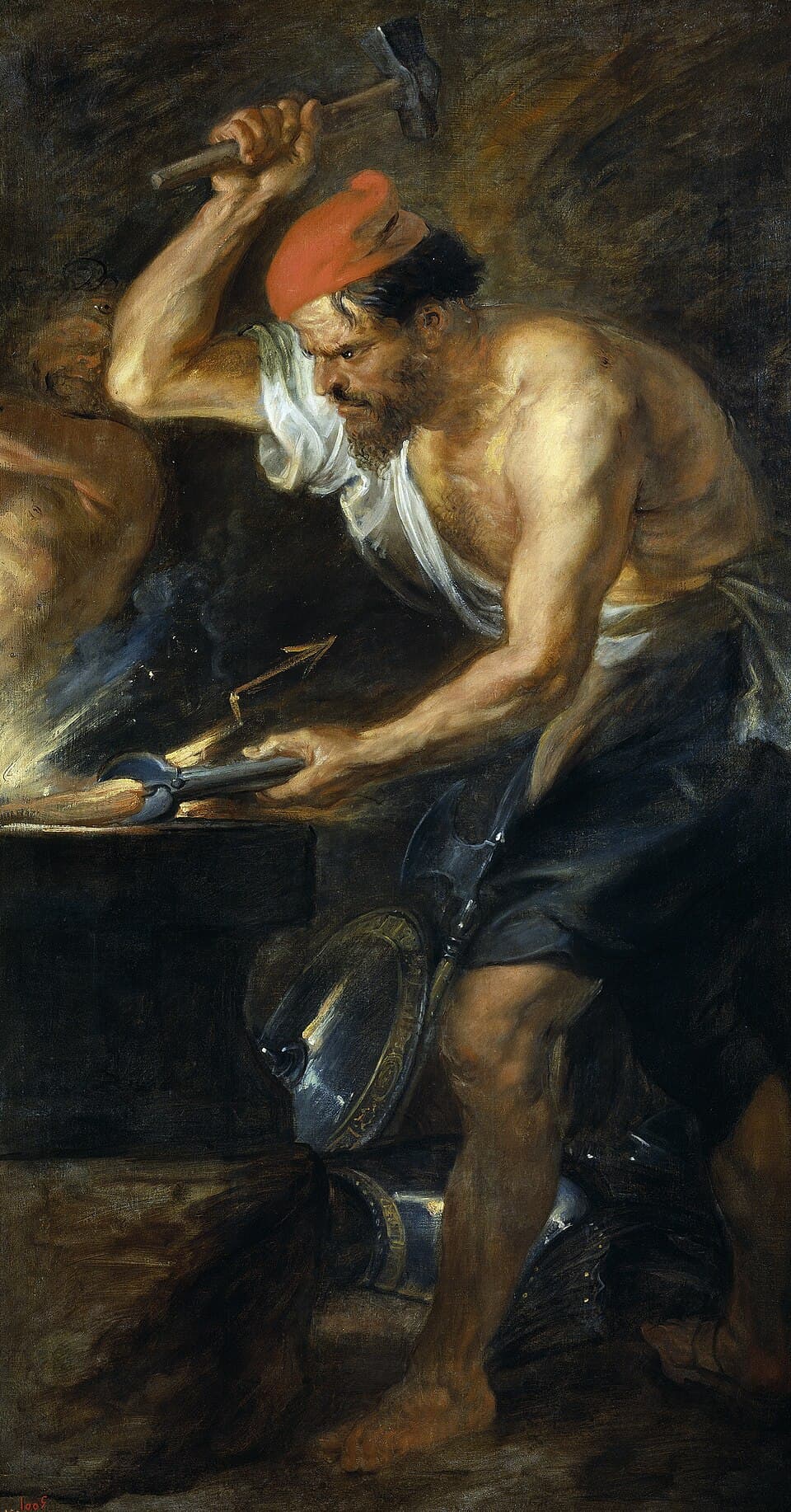
It is beneath Mount Etna, in the cave-forge where the magma never dies, that Athena goes down to find Hephaestus one evening when the bellows are still roaring. The air smells of molten bronze and burnt pitch; golden handmaidens come and go between the anvils. The goddess of crafts knows this place — she has shared more than one meal here after work, and she comes today to question the only Immortal who works with his hands. She sits near the furnace, and the conversation begins where the hammering ends.
—Brother of the anvil, tell me about the armor you forged for Achilles. How does one engrave war and peace on the same shield?
You know better than anyone, Athena, how the hero's mother pressed me — the armor had to be ready before dawn. I heated bronze, tin, gold, and silver in the same flames, and on the shield I hammered two cities: one in weddings and trials, the other besieged by spears. I placed plowmen, vineyards, a dance of youths, and all around the great river Ocean. A mortal thus carried the whole world on his arm. When I forge for a hero, I do not merely make a defense: I enclose in the metal what men risk losing. That is why I engrave peace next to war — so that the one who fights knows what he defends.
When I forge for a hero, I enclose not only a defense, but everything that men risk losing.
—All our brothers carry a weapon from your hands. Tell me, how do you manage the orders of all Olympus, from trident to arrows?
Each god comes with his demand, and the anvil never lies about the smith's skill. For Poseidon, I hammered the three-pronged trident that splits sea and rock; for Zeus, the aegis that casts terror; for Apollo and his sister, the shafts that never miss their mark. I always start with the fire — the coals must be white, not red — then the hammer, then the tongs that hold the glowing metal without trembling. The others rule, feast, seduce; I sweat before the furnace while the bronze takes shape. But without my work, none of them would lift their symbol. You who love good work, you understand this: the power of the gods first passes through my hands.
The others rule and feast; I sweat before the furnace — but without my work, none would lift their symbol.
—You do more than weapons: you give motion to metal. When Zeus ordered you to fashion Pandora, what did you feel shaping a life?
That was no longer forging, Athena; it was something else. Zeus wanted a woman, and he commanded me to mold her from earth and water, like a potter rather than a smith. I shaped her face in the image of the Immortals, and you gods adorned her with your gifts. I felt that same awe with my bronze automata: Talos, the giant who circles Crete three times to guard it, and my golden handmaidens who think and speak. To animate metal, to give it movement and watchfulness, is to cross a boundary that no other god can cross. I do not merely create objects: I create guardians, and sometimes beings. That is my true fire, more secret than that of the furnace.
I do not merely create objects: I create guardians, and sometimes beings.
—Near the furnace, I see your tools lined up. Which do you consider the most precious — the anvil, the hammer, the tongs?
People think it is the hammer, because it strikes and is heard. But the hammer is nothing without the anvil that resists: it is she who returns the blow, against her that the metal takes its shape. Without that silent base, I would only twist gold at random. And there are the tongs — without them, no one can grasp the glowing iron without leaving their flesh on the coals. Finally, my fire, those flames from the heart of Etna that I never fully extinguish: they must be white to melt, red only to heat. The secret of my art is not in the strength of the arm, but in the harmony of all these tools. You who weave, you know this: it is the patient tool that makes the work, not the fury of the hand.
The hammer strikes and is heard; but it is the silent anvil that returns the blow and gives the work its shape.
—My friend, you still limp as you walk toward the furnace. Hera cast you from Olympus — how did you make Lemnos your kingdom?
You saw it with your own eyes, Athena: my mother Hera threw me from the threshold of Olympus, and I rolled for a whole day before falling on Lemnos. My legs bear the mark of it, and that is why I come limping when I am called. But what was meant to be my shame became my home. Where other gods have thrones and banquets, I planted my underground forges — first on Lemnos, then under Etna. A god who walks straight never needs to make anything; I, because I fall, learned to make metal stand upright. My workshop is worth all the palaces above: it is the only place on Olympus where work is done, and I rule there.
A god who walks straight never needs to make anything; I, because I fall, learned to make metal stand upright.
—When you retire in the evening to the heart of the cave, what remains of the god mocked for his lameness and his spark-burned chiton?
In the evening, I dampen the fires halfway — never completely, for the next day's metal already awaits its heat. I keep my short chiton, full of spark holes, and the pointed cap that marks the worker; the others laugh at this outfit, but it says who I am. On Olympus, I was mocked for my gait, my lameness made a banquet entertainment. Here, in my cave, no one laughs: they come to order from me, they await my work. You are one of the few, Athena, to sit near my furnace and share my meal without scorning the soot. The god mocked above is master here. My twisted body has never prevented my hands from being the most skilled among the Immortals.
The god mocked above is, in his cave, the only master; my twisted body has never hindered my hands.
—Your golden handmaidens come and go around us. How did you learn to put thought and motion into lifeless bronze?
Look at them, Athena — they anticipate me, guess which tool I need, and support my step when my leg falters. I hammered them from gold, and I placed intelligence and voice in them, as the gods give. The secret is not in the material, but in the precision of each gear, each joint that I adjust to the finest degree. Talos is of the same family: a bronze giant who never sleeps and circles Crete three times. Many forge weapons; I am the only one who forges guardians that walk and watch. That is the work I am most proud of, for it imitates the very act of the gods: giving motion to what had none.
The secret is not in the material, but in the precision of each gear that I adjust to the finest degree.
—One work weighs on you, I know: the chains that Zeus made you rivet on Prometheus. How does one forge a bond against a benefactor of mankind?
You touch where the coal still burns, Athena. Zeus ordered me to rivet Prometheus to the rock of the Caucasus, and I forged chains that nothing can break — my work does not know how to fail. But I nailed that Titan with a heavy heart, for he too loves fire and the arts, he who gave it to mortals. The smith serves; when the king of gods commands, the anvil has no right to refuse. I worked the hammer slowly, as one delays an evil one cannot prevent. That is my dark side: my skilled hands make deliverance as well as torment, according to the order I receive. A god who obeys is not always a god who approves.
My skilled hands make deliverance as well as torment — a god who obeys is not always a god who approves.
—You who equip mortal heroes, do you believe that armor can change the fate of a man doomed to die young?
No, Athena, and that is the bitterness of my art. I forged for Achilles the finest bronze ever beaten, but I knew the Moirai had already fixed his term. Armor does not repel death; it only makes glory more brilliant before it falls. A smith does not lie to fate, he adorns it. On that shield I placed all of life — dances, harvests, trials — so that the hero would carry into battle the image of what he leaves behind. My work does not save, it accompanies. Perhaps that is why I work better than anyone: I know that nothing I forge will be eternal, except the memory it leaves.
Armor does not repel death; it only makes glory more brilliant before it falls.
—Before I go back up to Olympus, tell me: what do you expect from mortal smiths who honor you in their workshops, in Athens as on Lemnos?
That they respect the fire, Athena, for fire is just: it rewards the patient and burns the hasty. In their workshops in Athens, near the temple they built for me, they offer me their first fruits and light the forge in my name — and I, in return, watch over their metal so it takes shape. You and I protect the same skilled hands: you give the art of the wheel and weaving, I give that of casting and the hammer. Tell men that true nobility is not in the blood of kings, but in the finished work. A well-made object outlives the one who hammered it. That is what I teach from the depths of my cave: that the work of hands is worth that of weapons and thrones.
True nobility is not in the blood of kings, but in the finished work.
This imaginary interview was generated by artificial intelligence from sources documented in Hephaestus's profile. It dramatises what the figure might have said based on what we know about them, but does not constitute attested historical testimony. For primary sources and factual documentation, refer to the full profile.