Kids interview Hephaestus
by Charactorium · Hephaestus · Mythology · 5 min read
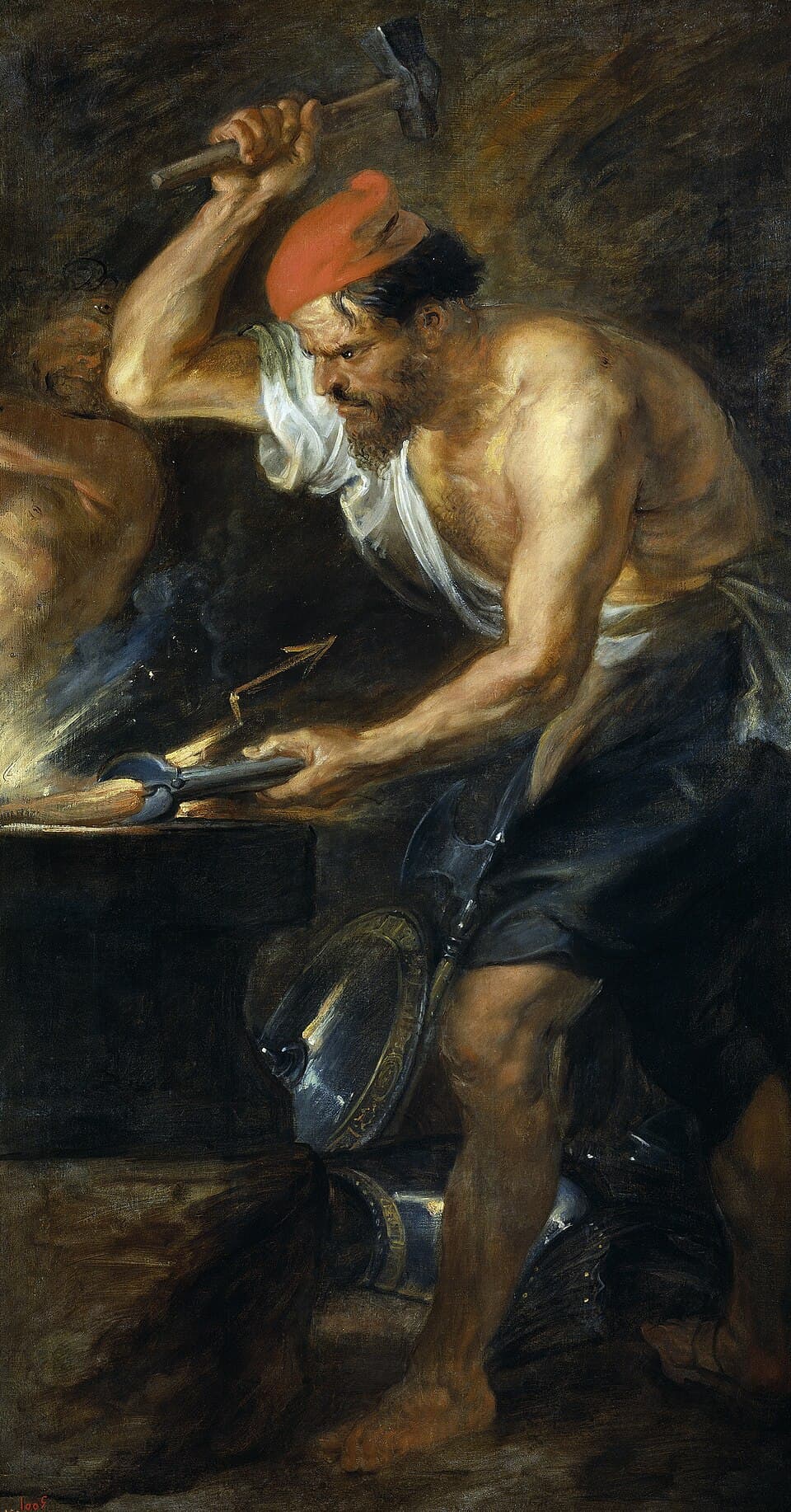
Two young visitors of twelve years old descend a staircase of burning stone. The heat rises, and the regular strikes of a hammer are heard. At the back of a glowing cave, a lame god sets down his tool and smiles at them, glad to have visitors.
—What was your workshop like? What did it smell like when you walked in?
Come close, my child, but watch where you step. My forge is hollowed out beneath Mount Etna, that volcano in Sicily. Imagine a vast cave, with no daylight at all, just the red glow of embers everywhere. It smells of hot metal, smoke, and a bit of sulfur from the volcano. The magma—that's molten rock that flows from volcanoes—heats my fires without needing wood. Do you hear that hammering? It never stops. My assistants, the Cyclopes, those one-eyed giants, strike the anvil alongside me. It is so hot that my sparks dance like a rain of stars.
My sparks dance like a rain of stars.
—Did you work all day? Did you ever sleep?
Oh, I work a lot, that's true. In the morning, I look at what I forged during the night and sharpen my hammers. My tongs let me grasp the hot metal without burning my hands. In the afternoon, I hammer bronze and gold for the other gods who place orders with me. I even made golden handmaidens—statues that move and help me carry things! In the evening, I let the embers glow softly. Sometimes the goddess Athena comes to share a meal and admire my work. You know, a god doesn't sleep like you do. But the fire—it never goes out.
The fire never goes out.
—Is it true that you made the weapons for all the other gods?
Yes, my child! On Olympus, when a god wants a weapon, they come down to me. I forged Poseidon's trident, that great three-pronged fork for the god of the sea. I hammered Zeus's aegis, a shield that protects the king of the gods. And for Apollo, the god of light, I made his bow and arrows that never miss their target. Imagine: all the greatest gods depend on my hands and my anvil. I am lame, I cannot run fast. But without me, none of them could fight.
Without me, no god could fight.
—Which weapon are you most proud of?
Ah, you touch my heart! The armor of the hero Achilles—that is my masterpiece. The poet Homer tells of it in the Iliad, that great tale of the Trojan War. His mother came to beg me, so I forged for him an extraordinary shield. On it, I carved an entire world: cities at peace, weddings, dances, but also battles. Imagine a shield that tells the whole life of men—happiness and war side by side. I did not just make a weapon, my child. I made an image of the world in metal.
I carved the whole life of men in metal.
—I heard you created a woman. Is that possible?
It's true, and it was strange even for me. Zeus ordered it, so I shaped Pandora from clay and water, like a potter shapes a vase. The poet Hesiod tells this in his Theogony. Then each god gave her a gift: beauty, grace, a voice. Imagine you mold a statue from earth, and one morning it opens its eyes and breathes. That is what my hands did. She was the first woman in the world of men. Do you understand now why they say I bring matter to life?
I shape the earth, and one morning it breathes.
—And is it true you made a walking giant of metal?
Talos, yes! A giant made entirely of bronze, that copper-colored metal. I forged him to guard the island of Crete. Imagine a huge statue that is not still: it walks around the island, day and night, and keeps away anyone who tries to land. Metal that moves, that watches, as if it were alive. In my time, people saw blacksmiths as magicians, because we transform hard stone into objects that seem to breathe. Talos had no heart, my child. But he was as faithful as a good watchdog.
Metal that walks, faithful as a watchdog.
—Why do you limp? What happened to you?
You noticed, eh? Don't look down, it's okay to talk about it. My mother Hera did not find me beautiful enough at my birth. So she hurled me from the top of Olympus. I fell for a long, long time, until I landed on the island of Lemnos. It is from that fall that I have my damaged leg. The poet Homer calls me 'the lame god.' You know what? When I walk, I hobble, it's true. But my hands—they are the most skilled of all the gods. You can be lopsided and still create wonders.
You can be lopsided and still create wonders.
—Did you hold a grudge against your mom after that?
That's a question of the heart, and I'll answer you honestly. Yes, I was hurt. But I did not respond with cries. I responded with my art. I forged for Hera a magnificent golden throne, as the Iliad tells. Imagine a seat so beautiful that you dream of sitting in it. Except that throne was trapped: once seated, she could not get up! That was my way of saying: you rejected me, but you still need my hands. Later, I returned to Olympus. The forge, you see, made me indispensable.
I did not respond with cries, but with my art.
—Is it true you chained someone to a mountain?
Yes, and that episode still weighs on my heart. The Titan Prometheus had stolen fire to give to humans. Zeus, furious, ordered me to chain him to Mount Caucasus. So I forged bonds so strong that no force could break them. The poet Aeschylus tells this scene. Imagine: I held my hammer, and I had to bind the one who had helped humans—with the very fire I master. I did not agree, deep down. But when the king of the gods commands, even a god obeys. That day, my craft felt heavy.
When the king of the gods commands, even a god obeys.
—Didn't you like obeying Zeus to do mean things?
You see clearly, my child. My hands are meant to create beautiful things. But sometimes, Zeus asked me to make them into instruments of punishment. Prometheus's chains were that. The same fire that forges a shield can also forge a prison. That is the weight of my gift: I am the arm that executes, whether I am commanded to do good or harsh deeds. Imagine you are the only one who knows how to do something, and you are asked to use it for something you dislike. I never liked chaining. But I have always loved forging.
The same fire that forges a shield can forge a prison.
—If we could keep just one of your creations, which one would you give us?
What a beautiful question to end with! I would not give you a weapon, nor the trident nor the aegis. No. I would give you the anvil itself. That great block of metal on which I strike everything I create. Why? Because a weapon breaks one day. But the anvil—it is the beginning of all things. With it, and a little fire and patience, you can make the whole world. That is my true gift, my child: not the finished object, but the tool that allows creation. Learn to work with your hands, and you will never need anyone.
Learn to work with your hands, and you will need no one.
This imaginary interview was generated by artificial intelligence from sources documented in Hephaestus's profile. It dramatises what the figure might have said based on what we know about them, but does not constitute attested historical testimony. For primary sources and factual documentation, refer to the full profile.