Imaginary interview with Hephaestus
by Charactorium · Hephaestus · Mythology · 6 min read
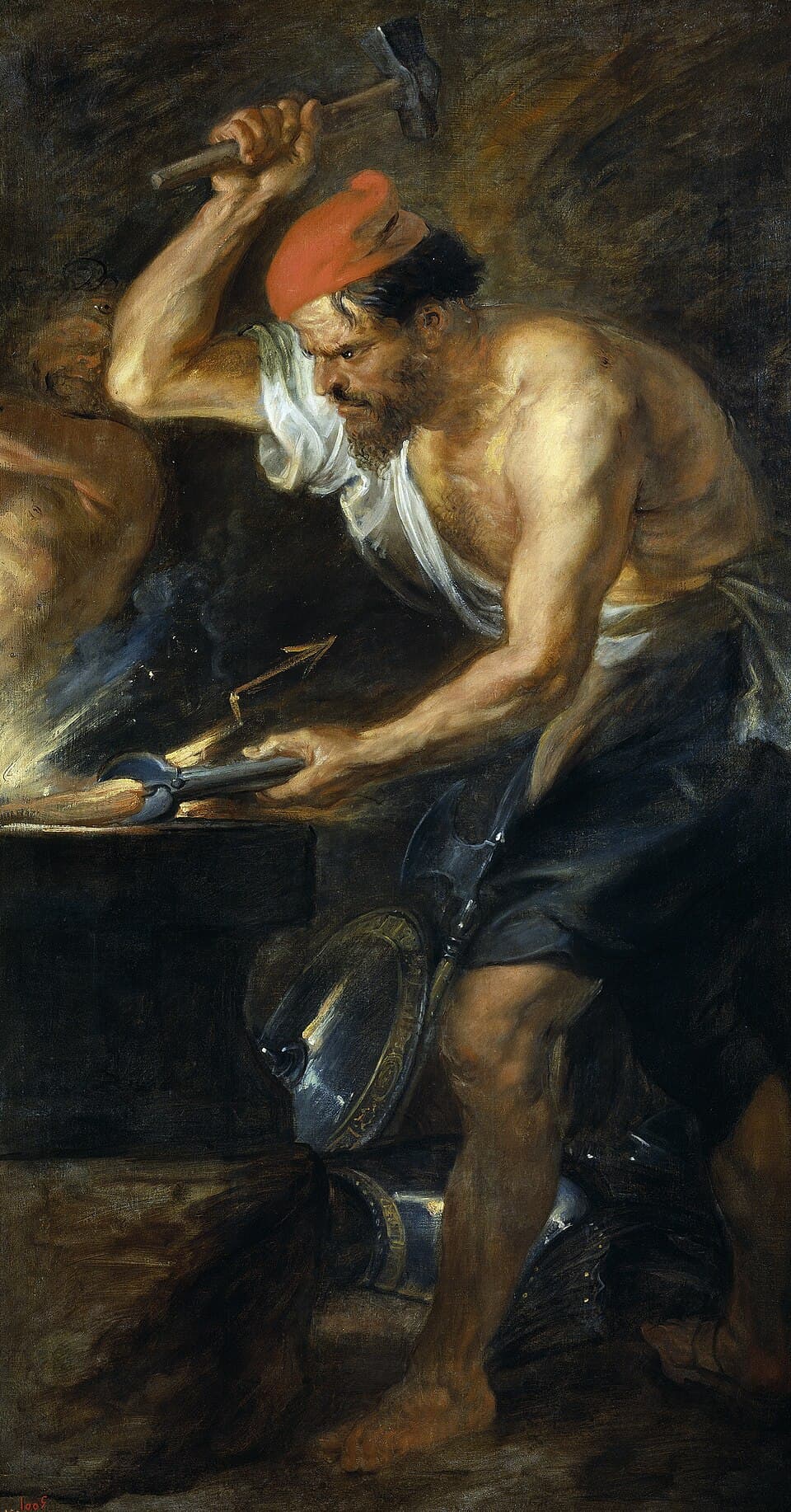
Beneath Mount Etna, where magma serves as a furnace, the heat makes the air tremble. The god sets down his hammer on a still-red anvil, wipes the soot from his brow, and agrees to speak — without ever quite stopping to watch the cooling bronze out of the corner of his eye.
—You are always described as walking with a limp. Where does this lameness that follows you even into Homer's verses come from?
That is how they sing of me: the lame god who hobbles up when his mother calls. The truth is harder than my anvil. Hera, my mother, looked upon me at birth and did not like what she saw. She hurled me from the threshold of Olympus, and I fell, fell a long time, until I crashed upon the island of Lemnos. My legs never recovered. The other gods have the stride of athletes; I drag this twisted body like a bellows too heavy. But it was there, in my fall, that everything began: a god who cannot run learns to craft. My hands are worth their legs.
A god who cannot run learns to craft. My hands are worth their legs.
—How does one live in exile when rejected by one's own mother, the queen of the gods?
Lemnos took me in where Olympus had spat me out. It was there that I built my first forge, in silence, far from the banquets where they laugh loudly while drinking nectar cut with water. People think a god does not bleed in his soul: they are wrong. For a long time I nursed a cold grudge against Hera, cold as tempered iron. And one day, I forged for her a wonderful golden throne, adorned with all the arts — a trap. As soon as she sat down, invisible bonds seized her. Neither Zeus nor the others could free her. They had to come and beg me, the outcast, in my workshop. That was my craftsman's revenge: not the thunderbolt, but a throne too well made.
—Describe an ordinary day in your underground workshop.
Before Helios's chariot crosses the sky, I am already up. I inspect the night's work, sharpen my hammers, revive the embers that the magma of Mount Etna never lets fully die. The afternoon is for hammering: bronze sings under the blow, gold stretches, mechanisms take shape. My golden handmaidens, whom I fashioned myself, come and go around me like obedient thoughts. And the Cyclopes, those magnificent brutes, blow on the furnace until stone melts. In the evening, I never fully extinguish: I let the heat smolder, because a dead fire is a lost day. Then I eat alone, most often, with ambrosia placed near the warm anvil.
I never fully extinguish: a dead fire is a lost day.
—Why did you choose the bowels of a volcano rather than a palace on Olympus to work?
What would I do with a marble palace where one fears to dirty the floors? Fire is not commanded from a throne; it is courted in the belly of the earth. Beneath Mount Etna, the magma gives me for free what no altar would offer: a furnace that never goes out. My dwelling is my forge, and my forge is a vast cave piled with ore, anvils, and stores of bronze. The other gods live in light and idleness; I live in soot and usefulness. They call me chthonic god, god of the depths — it is true. The beauty that the Olympians display, I manufacture below them, in the dark, by the sweat of my twisted arms.
—You are the armorer of Olympus. How do you feel forging for gods who have sometimes scorned you?
Look at my hands: Poseidon's trident, that is me. Zeus's aegis, that shield that protects the king of the gods, that is also me. Apollo's arrows and those of Artemis, from my anvil. Everyone comes to me, with a sweet voice, when they need an object that no mortal could make. I do not forge out of love for them — many have mocked me for my leg and my soot. I forge because the material does not lie to me. A god betrays you; bronze, on the other hand, becomes exactly what my hammer commands it to be. That is why I hold the anvil higher than all thrones: it is the only place where I reign without contest.
—Among all these divine weapons, which one required the most care?
The armor of Achilles, without hesitation. His mother, the goddess Thetis, came to beg me one night, in tears, for her son destined to die before Troy. I forgot sleep. On the shield, I did not merely beat the metal: I engraved an entire world — cities at peace and cities at war, weddings, harvests, herds, the sky and the sea. A warrior had to carry on his arm all the life of men before going to leave it. My tongs never grasped a work more tender or more bitter. For I knew, while hammering, that this splendor would not save the young man. I forge wonders; I do not forge destiny.
I forge wonders; I do not forge destiny.
—Beyond weapons, you gave life to matter. How is a creature like Pandora born?
Zeus wanted to punish men, and he used my genius as a weapon disguised as a gift. On his order, I took earth and water, and I shaped Pandora — the first woman, modeled like a precious vase. The other gods came to adorn her: grace, voice, finery. But it was from my hands that she emerged from the clay, alive. It is a strange thing for a blacksmith to go from inert bronze to a breathing breath. I know metal that obeys; there, I shaped a being who would have her own will. They say I am the god of fire: that day, I was above all the one who animates what was only dust.
—Your bronze automata, like the giant Talos, fascinate as much as they unsettle. What were you seeking in creating them?
Talos, the bronze giant, walks around Crete three times a day to drive out intruders — and he has neither heart nor fatigue, only a vein of ichor sealed by a pin. I forged him entirely, as one forges a sword, but I gave him movement. I also made golden handmaidens who think and speak and assist me at the forge. Why? Because a craftsman always dreams of the tool that could do without his hand. I wanted to see if metal could not only serve, but act. Mortals look at me and think it is magic; I know it is only metallurgy pushed to the brink of audacity — where bronze ceases to be an object and becomes a guardian.
A craftsman always dreams of the tool that could do without his hand.
—You are the patron of blacksmiths and artisans. What have you passed on to them?
I am sung as the one who taught humans the works of the forge and metallurgy. That is my greatest pride — more than all the weapons of the Olympians. Before me, men shivered near fires they did not master; I showed them how to smelt ore, how to beat iron, how to turn a shapeless stone into a plowshare, a blade, a cauldron. In Athens, potters and founders set up offerings to me in my temple, the Hephaisteion, which overlooks their workshop district. Those men, covered in ash like me, are my true followers. I care nothing for those who pray for glory; I watch over those whose hands tremble with fatigue in the evening.
—What would you say to a young artisan who, in the evening, doubts the value of his manual work?
I would tell him to look at his hands before looking at the sky. The gods who scorned me for my twisted leg all came, one day, to knock at my forge. Fire does not ask if you are handsome; it asks if you are patient. Let him honor the anvil as I do: it is she, not the throne, that transforms the world. An artisan who doubts forgets that he does what no king knows how to do — give form to raw matter. In Athens as in Lemnos, I have seen wonders born under calloused and humble fingers. Let him relight his forge tomorrow. Glory passes; a beautiful work, on the other hand, crosses the centuries, and it is through it that we will be remembered.
Fire does not ask if you are handsome; it asks if you are patient.
This imaginary interview was generated by artificial intelligence from sources documented in Hephaestus's profile. It dramatises what the figure might have said based on what we know about them, but does not constitute attested historical testimony. For primary sources and factual documentation, refer to the full profile.