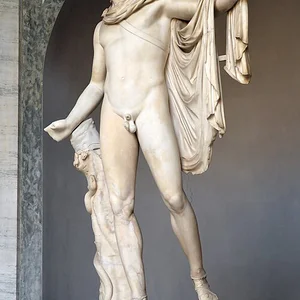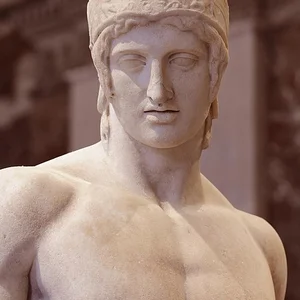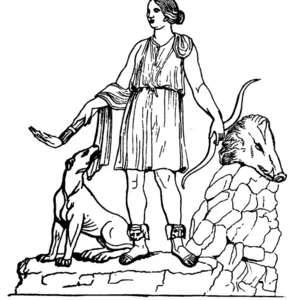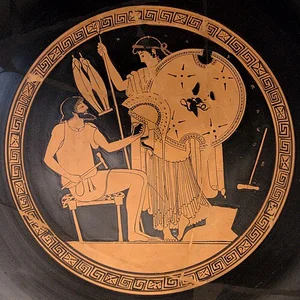

Greek god of fire, the forge, and metalworking, Hephaestus is the patron of craftsmen and blacksmiths. Son of Zeus and Hera according to Greek mythology, he is depicted as a lame god who works in his underground workshop creating wondrous objects.
Hephaestus
Hephaestus
7 min read
Frequently asked questions
Key Facts
- Creator god of magical objects and legendary weapons (Athena's aegis, Poseidon's trident, Achilles' armor)
- Depicted as the only Olympian god with a physical disability (lameness), rejected by his mother Hera according to some accounts
- Master of the underground forge on Mount Etna, a workshop where he labors alongside his automata and the Cyclopes
- Husband of Aphrodite in the Homeric epics, a union symbolizing the bond between craft and beauty
- Venerated by craftsmen, blacksmiths, and metalworkers throughout ancient Greece
Works & Achievements
A magical shield forged by Hephaestus for the king of the gods, endowed with extraordinary protective powers. This creation symbolizes Hephaestus's role as craftsman of the gods.
A divine weapon forged by Hephaestus and given to the god of the sea. This object stands as one of his greatest creations for the Olympian deities.
Precision instruments forged by Hephaestus for the god of light and the arts. These creations highlight Hephaestus's importance in the divine arsenal.
The first woman, created by Hephaestus on Zeus's orders and shaped from clay. She represents the divine smith's living masterpiece and plays a central role in Greek mythology.
Mechanical creatures forged by Hephaestus, most notably the giant Talos, guardian of Crete. These metal innovations demonstrate the god's technical and magical genius.
A divine vehicle forged by Hephaestus that allows the Sun god to cross the sky each day. This creation symbolizes the harmony between craftsmanship and cosmic order.
Unbreakable chains created by Hephaestus on Zeus's orders to bind the Titan Prometheus. This work illustrates the power and ambiguous nature of the divine smith.
Anecdotes
In Homer's Iliad, Hephaestus crafts the armor of Achilles, including a magnificently engraved shield depicting scenes of war and peace. This armor became one of the most celebrated divine creations in Greek mythology, a symbol of the outstanding craftsmanship of the gods.
According to the myth recounted by Hesiod in the Theogony, Hephaestus fashions Pandora, the first woman, from earth and water. The gods bestow various gifts upon her, making her a prime example of Hephaestus's creative power in the Greek tradition.
Mythology tells that Hephaestus created automatons — living bronze creatures — including Talos, the giant who guarded Crete. These creations reveal how the ancient Greeks viewed blacksmiths as almost magical makers capable of breathing life into metal.
Hephaestus forged the poisoned arrows of Apollo and Artemis, as well as Poseidon's trident, according to epic tradition. These divine weapons illustrate his essential role in equipping all the gods of Olympus.
In the myth of Prometheus as told by Aeschylus, it is Hephaestus who, on Zeus's orders, chains the Titan Prometheus to the Caucasus Mountains. This episode highlights the smith god's role in carrying out divine justice.
Primary Sources
Hephaestus of the mighty hands, the lame god, came limping up, for his mother had called for him. He forged a wondrous golden throne, adorned with every art.
Hera, without the love of Zeus, gave birth to Hephaestus, the god of skillful hands, who surpasses all the Immortals in his craft.
I sing of Hephaestus, famed for his wisdom, who taught mankind all the crafts of the forge and metalworking.
Hephaestus, the lame god, shaped with his skilled hands Pandora, the first woman, adorned with every charm and every gift of the gods.
Key Places
Divine dwelling where Hephaestus resides according to Greek mythology. It is the seat of the twelve Olympian gods and the birthplace of the deity.
The place where Hephaestus was said to have been thrown by Hera, and where he established his main underground forge. The island was considered the center of his cult in Greece.
Capital of ancient Greece where a temple dedicated to Hephaestus, the Hephaesteum, was built. It was an important center of worship for the god of the forge.
Volcano where mythology sometimes places the workshop of Hephaestus and his underground forges. The Cyclopes were said to have assisted the god in his creations there.
Sacred island of ancient Greece home to a sanctuary where Hephaestus was venerated alongside other Olympian deities.
Typical Objects

A massive metal block on which Hephaestus forges metals. It is the emblematic tool of the smith god and the central symbol of his underground workshop on Mount Olympus.

The primary tool of the Greek blacksmith, used to strike and shape metals. Hephaestus wields it to create magical objects such as Poseidon's trident and Zeus's aegis.

Essential tools for gripping and handling red-hot metal at the forge. They symbolize the god's technical mastery over incandescent materials.

A masterpiece created by Hephaestus for his brother Poseidon. This three-pronged divine weapon showcases the smith god's extraordinary talent for crafting legendary objects.

A divine armor or shield forged by Hephaestus for Zeus. It stands as one of the god's most prestigious creations and symbolizes his power as a maker.

A mythological vehicle crafted by Hephaestus, frequently depicted in Greek iconography. It demonstrates how the god applied his talents to mobile and sophisticated creations.

A fundamental element associated with Hephaestus as god of fire. The flames of his underground workshop are essential for transforming raw ore into magnificent objects.

A worked metal vessel or container, a typical object of ancient Greek craftsmanship. It represents the everyday items that Greek artisans crafted in their workshops.
School Curriculum
Vocabulary & Tags
Key Vocabulary
Daily Life
Morning
Hephaestus begins his day in his underground workshop beneath Mount Etna, where eternal flames fuel his forges. He inspects the previous night's work and prepares his blacksmith's tools, sharpening hammers and bronze anvils. He lights the sacred fires that will maintain the temperature needed to smelt metals.
Afternoon
The afternoon is devoted to the forge work itself: hammering bronze and gold to create divine weapons, sacred objects, and extraordinary mechanisms. His golden automaton handmaidens assist him in his tasks. He works with intense concentration, perfecting his creations according to the commissions of the other Olympian gods.
Evening
At the end of the day, Hephaestus partially damps the forge fires while keeping enough heat for the next day's work. He retires to his private chambers at the heart of his underground workshop, where he occasionally shares a meal with Athena or divine companions who have come to admire his creations.
Food
Hephaestus's diet consists of ambrosia and nectar, the food of the gods that guarantees immortality. Like all Immortals, he feeds primarily on the sacrifices offered by mortals at temples — especially the grilled portions of horses and oxen. He also enjoys wine mixed with water, following Greek custom.
Clothing
Hephaestus typically wears a short, simple chiton in ochre or brown tones, suited to the extreme heat of his workshop. He wears a distinctive pointed Phrygian cap and leather leg wrappings that protect his legs from fire and sparks. His depictions emphasize his limp and the wounds of a working blacksmith.
Housing
His home is the underground forge-workshop beneath the volcano Etna in Sicily — a magical space that combines living quarters and workplace. This vast cavern holds his anvils, furnaces, and ore reserves, kept permanently heated by volcanic magma. The workshop includes private chambers and occasionally welcomes other deities who come to commission his creations.
Historical Timeline
Period Vocabulary
Visual Style
Un univers de forge antique où la technique de la poterie grecque classique rencontre le dramatisme de la Renaissance, dominé par des contrastes de feu doré et d'ombres profondes. L'atmosphère mêle l'artisanat métallurgique brut à une sophistication mythologique ornementale, avec des jeux de lumière intenses sur les matériaux brillants.
Sound Ambience
Une ambiance sonore immersive d'une forge divine souterraine : martèlement régulier des métaux sur l'enclume, rugissement des fournaises brûlantes, crépitement des étincelles et sifflement de la vapeur, le tout résonnant dans une caverne caverneuse chargée d'une énergie magique ancestrale.
Liens externes & ressources
Références
Œuvres
L'égide de Zeus
inconnue
Le trident de Poséidon
inconnue
Les flèches et l'arc d'Apollon
inconnue
Pandore
inconnue
Les automates de bronze (Talos)
inconnue
Le char d'Hélios
inconnue
Les chaînes d'or de Prométhée
inconnue