Imaginary interview with Hildegard of Bingen
by Charactorium · Hildegard of Bingen (1098 — 1179) · Literature · Music · Sciences · 9 min read
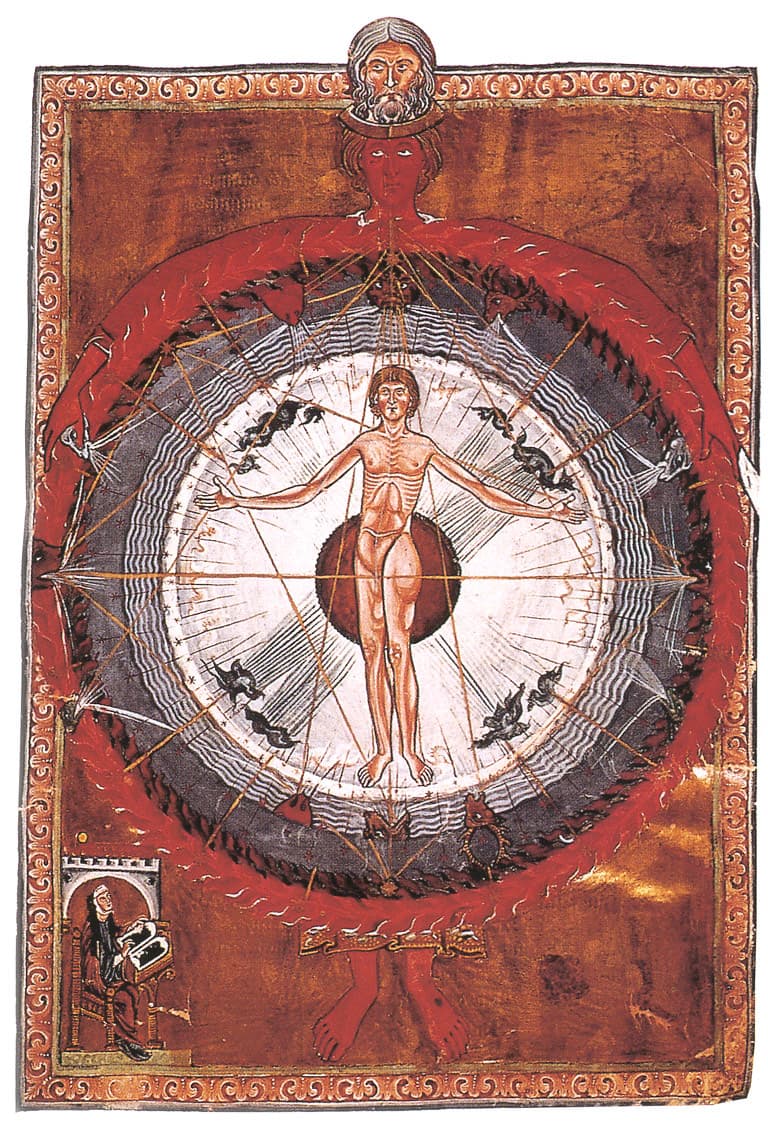
We meet Hildegard at the monastery of Rupertsberg, perched above the confluence of the Rhine and the Nahe, in the late autumn of 1178 — weeks after an archiepiscopal interdict fell on her community, and months before her death. The abbess receives us in the scriptorium, where a candle gutters in the draft and the smell of dried herbs drifts up from the garden below. She speaks slowly, choosing each word as if aware that every sentence may eventually be copied, glossed, and argued over by people she will never meet.
—You were given to a monastery before the age of ten. How did those early decades of enclosure shape the woman who would eventually speak before cardinals and kings?
At Disibodenberg, I was given over as the tenth child — a tithe of flesh, as families of standing reckon these things. I did not choose the monastery; the monastery chose me before I had words for anything. But I will not pretend to have been miserable. The Rule of Saint Benedict is strict and kind at once: the seven offices divide the day like ribs hold a body upright, and within that structure there is more freedom of mind than most people suppose. I learned Latin, I learned to copy and illuminate manuscripts in the scriptorium, I learned to grow herbs and watch what they did to bodies in pain. Jutta of Sponheim was my teacher, my magistra, my first model of a woman whose inner life exceeded the boundaries of her cell. When she died in 1136 and the community looked to me, I understood for the first time that I had been prepared for something I had not yet been allowed to name.
—In 1148, at the Synod of Trier, Pope Eugene III read your Scivias aloud and authorized its circulation. How did that recognition change what was possible for you?
Before Trier, I spoke into a very small room. The women of my community listened because they were mine to lead; the monks of Disibodenberg listened out of courtesy. After Pope Eugene III held my pages in his hands and read them publicly — that changed the geometry of things. A woman who claims vision is always one accusation away from being called possessed or deceived. Papal authorization was a shield I would carry for the rest of my life; it was also a weight, because it made silence no longer available to me. Letters arrived from every corner of the Christian world — from abbots, from kings, eventually from Emperor Frederick Barbarossa himself. I answered them all. Not from ambition, but because the recognition that protected my voice also obligated it. To receive such authorization and then fall quiet would have been its own kind of pride.
A woman who claims vision is always one accusation away from being called possessed or deceived.
—You say you were commanded to write the Scivias — that you could not resist without falling ill. What was it like to work on a text that felt not entirely your own?
The word I would use is pressure. From 1141 onward, what I can only describe as a burning radiance flooding through the brain pressed upon me until I took up the stylus. The illness that had followed me since childhood grew worse whenever I resisted; it lifted when I wrote. I dictated to Volmar, the monk who served as my secretary for decades, and he corrected the grammar of my Latin — for mine was imperfect, being a woman's Latin, learned without the schools. But the visions themselves were not his to touch. I want to be precise: I did not hear voices like a madwoman in the road. I saw, with open eyes, the living light, and within it meaning arranged itself like a sentence already formed. I was the pen; the hand that held me was not mine. The Scivias took ten years to complete. Ten years of transcribing something I did not fully understand.
—The Symphonia contains seventy-seven compositions, including the dramatic Ordo Virtutum. How did music come to you — was it closer to prayer, or to something more like craft?
The two are not separable in the monastery, and I distrust anyone who claims otherwise. The melodies existed inside me long before I set them to parchment — the way the properties of a herb exist inside the plant, latent, waiting for the right conditions to be drawn out. The discipline came afterward: the matching of notes to syllables, the shaping of sequences and antiphons that my sisters could actually sing. The Ordo Virtutum was something different. I wanted the struggle between the Soul and the devil made audible, made performable, enacted by human bodies in the church. A sermon teaches the mind; a sung drama enters through the breath and the chest. I composed from obedience — but obedience to what I had heard, not to what I had planned. The psaltérion would set the pitch, the voices would rise, and for a moment the monastery was no longer a building but an act of praise.
—Each evening you led your sisters through vespers and compline, sometimes performing your own compositions. What did that shared sound mean to you, standing among them?
After Vespers, after Compline closed the day, there was sometimes a moment — the last note still settling in the stone — when the distinction between prayer and music dissolved entirely. I will not pretend my sisters were always rapt; we were a community of women, not a choir of angels. There were evenings when someone coughed at the wrong measure, or the cold rising from the Rhine shortened everyone's patience. But music is the only art that does not leave the body outside. A written page asks you to think; a painted image asks you to see; a sung hymn asks your lungs, your posture, the air in your chest. I wrote those compositions because beauty offered to God in common is worth more than beauty appreciated alone. On the evenings when it worked — when the voices truly joined — I forgot the archbishop's letters lying on my table entirely.
Music is the only art that does not leave the body outside.
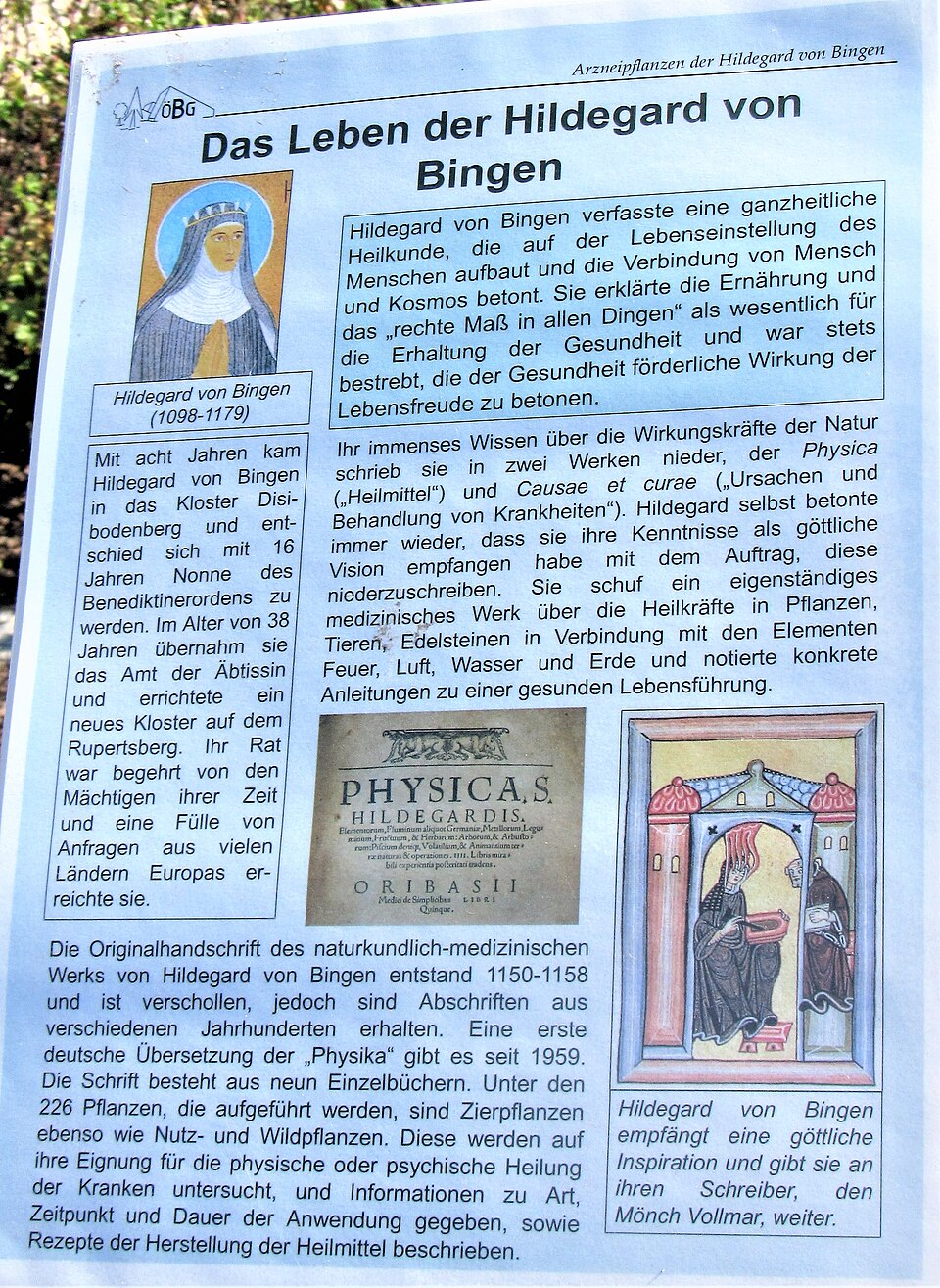
—Your Physica catalogues more than two hundred plants, each with its properties and uses. Was that encyclopaedia the work of a scholar, or of a healer who had watched people suffer?
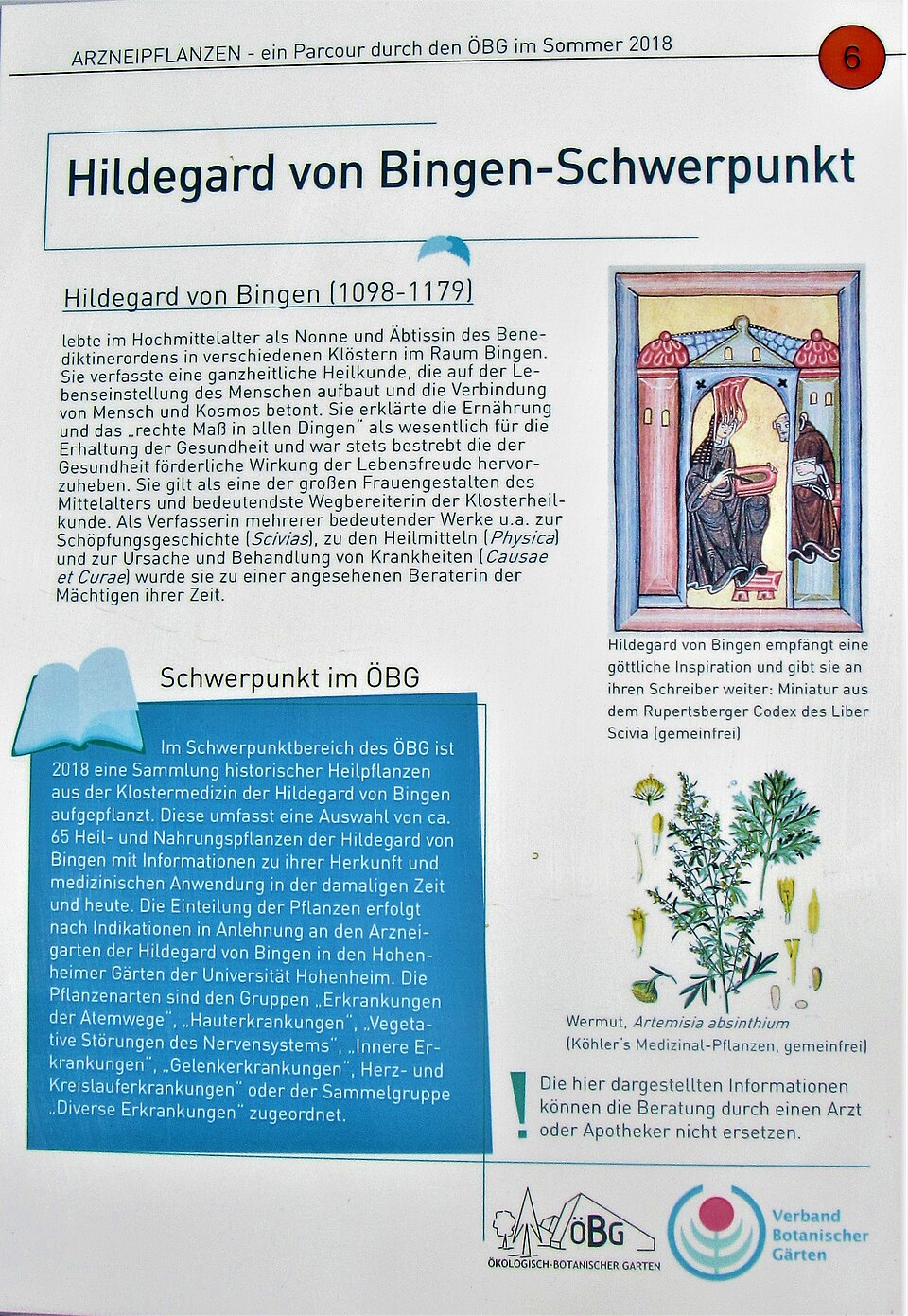
The healer first, and then the cataloguer. The sick came to Rupertsberg — pilgrims, local people, occasionally noblemen whose physicians had given up — and we could not refuse them. I watched what fevered bodies needed, which simples from the garden eased inflammation, which preparations settled the humours when they had grown disordered. The Physica grew from that watching, over many years; I folded it into the framework of Galenic medicine because that is the language physicians understand, not because I accepted everything Galen said without question. When I note that a particular plant is hot and slightly dry, I am summarizing method, not speculation. I also believe — and I hold this alongside the medical observation, not in tension with it — that God built a correspondence between the created world and the human body. A herb's warmth is not accident. It is design, and knowing design is a form of gratitude.
—Causae et curae goes further than any physician of your century dared — into the body's most intimate territories, including sexuality. What gave you the authority to write about such things?
The same authority that permitted me to address kings: necessity, and the light that instructed me. Men who write about the body write about a body they observe from outside. I live inside one — one that has been ill from childhood, that fasted and prayed and aged, and that I have observed in my sisters and in the women who came to the monastery seeking remedies no male physician had been willing to provide. The humours govern desire as surely as they govern digestion; to write a medical treatise that left those territories blank would have been dishonest, a physician's cowardice. I wrote once to Bernard of Clairvaux, describing myself as a poor little womanly form who had not lived a single hour without fear — and those were honest words, not false humility. But the frailty of the vessel does not make the message smaller. God made the body in its entirety, and it is not piety to pretend otherwise.
—You constructed an entire language — the Lingua Ignota — with its own script and close to nine hundred words. What moved you to build something so unusual?
I have asked myself this question for thirty years without arriving at a single answer I trust completely. What I know is that ordinary Latin carries centuries of weight — words worn smooth by so much handling that they sometimes slide off the things they are meant to describe. When I devised the Litterae Ignotae and the vocabulary that accompanied them, it was partly an experiment in attention: could a new name for a thing force you to see that thing differently? Adam named the animals in the Garden, and in naming them he knew them — so the tradition holds. The act of naming is an act of power, of intimate contact with the world. Whether my sisters used these words in our private liturgy, or whether the exercise was closer to contemplation — a way of making the monastery feel, briefly, like a place outside ordinary time — I cannot now say with certainty. I only know the language felt necessary when I was building it.
—The vocabulary of the Lingua Ignota names creatures, plants, degrees of persons — but very few abstract ideas. What were you trying to name that Latin could not?
The concrete world first — and that, too, surprised me. I gave new names to birds, to trees, to the ranks of men and women in the monastery, to ailments of the body. Not to justice or grace or humility — those Latin words still seem to me the best available. What needed renaming was closer to the surface: the thing itself, before interpretation gets hold of it. When I give a plant a name in my invented tongue, that name carries no centuries of commentary attached to it, no schoolman's gloss, no history of how another physician used it badly. The plant is, for a moment, only itself. That may seem a small gain. But a contemplative knows how rarely we see anything as only itself, stripped of familiarity. The Lingua Ignota was, perhaps, a discipline of attention — a small grammar of the present moment, constructed word by word against the grain of habit.
—From 1158 onward, you preached publicly — in cathedrals, before crowds of monks, clergy, and laypeople. How did those audiences receive a woman at the pulpit?
Strangely — not always badly, but strangely. On my first preaching tour in 1158, I entered cities where monks had heard of me through my letters and my reputation; they were curious, sometimes respectfully skeptical. In the great cathedral spaces, the audience did not quite know how to arrange their faces. A woman at the pulpit is not in the natural order of things, as men understand that order. I did not try to look like something they expected. I said what I had come to say: that the Church needed renewal, that comfort had corrupted parts of its clergy, that the patience of God was not without limit. The authority I claimed was not mine — it was the living light, which does not inquire about the sex of the vessel it chooses. But I was always aware, on each of those four tours, that one syllable of visible pride could unravel twenty years of papal protection. I spoke carefully. I meant every word.
—In 1178, the Archbishop of Mainz ordered you to exhume a man buried on your monastery's ground. You refused. What did that refusal cost your community?
The interdict fell on us, and with it came a silence that was its own kind of torment. No public Mass. No full singing of the offices — my sisters, who had given their voices to God every day for decades, were asked to murmur where they had always sung. I had refused to open the grave of a man I believed had died reconciled to the Church; the Archbishop of Mainz believed otherwise, and his seal carried more institutional force than my testimony. For months I wrote letters, marshalled witnesses, sent appeals beyond Mainz. My community bore the cost of my conviction with a dignity I do not think I could have matched had I been a younger woman. The interdict was lifted a few months before my death. The man remained in consecrated ground. I do not claim I was certainly right. I claim I examined the question as carefully as God gave me the means to do.
—You have spent your life navigating the authority of abbots, bishops, synods, and emperors. Where does rightful obedience end, and necessary resistance begin?
In the interior voice — which is not a comfortable answer, because anyone can claim an interior voice to justify whatever they already wish to do. I know the difference, after seventy years, between the voice of God and the voice of my own desires. The first carries a quality I can only call weight; it does not flatter me, it does not make things easier, and it requires things I would have preferred to leave undone. When I wrote to Emperor Frederick Barbarossa, I did not write to humiliate him. I wrote because the living light required me to speak a truth he needed to hear. Obedience to that voice sometimes means disobeying an archbishop. But I have never refused an earthly authority in anger, or in search of my own standing. To serve the Church faithfully, one must sometimes refuse it. The hardest thing is to refuse quietly — without making the refusal into a monument to oneself.
To serve the Church faithfully, one must sometimes refuse it.
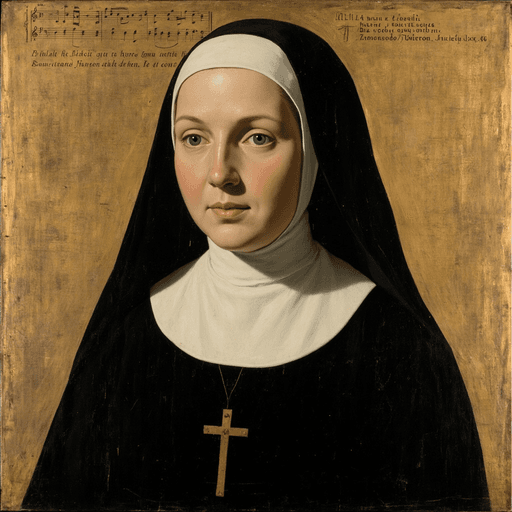
This imaginary interview was generated by artificial intelligence from sources documented in Hildegard of Bingen's profile. It dramatises what the figure might have said based on what we know about them, but does not constitute attested historical testimony. For primary sources and factual documentation, refer to the full profile.