Imaginary dialogue between Isis and Horus
by Charactorium · Horus · Mythology · 5 min read
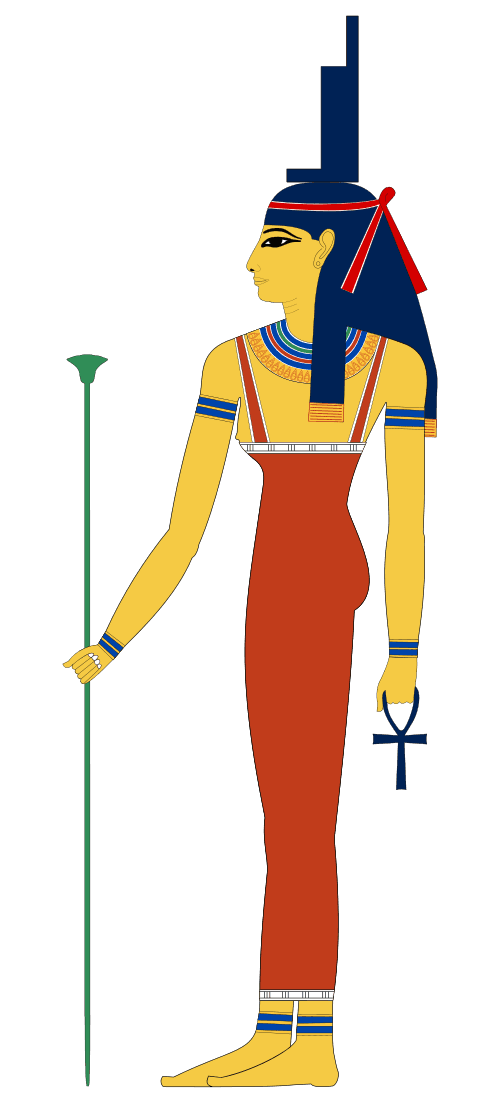
On the floating island of Khemmis, in the marshes of the Delta where the papyrus rustles under the wind of the Nile, Isis finds her son, now king. The evening light gilds the double crown upon his falcon head, and the smell of silt rises from the waters where she once hid him as an infant, far from Set's eyes. She raised him in secret, healed his torn eye, guided him to the throne — and it is this mother, not a stranger, who comes tonight to question the god she made. Between them, all is already known, and that is why the questions can touch so close.
—My son, do you remember the day you claimed the throne of your father Osiris before the assembly of the gods? What did you feel facing Set?
You who carried me in your womb for this very purpose, mother, you know that I trembled not with fear but with contained anger. Set had dismembered my father, thrown his body into the river, and he dared to call himself king. Before the tribunal of the gods, I did not plead like a supplicant: I spoke as an heir. The throne of Egypt belongs to the son, not to the murderous brother — that is order, that is Ma'at. The gods hesitated for a long time; some feared my uncle's strength. But my cause was just, and you had taught me that patient justice eventually overcomes violence. I waited. I won by right before I won by arms.
The throne of Egypt belongs to the son, not to the murderous brother — that is order, that is Ma'at.
—When you fought Set hand-to-hand, I trembled on the riverbank. Tell me truly: did you ever think you could lose?
Yes, Isis, to you I can confess. Set is powerful as the desert storm, and he knows cunning as much as strength. More than once, in our struggles, I felt the ground give way. He tore out my eye; I took from him what makes him male. We tore at each other under every form — bulls, hippopotami in the waters. It was not a clean fight; it was chaos trying to swallow order. If I held on, it was because I carried within me the name of my father and yours. I was not fighting for myself alone: I was avenging Osiris and defending all Egypt against the return of the night.
It was not a clean fight; it was chaos trying to swallow order.
—My child, it was I who healed your wounded eye. What have your eyes become, since then, for the people of Egypt?
My eyes no longer belong entirely to me, mother: they have risen into the sky. My right eye is the Sun, my left eye the Moon — when the moon wanes, it is the wound Set gave me; when it waxes again, it is your healing that reenacts itself each month. Men have kept the image of this restored eye, the Oudjat, and they make amulets of it. They wear it against evil, place it on their dead, paint it on their boats. What you repaired in a wounded son has become for an entire people the sign of wholeness and restored health. My childhood misfortune now watches over the living.
My right eye is the Sun, my left eye the Moon — when the moon waxes again, it is your healing that reenacts itself.
—Your eye is carved on amulets even in tombs. Does that move you, you who have known the pain of losing it?
It moves me, yes, for men do not always know what suffering hides behind the symbol they hold. For them, the Oudjat is protection, healing, fullness — a good luck charm. For me, it is the memory of torn flesh restored. But I do not resent them for forgetting the wound: this is how gods serve. Our pain becomes their remedy. When an Egyptian mother places this amulet on the forehead of her sick infant, she unknowingly repeats your gesture over me. That is why I leave my eye in their hands: it heals others better than it healed me.
Our pain becomes their remedy.
—You whom I raised among the reeds, now every pharaoh calls himself 'Living Horus'. How do you bear this weight upon mortal kings?
It is a weight and an honor, Isis, and you alone measure the journey from the hidden child of Khemmis. Every king who ascends the throne receives my name: he becomes my body on earth, the living falcon between the Two Lands. When he wears the pschent, the double crown, he proclaims to the world that Upper and Lower Egypt are united under a single will — mine, which is order. If the king is just, it is I who reign through him; if he fails, Egypt falters. Thus I hold the thread that links the sky to the throne, generation after generation. As long as a pharaoh lives, my father Osiris will reign over the dead and I over the living.
Every king who ascends the throne receives my name: he becomes my body on earth.
—In the royal lists engraved at Abydos, your name crowns every sovereign. Do you believe this alliance will last beyond the dynasties you see?
I do not read the future like you, mother, who have known so many twists of fate, but I sense the strength of this bond. As long as scribes engrave the names of kings and place the falcon above each titulary, I will remain in stone and in the blood of pharaohs. This is not a court fashion: it is the very foundation of Egyptian kingship. A king without Horus is merely a man; with me, he is the guarantor of Ma'at against the return of chaos. Dynasties pass, capitals move from Memphis elsewhere, but the principle remains. I was conceived for this: not to reign for a day, but to establish the legitimacy of all days to come.
A king without Horus is merely a man; with me, he is the guarantor of Ma'at.
—They build stone temples for you at Edfou, far from our marshes. You who grew up in a reed hut, what do you feel before these walls?
What a reversal, is it not, Isis? The child you secretly fed, fearing the slightest noise, now possesses at Edfou one of the largest stone dwellings in Egypt. On its walls, the priests have carved my battles against Set, my victories, the story you know better than anyone since you lived it by my side. Each day hymns are recited there, bread and beer are offered to me, my triumph is reenacted in festivals. This temple is my earthly dwelling, the reflection of my celestial domain. And yet, I do not forget the reeds of Khemmis: the stone is only worthwhile because a mother first protected the fragile flesh it shelters.
The stone is only worthwhile because a mother first protected the fragile flesh it shelters.
—In this sanctuary at Edfou, the priests reenact your victory over Set every year. Why do you think it must be repeated endlessly?
Because chaos never fully dies, mother — you know this, you who gathered the scattered pieces of my father. Set is not annihilated: he prowls at the edges of the desert, in the storm, in the drought. Each year, the danger returns, and each year it must be vanquished anew. When the priests reenact my triumph at Edfou, they do not merely celebrate an old myth: they renew the order of the world, they push back the threatening night. The rite is a dike against the return of disorder. That is why nothing is won once and for all. The victory of order must be regained with every flood, every sunrise.
The rite is a dike against the return of disorder.
—My son, they call you falcon of the sky, but also companion of Ra at Heliopolis. How can you be both my child and the sun itself?
The gods cannot be confined to a single form, Isis, and you know this better than anyone, you who take a thousand faces. I am your son, Harsiesis, the avenger of Osiris — and I am also Horus the Elder, the falcon whose wings cover the sky since the dawn of time. At Heliopolis, my nature unites with that of Ra: I become Ra-Horakhty, Horus of the Two Horizons, who traverses the firmament in the solar barque Mandjet. In the morning I rise in the east, in the evening I reach the west. To be many is not to contradict oneself: it is to embrace the entire sky. You gave me a son's life; the theologians recognized a sun's life. Both are true.
To be many is not to contradict oneself: it is to embrace the entire sky.
—When you cross the sky each day in your barque, do you still think of us, of your father Osiris and me, left in the shadow of the dead?
At every crossing, mother. The daytime sky is my domain, the realm of the dead is Osiris's: thus we hold together the two halves of the world. When I traverse the firmament at zenith, dispensing light upon the living, I know that my father reigns below over the justified, and that your love links our two kingdoms as it once linked his scattered limbs. In the evening, when I reach the west, I bow toward the underworld where he rests. The setting sun is not a death: it is a visit. I am never far from you. As long as I rise each morning, it is proof that the order we defended still holds, and that the family is not broken.
The setting sun is not a death: it is a visit.
This imaginary interview was generated by artificial intelligence from sources documented in Horus's profile. It dramatises what the figure might have said based on what we know about them, but does not constitute attested historical testimony. For primary sources and factual documentation, refer to the full profile.