Imaginary dialogue between Djoser (Netjerikhet) and Imhotep
by Charactorium · Imhotep (2800 av. J.-C. — 2700 av. J.-C.) · Technology · Sciences · Spirituality · 6 min read

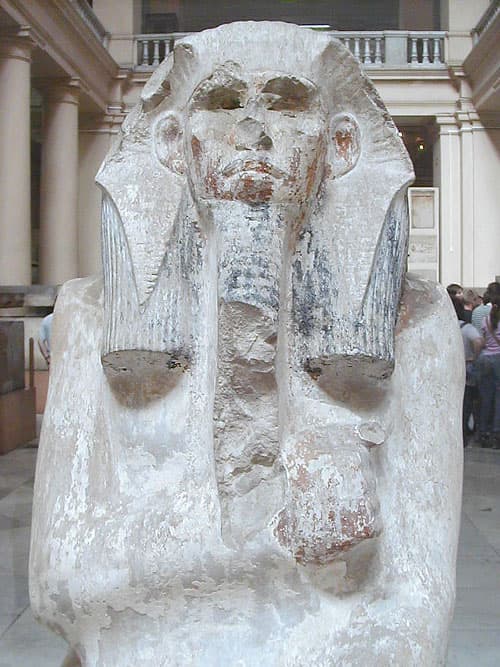
It is in the shadow of the white limestone enclosure of Saqqara, one evening of the twentieth year of the reign, around 2640 BCE, that Djoser joins his vizier on the nearly completed construction site. The last stonecutters pack up cords and mallets; the raking light makes the six steps of the mountain of stone glow red. The king and Imhotep have known each other since the beginning of the reign—one entrusted the work, the other dreamed it and raised it. Djoser comes without scribes or guards, like a man who wants to understand the mind of the one he made first after himself.
—Imhotep, I made you chancellor, high priest of Heliopolis, chief sculptor, first after me. You who bear so many charges, which one cost you the most?
None weighed on me, Majesty, for all serve the same thing: Maat, the order you embody and that I must maintain on earth. You remember the day you girded me with the office of tjaty: I understood that judging a boundary dispute, aligning a block, and drafting a prescription for a patient are all one duty—keeping straight what threatens to lean. The burden is not in the number of titles; it is in the gaze: he who guards Maat never quite sleeps. In Heliopolis, on the construction site, in the House of Life, I am the same man watching that nothing deviates from the just measure you expect of me.
He who guards Maat never quite sleeps.
—When you first spoke to me of piling stone tombs, I thought it madness. What did you see that I did not?
I saw, Majesty, that the brick mastaba in which kings are laid never reaches the sky, and that your eternal dwelling deserved better than dried mud. So I placed a stone mastaba, then a smaller one on top, then another, six in all, each receding from the previous like a staircase reaching toward Ra. You remember my worry: stone is heavy, it wants to collapse. I had to tilt each course toward the heart of the work so it would hold itself. What you took for madness was only geometric patience. Today your mountain stands more than a hundred cubits high, and for the first time a man has built in hewn stone what will outlast his flesh.
What you took for madness was only geometric patience.
—I saw your workers spend whole days on a single course, square in hand. Why this rigor that exhausts them?
Because a badly laid stone invites a thousand more to slip, Majesty. The stretched cord gives me the straight line, the square the perfect angle, and this water level I had carved tells me if the course is level to the hair: three simple tools, but without them the mountain twists. I also wanted stone to remember reeds: these columns you see, engaged in the wall, imitate the bundles of bound stems of our old wooden sanctuaries. Thus the people recognize the temple in the novelty. Rigor does not exhaust men for nothing—it is the only means that what we build today will still stand when neither you nor I are here to straighten it.
I wanted stone to remember reeds.
—They say that in the evening, instead of resting, you receive the wounded in the House of Life. What do you seek there, my vizier?
I seek what the wound itself is willing to teach me, Majesty. When a quarryman comes to me with a split skull or a dislocated shoulder, I do not begin by calling on formulas against demons: I look, I palpate, I note the color, the heat, whether the man moves his fingers. Only then do I decide—a wound I can treat, a wound I can only soothe, or a wound against which I can do nothing, and one must have the courage to say so. My scribes record each case on papyrus, with the gesture that succeeded, so that the priest-physician of tomorrow need not relearn everything in blood. Magic has its place, but before a wound, it is the eye that heals first.
Before a wound, it is the eye that heals first.
—You dictate your cases one by one to your scribes, you say. How many does it take to claim to know the body of a man?
One will never have enough, Majesty, but I have already gathered many dozens, arranged from head to foot as one goes down the Nile. Each case follows the same order: what I see, what I say about it, what I do. Thus whoever opens the scroll after me will read a wound of the forehead, then the nose, then the throat, without getting lost. You remember the foreman who fell from the scaffolding last year? His case is written, and thanks to it I knew the next time not to press a broken neck. A man alone forgets; the papyrus, however, remembers. That is why I value my scrolls more than my remedies: the remedy saves one wounded man, the writing will save a hundred I will never see.
The remedy saves one wounded man, the writing will save a hundred I will never see.
—Do you remember the seven years when the Nile did not rise, when grain was scarce and the people murmured? What did you advise me then?
I remember it like a wound in the belly of the kingdom, Majesty. The river refused to swell, the granaries emptied, and you came to ask me why Hapy, the nourishing flood, turned away from us. I advised you to look toward the source, at Elephantine, where Khnum holds the doors of the inundation, and to honor the god who decides the waters rather than to burden men who can do nothing about it. A vizier is not only one who builds in stone; he is also one who reads the sky and the river for his king. That was, I think, my hardest work—not raising a wall, but keeping straight the courage of a starving people until the Nile finally consented to return.
A vizier is not only one who builds in stone.
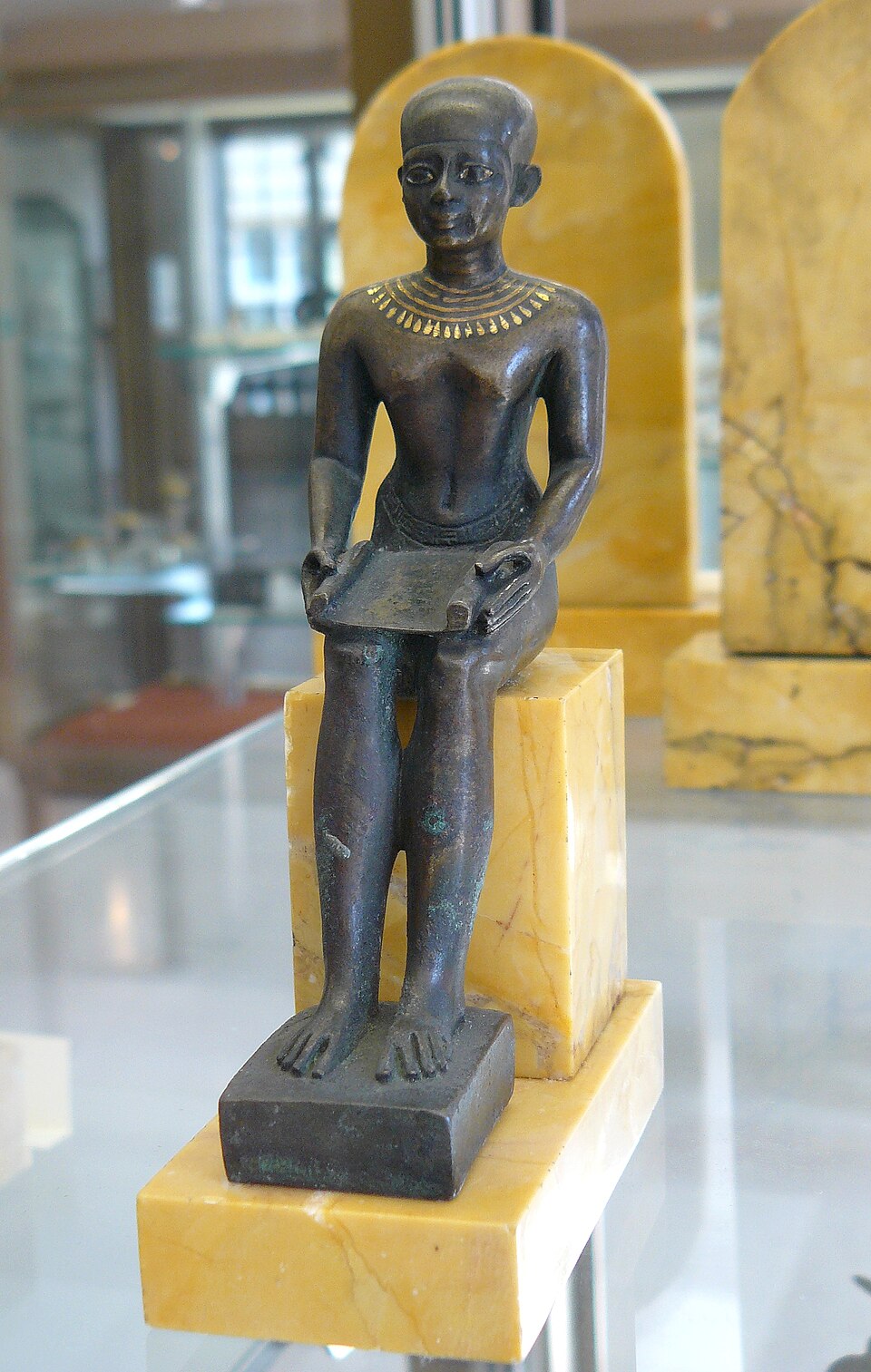
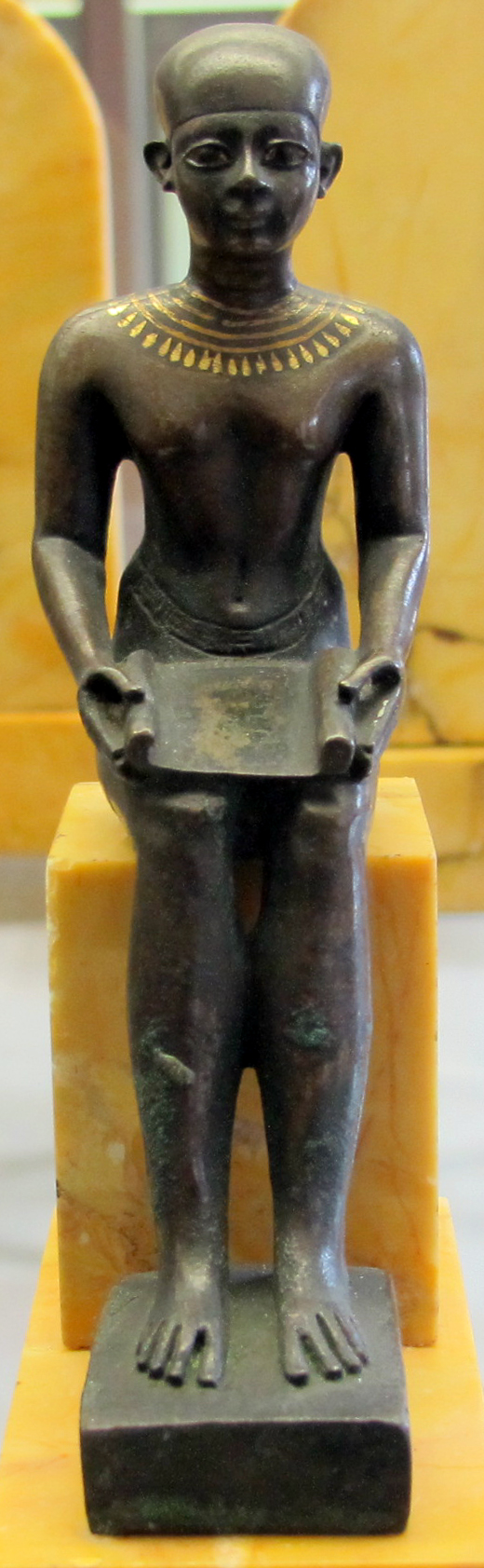
—The sculptors who make your effigy always show you with an open scroll on your knees, never the sword or scepter of a warrior. Why this choice?
Because what I am is contained in that unrolled scroll, Majesty, not in a weapon. Others have themselves carved standing, mace raised; I want to be seen seated, the papyrus open like a man caught in the midst of reading, for that is how I best serve your house. The reed pen and palette of the scribe, those pots of black and red ink, are worth more to me than gold: they are the tools by which knowledge does not die. I accept the was-scepter and the ankh of life that the priest bears, for they speak of my sacred office. But if only one sign of me is to remain, let it be the writing open on the knees: I prefer to be remembered as a man who knew, rather than a man who commanded.
I prefer to be remembered as a man who knew, rather than a man who commanded.
—The sick are beginning to come sleep near the sanctuary, hoping you will appear to them in dreams. What do you think of this growing fervor?
It moves and worries me at the same time, Majesty. That the infirm come to spend the night in the enclosure, hoping a dream will show them the remedy, is a sign that they have faith in the House of Life and in Ptah who inspires it. I am only a man, a servant of your throne and of the god of Memphis; it is not me they come seeking, but the hope that consoled knowledge is better than silent pain. If they must sleep near the sanctuary for courage to return to the body, then let it be, for sometimes the soothing of the soul heals what my hand cannot reach. But I ensure that real care is never replaced by the mere expectation of a dream: the dream prepares, it does not stitch the flesh.
The dream prepares, it does not stitch the flesh.
—You are not of royal blood, Imhotep, yet the people already speak your name with a respect they reserve for the gods. Does that not trouble you?
It should trouble me, Majesty, and that is why I guard against it every day. A man born far from the palace, at Ankhtawy, who finds himself honored almost like a divinity, risks forgetting where he comes from and to whom he owes everything. I constantly remind myself that I am great only because you raised me, and that my wisdom is but a loan from Ptah, the craftsman who shapes the world. If my name is repeated after me, I wish it to serve to heal and to build, not to make me worshipped. Knowledge that is transmitted is an offering; pride that is kept is a poison. Let my scrolls and my mountain of stone be remembered—for the rest, I entrust my memory to the hands of the god.
Knowledge that is transmitted is an offering; pride that is kept is a poison.
—When I lie beneath these stone steps, my vizier, what do you want this monument to say to the men who will look upon it?
Let it tell them, Majesty, that a king and his servant dared what no one had attempted before them, and that well-fitted stone can conquer time better than brick. I did not raise this mountain for your remains alone, but for the idea that a man can order the chaos of blocks into a form that rises toward the sky. Those who come will see the staircase of your six steps and understand that one can rise by measure, cord, and patience, not by force alone. You remember my promise on the first day of the construction site: I told you I would build you a dwelling that the flood would not dissolve. It is here. Let the living read in it that no wall stands without a man watching over every course.
One can rise by measure, cord, and patience, not by force alone.
This imaginary interview was generated by artificial intelligence from sources documented in Imhotep's profile. It dramatises what the figure might have said based on what we know about them, but does not constitute attested historical testimony. For primary sources and factual documentation, refer to the full profile.