Imaginary interview with Imhotep
by Charactorium · Imhotep (2800 av. J.-C. — 2700 av. J.-C.) · Technology · Sciences · Spirituality · 7 min read
The sun declines over the necropolis of Saqqarah, and the shadow of the Step Pyramid lengthens across the deserted courtyards. Within the white stone enclosure that he himself raised, a man with a shaved head, an unfurled papyrus scroll on his knees, agrees to answer. Here is Imhotep, architect of King Djoser, long before the centuries made him a god.
—You are known by an avalanche of titles. Which one truly says who you are?
I have been given many titles, and I bear them like so many stones on my shoulders. Chancellor of the King of Lower Egypt, the one who comes just after the throne, administrator of the Great Palace, priest of Heliopolis where the course of Ra is observed. But none says who I really am: a man born without a crown, near Memphis, whom King Djoser chose to place at his right hand. The day the engraver inscribed my name on the base of the king's statue, right next to his own, I understood that I would never again be a simple scribe. A child of the people whose name neighbors that of a living god: that had hardly been seen before me, and I sometimes fear I have not deserved it.
—How was the idea born to make stone rise so high, when no one had attempted it?
In the beginning, we knew how to build low, wide tombs with flat roofs — the mastaba, that brick bench where the deceased king rested. For Djoser, that was not enough: his eternal dwelling had to pierce the sky. So I did what no one had dared: I placed a mastaba on top of a mastaba, then another, six in all, each narrower than the one below, until it rose sixty cubits toward the sun. And I abandoned sun-dried brick for cut stone, hard, eternal. Each block, I wanted it aligned to the finger, controlled with the cord and the square. It was not just a tomb rising at Saqqarah: it was a staircase carved so that the king's soul might climb the starry vault.
—Your columns at Saqqarah resemble nothing that existed before. Why did you give them that form?
Look closely at the columns of Saqqarah: they are not simple pillars. I wanted them to remember the reeds bound in bundles and the palm trunks with which our fathers made their shelters, along the river. Stone imitates the vegetal, the durable preserves the memory of the fragile. Before me, stone was not erected like this, fluted, carved into a shaft, set against the wall so it would not break. Each course, I laid it with the plumb level, because a single crooked stone makes the whole edifice lie to Maat. Building is not stacking: it is writing in matter an order that must last a thousand years. Those who come after me will still carve their columns on this first model.
—What is it like to govern alongside a pharaoh?
To be tjaty, vizier, is not to command: it is to answer. To answer for the granaries when the river rises poorly, for the courts when two men quarrel over a field, for the worksites when the mason demands his bread. Everything, in the end, is weighed on the same balance: Maat, that just order without which the country returns to chaos. Even before the disk rises, I purify myself in the temple of Ptah, my head shaved, dressed in white linen, and I open the mouth of the divine statue so that the god inhabits the stone. At royal funerals, I don the leopard skin of the sem priest. I serve the king by day, the god at dawn: one man, two faces turned toward the same order of the world.
—When faced with an injured man, many would first recite incantations. What did you do?
Many, when fever seizes a man, immediately call for incantation and amulet. I do not despise them — but I learned to first look, touch, listen to the wound before addressing the gods. A split skull, a broken collarbone, a suppurating wound: each tells its story to those who know how to observe. I told my students to describe what they saw, to name the ailment, then to judge whether to treat it, to fight it, or honestly admit that nothing could be done. To dress a wound, set a bone, sew flesh: the hand heals as much as prayer. They say these lessons survived me, copied long after my time onto scrolls that describe forty-eight cases without ever lying about what is unknown. That, perhaps, is my true monument — more fragile than stone, and yet more enduring.
The hand heals as much as prayer.
—Where was this knowledge transmitted, once the sun had set?
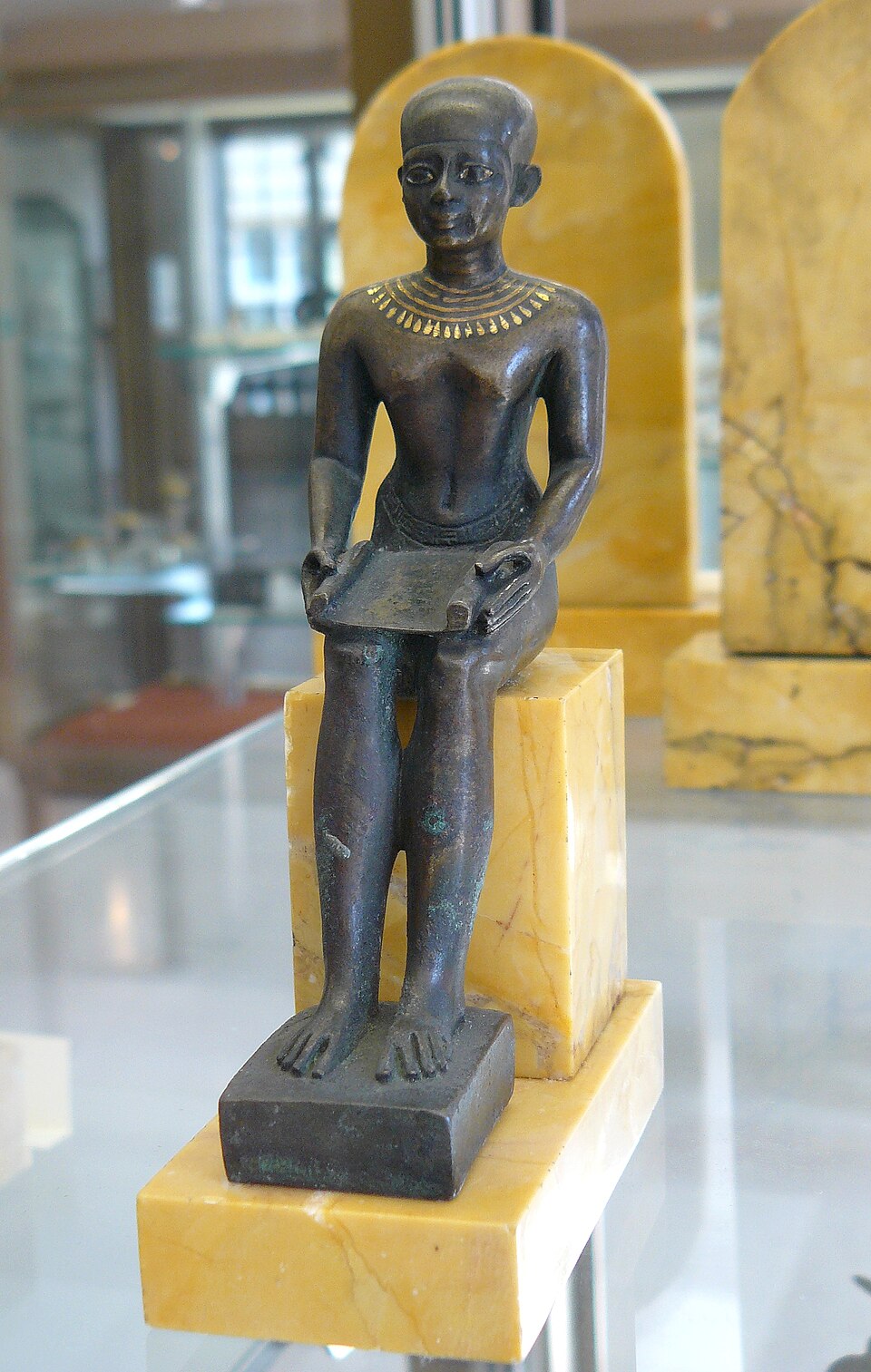
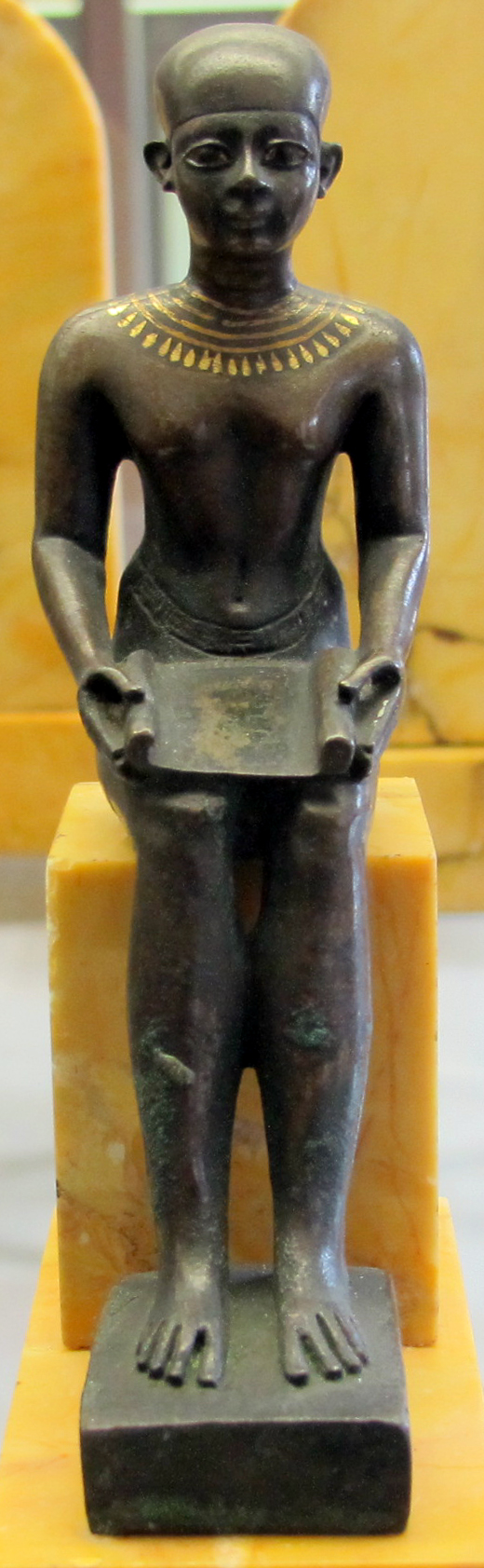
When evening comes, when the worksites fall silent, I retire to the House of Life, the Per-Ankh, that place attached to the temple where the scrolls are kept. It is at once a library, a school, and a sickroom. There, by lamplight, my scribes unroll papyrus on their knees, sharpen the calamus, prepare black ink and red ink. Difficult cases are brought to me, and I dictate: here is the ailment, here is what my hand will do. Knowledge is only worth if it is transmitted; a remedy that dies with the physician never existed. That is why I have always been depicted with an open scroll on my knees — not a crown, not a scepter, but the papyrus, because through it alone does knowledge escape death.
—A mere mortal turned into a healing god: how is such a destiny possible?
I am told that, long after my ka left the body, men ceased to see me as a vizier and called me neter — god. That had almost never happened: a child of the people raised to the rank of divine powers. In the underground galleries of Saqqarah, near the Apis bulls, the sick come to sleep on the stone, all night long, hoping that I will descend into their sleep and whisper the remedy to them. They call this incubatio. I do not know if my breath truly crosses their closed eyelids; but that a man falls asleep in trust and wakes up comforted — is that not already a part of healing? I who in my lifetime scrutinized wounds by daylight, here I have become the dream that one comes to seek in the dark.
Here I have become the dream that one comes to seek in the dark.
—What remains in your sanctuaries of all those who come to implore you?
Go into my sanctuaries and you will see them by the thousands: small bronze statuettes depicting me seated, the scroll unfurled on my knees, deposited there by the sick, childless women, young people learning medicine. At Philae, that southern island on the borders of Nubia, a temple was built for me and there I am called son of Ptah, as if the artisan god of Memphis had fathered me. The Greeks later called me Imouthes and confused me with their own healer, the one they call Asclepius. Strange fate for a man whose tomb no one even knows where it lies today, and yet whose name travels from one shore to the other of the Great Sea. They sought me underground, and they found me in the sky.
—It is said that you advised Djoser during a terrible seven-year famine. Does this story belong to you?
A tale circulates, carved on a rock on the island of Sehel — much later than my days, I know. It tells that the Nile had refused to rise for seven years, that famine ravaged the Two Lands, and that Djoser, distraught, turned to me to know where the river springs and which god to appease. That scribes from distant centuries put my words into that mouth troubles and honors me: they sought a sage to place beside the king, and it was my name that came to them. Did I really advise Djoser against hunger? Memory swells with time like the river at flood. But that they wanted, two thousand years later, for it to be me — that weighs heavier than the truth of the facts.
Memory swells with time like the river at flood.
—Architect, physician, sage, god... Do you recognize yourself in this portrait that never stopped growing?
I am also attributed maxims, Wisdom texts that I may never have traced with my own hand, and that were still recited in scribal schools long after me. That teaches me one thing: a name, when respected long enough, becomes a chest where each generation deposits what it admires. They have stored there the architect, then the physician, then the sage, then the god. I do not always recognize myself in this portrait that grows without me. In my lifetime, I was only a meticulous man who checked his alignments with the cord and feared lying to Maat. If anything of me must endure, let it be this: care, exactitude, the refusal to build crookedly. The rest, men will add well enough without me.
—At the end of it all, if asked what you truly accomplished, what would you reply?
When I still walk in thought within the enclosure of Saqqarah, along those walls where I had the false palace facade carved, the serekh engraved in stone, I do not think of glory. I think of the quarrymen who bled their hands on those blocks, of the teams I inspected at dawn, correcting with a finger a poorly laid course. We were the first to entrust to stone what was once entrusted to perishable brick — and stone does not lie to time. If asked what I truly did, I answer neither pyramid nor temple: I taught men that the durable must be earned, course after course, in patience and uprightness. The sky is not touched in a single bound. One climbs it by degrees.
The sky is not touched in a single bound. One climbs it by degrees.
This imaginary interview was generated by artificial intelligence from sources documented in Imhotep's profile. It dramatises what the figure might have said based on what we know about them, but does not constitute attested historical testimony. For primary sources and factual documentation, refer to the full profile.