
A high official, architect, and physician of ancient Egypt in the 3rd millennium BC, Imhotep is considered the first known engineer and architect in history. Designer of the Step Pyramid of Saqqara, he was later deified as a god of medicine.
Imhotep(2800 av. J.-C. — 2700 av. J.-C.)
Imhotep
Égypte antique
8 min read
Frequently asked questions
Key Facts
- Around 2650 BC: design and construction of the Step Pyramid of Saqqara, the first large structure built from dressed stone in history
- Vizier to Pharaoh Djoser, he held the titles of high priest, physician, architect, and scribe
- The first engineer and architect identified by name in human history
- Deified approximately 2,000 years after his death, he was equated with the Greek god Asclepius (god of medicine)
- His name is among the rare non-royals to have been honored with an official cult in ancient Egypt
Works & Achievements
The first great monumental structure built in dressed stone in human history, designed for Pharaoh Djoser. Imhotep revolutionized architecture by stacking six progressively smaller mastabas to reach a height of 62 meters, thereby inventing the pyramidal form.
A vast 15-hectare enclosure surrounding the Step Pyramid, comprising temples, ceremonial courtyards, false chapels, and underground galleries. It represents the first systematic use of dressed stone for a complete architectural complex.
A body of medical texts of which Imhotep is considered the author or inspiration. The Edwin Smith Papyrus, believed to be a later copy, describes 48 clinical cases with a rational, empirical approach that is remarkable for its time.
Imhotep is credited with the first use of the dressed stone column, imitating bundles of reeds or palm trunks. Visible at Saqqara, this innovation became the prototype for all columns in classical Egyptian architecture.
Moral maxims and wisdom texts were attributed to him in ancient Egypt. Though none survive directly, their mention in New Kingdom papyri confirms that Imhotep was venerated as the author of moral precepts.
Anecdotes
Imhotep is one of the very few non-royals of ancient Egypt to have been officially deified after his death. About two thousand years after his passing, he was venerated as a full healing deity, and pilgrims would come to leave offerings in the form of bronze statuettes bearing his likeness at his temples.
The Step Pyramid of Saqqara, which Imhotep designed for Pharaoh Djoser around 2650 BCE, was the first large-scale cut-stone structure in human history. By stacking six mastabas of decreasing size, he literally invented a new architectural form that would dominate Egypt for centuries.
The ancient Greeks, who called Imhotep "Imouthes
regarded him as the equivalent of their own god of medicine, Asclepius. This cultural fusion shows just how far his reputation as a healer transcended borders and eras, many centuries after his death.
Later texts attribute to him the authorship of medical treatises that were remarkably rational for their time, the content of which is thought to have inspired the Edwin Smith Papyrus. These texts describe injuries and prescribe treatments by observing symptoms without resorting to magic, making Imhotep a forerunner of empirical medicine.
During the Ptolemaic period, an important temple was dedicated to him on the island of Philae, at the southern frontier of Egypt. This sanctuary attracted the sick and infirm who hoped to be healed through the intercession of Imhotep, by then a true protective deity of physicians and scribes.
Primary Sources
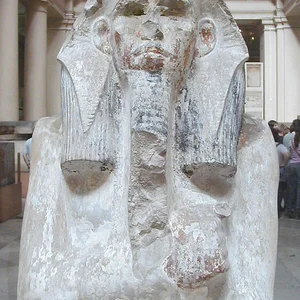
The titles carved on the base describe Imhotep as "chancellor of the king of Lower Egypt, first after the king of Upper Egypt, administrator of the Great Palace, hereditary noble, high priest of Heliopolis, chief builder, chief sculptor."
This medical papyrus, copied around 1600 BC but derived from a much older text, provides rational descriptions of 48 surgical cases with observations, diagnoses, and treatments. Egyptian tradition attributes its original content to Imhotep himself.
This Ptolemaic text depicts the vizier Imhotep advising Pharaoh Djoser during a seven-year famine, illustrating how his reputation as a wise counselor and universal scholar was kept alive for two millennia after his death.
The temple walls describe Imhotep as the son of Ptah, the creator god of Memphis, and detail his healing powers. These texts reflect his full integration into the Egyptian pantheon during the Greco-Roman period.
Key Places
Imhotep's architectural masterpiece, this 15-hectare complex houses the Step Pyramid of Pharaoh Djoser, the first great construction in cut stone in history. Imhotep worked here for many years as chief architect.
The political and religious capital of the Old Kingdom, Memphis was the seat of Pharaoh Djoser's power, where Imhotep served as vizier and high priest of Ptah, the craftsman creator god.
A great religious and intellectual center of ancient Egypt, Heliopolis was the home of the solar cult of Ra. Imhotep held the title of high priest there, which granted him immense spiritual and scholarly authority.
On this sacred island at the borders of Nubia, a temple was dedicated to the deified Imhotep during the Ptolemaic period. It became a pilgrimage site for the sick seeking divine healing, a testament to his full integration into the pantheon.
An underground necropolis for the sacred Apis bulls, the Serapeum was also a site of Imhotep's cult where pilgrims practiced *incubatio*, sleeping within the sanctuary to receive medical revelations from the healer god through dreams.
Typical Objects

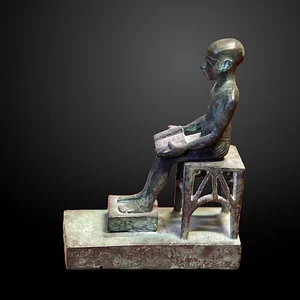
Imhotep was always depicted holding an unrolled papyrus scroll on his lap, a symbol of his encyclopedic knowledge. This iconographic attribute sets him apart from all other Egyptian gods.

Fundamental tools of the Egyptian architect, the square and surveyor's line were used to draw perfect right angles and align stone blocks with precision — essential for the construction of the step pyramid.

An elongated box made of wood or ivory holding *calames* (sharpened reeds) and inkwells of black and red ink, this attribute is inseparable from Imhotep as a high royal official and author of learned texts.

An emblem of divine power shaped like the head of a fantastical animal, the was scepter was carried by gods and high dignitaries. Depicted in the hands of the deified Imhotep, it symbolized his power over the forces of chaos.

From the New Kingdom onward, thousands of small statuettes depicting Imhotep seated with a papyrus scroll on his lap were left as offerings in his sanctuaries by the sick and by students of medicine.

A triangular wooden instrument using a plumb line to ensure the perfect horizontality of stone courses. Imhotep is said to have refined it to build the first dressed-stone monument in history.

The looped cross representing eternal life, the ankh accompanied Imhotep in his roles as priest and healer. In his funerary cult, it was offered as an ex-voto by pilgrims seeking healing.
School Curriculum
Vocabulary & Tags
Key Vocabulary
Tags
Daily Life
Morning
Imhotep began his day before dawn with purification rituals at the temple of Ptah in Memphis: a ritual bath, complete shaving of the skull and body, then donning the white linen robe of a priest. He then took part in the "opening of the mouth" ceremonies performed on the divine statue, ensuring the god's active presence.
Afternoon
After the morning rites, Imhotep devoted his afternoons to his duties as vizier: audiences with senior officials, drafting reports on papyrus, and overseeing royal construction sites. At Saqqara, he personally inspected teams of quarrymen and masons, correcting alignments with plumb line and set square.
Evening
In the evening, Imhotep withdrew to the "House of Life" (*Per-Ankh*) within the temple — a scriptorium and sacred library where priests copied and studied medical, astronomical, and religious texts. There he reviewed patients' cases and dictated his prescriptions to his scribe assistants.
Food
His table, befitting a high dignitary, featured finely ground spelt bread, roasted meats (beef, duck, goose), dried Nile fish, vegetables (onions, leeks, lettuces), and fruits (figs, dates, pomegranates). Palm wine and quality beer accompanied official meals.
Clothing
As high priest, Imhotep wore a long robe of immaculate white linen, the symbol of ritual purity. During royal funerary ceremonies, he draped a leopard skin over his robe — the distinctive attribute of *sem* priests. His plaited papyrus sandals touched the sacred temple floors only when he passed through them.
Housing
Imhotep resided in a vast palatial estate in Memphis, close to Djoser's palace. The compound included a lime-washed mud-brick residence, gardens irrigated by canals, and workshops for his scribes. The reception rooms were adorned with frescoes depicting his titles and achievements.
Historical Timeline
Period Vocabulary
Liens externes & ressources
Références
Œuvres
Pyramide à degrés de Saqqarah
Vers 2650 av. J.-C.
Complexe funéraire de Djoser à Saqqarah
Vers 2650-2630 av. J.-C.
Traités médicaux (attribués)
Vers 2650 av. J.-C. (tradition transmise)
Invention de la colonne engagée en pierre
Vers 2650 av. J.-C.
Textes de sagesse (Sagesses d'Imhotep)
Tradition transmise dès l'Ancien Empire