Kids interview Indira Gandhi
by Charactorium · Indira Gandhi (1917 — 1984) · Politics · 5 min read
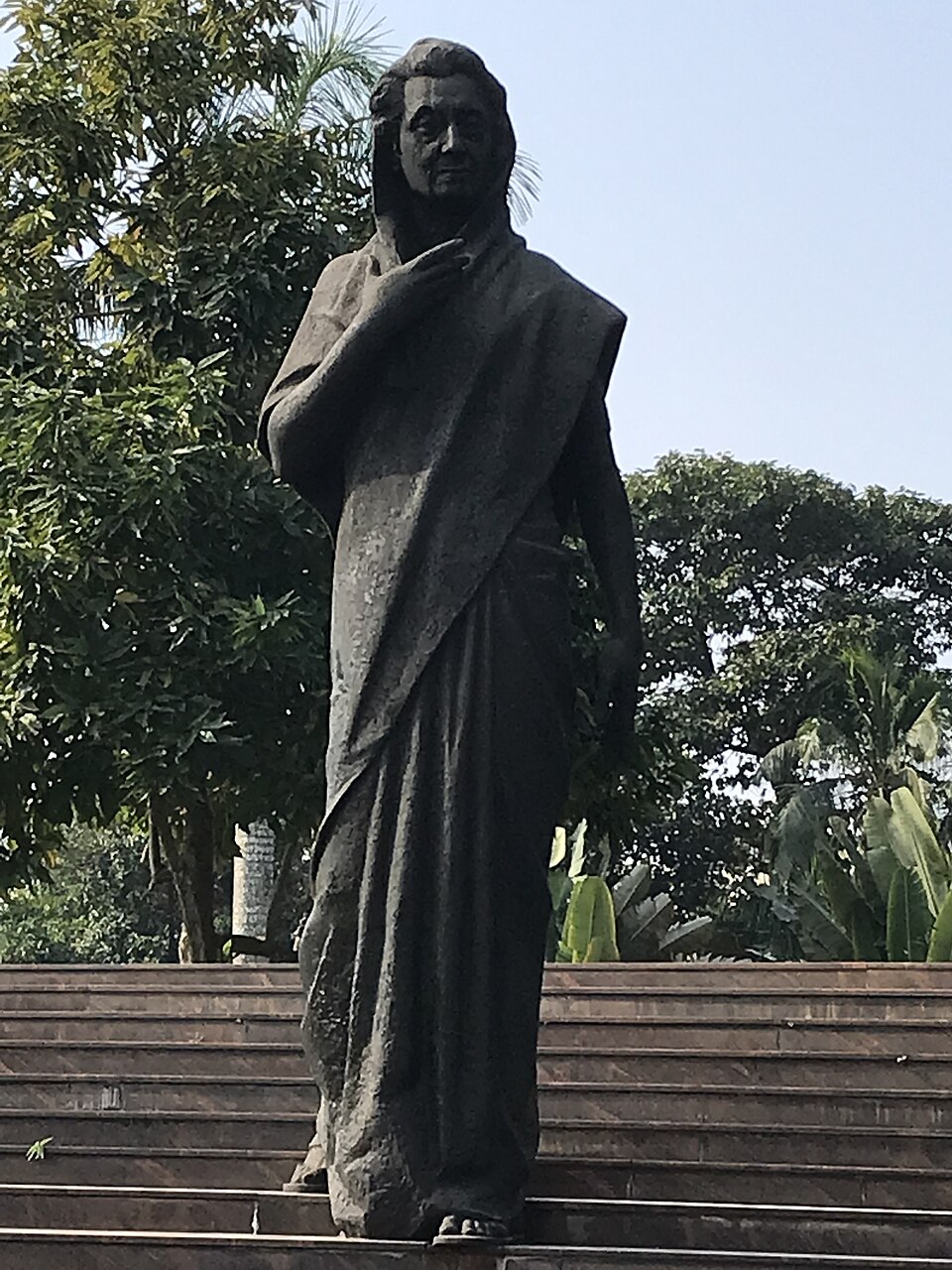
Two 12-year-old students visit an exhibition on India. In front of a large portrait of a woman in a white sari, a rose pinned on her shoulder, they dare to ask their questions. The lady smiles at them and sits down with them.
—What was your house like when you were little?
You know, my child, I was born in 1917 in a large house in Allahabad, Anand Bhavan. But it wasn't an ordinary house. Men were constantly coming and going, talking about freeing India from the British. My father, Nehru, was often in prison for that. Imagine: you're eight years old, and your father writes you letters from his cell to explain the whole history of the world. I waited for those letters like a treasure. My house smelled of struggle and courage. Very early on, I understood that my family lived for something greater than themselves.
My father wrote me the history of the world from his prison.
—Is it true you burned your dolls when you were little?
Yes, it's true, and I'll tell you why. In my time, the British forced us to buy their cloth, their objects from far away. My dolls were made of foreign cotton. One day, I decided to burn them to support swadeshi — that was our word for saying, "Let's use what India makes itself." My heart was heavy, you can imagine, burning your toys! But I understood something powerful: even a toy can become an act of courage. Later, I only wore saris made of khadi, that hand-spun cotton from our country.
Even a toy can become an act of courage.
—Why did people call you "the dumb doll"?
Ah, that! When I became Prime Minister in 1966, many politicians thought they could easily order me around. They nicknamed me goongi gudiya, "the dumb doll." They thought I would just sit there, saying nothing, signing whatever they wanted. Imagine being entrusted with a huge position while people think you're too fragile to handle it. Well, they were terribly wrong! I was the first woman to lead a great country like mine. I governed India for fifteen years. The dumb doll had a lot to say.
They thought they were leading a dumb doll. They were wrong.
—Did you handle everything yourself? Even early in the morning?
Oh yes! I woke up before the sun. Do you know what I did first? Yoga, to calm my mind. Then, by six o'clock, I read piles of reports — on agriculture, on the dangers threatening the country. At half past seven, my advisors were already having breakfast with me while working. I prepared my own files; I didn't like others deciding for me. And every morning, I pinned a fresh white rose on my sari. That was my little personal touch. Running a country, my child, never stops, not even at breakfast.
Running a country never stops, not even at breakfast.
—What was your most important dream for poor people?
My biggest fight was against poverty. I had a slogan: Garibi hatao, "Eradicate poverty." In 1969, I took over fourteen large private banks and placed them under state control. Why? So that even a very poor farmer could borrow a little money to feed his family. Before, only the rich had access. I also supported new wheat seeds so India could finally feed itself. One day I said that poverty is the worst form of violence. I deeply believed that. A hungry child is a wound for the whole country.
Poverty is the worst form of violence.
—Why were you called "Durga," the warrior goddess?
That was in 1971, my child. Our neighbors in Pakistan were terribly mistreating the people in their eastern part. Millions were fleeing to our country. I decided to act. From my office, by phone, I coordinated our army day and night. In two weeks, the war was won, and a new country was born: Bangladesh. Even my political opponents, who hated me, called me "Durga," our warrior goddess. Imagine: your own enemies saluting you! It was one of the proudest days of my entire life.
Even my enemies saluted me as a warrior goddess.
—Did you make India's first atomic bomb?
Yes, in 1974, in the desert of Rajasthan, at Pokhran. We conducted our first nuclear test, in secret. It was given a strange code name: Smiling Buddha. You're wondering why, I'm sure. In my time, the great powers all had the atomic weapon and looked down on countries like mine. I wanted India to be respected, to no longer be ordered around. It was a heavy decision, terribly heavy. But I wanted my country to stand tall, proud, without lowering its eyes before anyone in the world.
I wanted India to stand tall, without lowering its eyes.
—Is it true you banned people from speaking freely?
You ask the hardest question, and I will answer you frankly. In 1975, I felt threatened, the country was restless. I proclaimed the "State of Emergency": for almost two years, I had opponents arrested and limited press freedom. I wrote to the nation that democracy can only survive if order is maintained. But many were afraid and suffered. It was not my finest moment, my child. Freedom is fragile as glass. When you squeeze it too hard trying to protect it, sometimes you break it.
Freedom is fragile as glass.
—And then you lost the election. Were you angry?
In 1977, the people voted against me. After all that power, I found myself defeated. Do you know what I did? I accepted it. I packed my things and left without shouting, without hiding behind the army. Yet, shortly before, I had locked up my opponents. What a paradox, isn't it? Imagine losing a very important game after almost cheating: it's hard to greet the winner. But respecting the people's choice, even when it hurts, that too is governing with honesty. I returned three years later, elected again.
Respecting the people's choice, even when it hurts, is governing.
—Why did you send the army into a sacred temple?
That is my saddest story. In June 1984, armed men had barricaded themselves inside the Golden Temple in Amritsar, the holiest site for our Sikh brothers. Some were demanding a separate country, Khalistan. I ordered the army to enter and dislodge them. But entering a sanctuary with weapons wounds the hearts of millions of believers. Many never forgave me. I carried that decision like a stone. You never truly come out unscathed when you have to choose between a country's security and respect for the sacred.
Entering a temple with weapons wounds the hearts of millions of believers.
—Were you afraid, at the end, for your life?
The day before my death, I said I didn't care about living or dying, because I had devoted my entire life to my people. I truly meant it. I was advised to dismiss my Sikh bodyguards after the Golden Temple. I refused: I didn't want to show that I distrusted an entire community. On October 31, 1984, two of those guards killed me in my garden on Safdarjung Road. You see, my child, I chose trust over fear. That choice cost me my life. But I do not regret refusing to live in suspicion.
I chose trust over fear.
—If we could meet you on the street, how would we recognize you?
Oh, that's easy! You would recognize me by my white cotton sari, always in khadi, that hand-spun fabric I loved so much. And especially, by my streak of white hair and a fresh white rose, pinned every day without fail. I ate little, simply: rice, lentils, vegetables with mild spices, as in my family's tradition. No luxury. Remember me as a woman who loved her garden, her books, and her country above all. And never forget: a girl thought to be fragile can lift an entire nation.
A girl thought to be fragile can lift an entire nation.
This imaginary interview was generated by artificial intelligence from sources documented in Indira Gandhi's profile. It dramatises what the figure might have said based on what we know about them, but does not constitute attested historical testimony. For primary sources and factual documentation, refer to the full profile.