Kids interview Isabella I of Castile
by Charactorium · Isabella I of Castile (1451 — 1504) · Politics · 6 min read
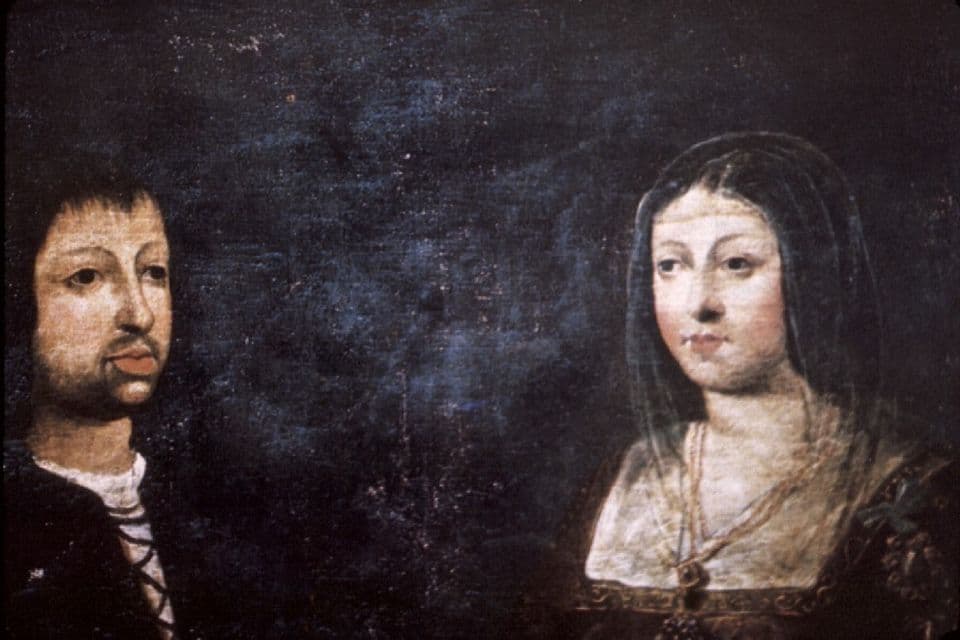
Two middle school students visit an exhibition on the Catholic Monarchs. In a hall draped with brocade, a queen with red hair seems to be waiting for them. She smiles at them and invites them to ask all their questions.
—Is it true you got married in secret, disguised as a merchant woman?
Yes, it's true, and I still smile about it! It was in 1469, in Valladolid. My half-brother, King Henry IV, did not want this marriage. So imagine an eighteen-year-old girl putting on simple clothes, like a cloth merchant, so as not to be recognized in the street. My Ferdinand of Aragon traveled disguised as a servant! We married almost in secret, our hearts pounding, without the king's permission. You know, that day, two kingdoms shook hands without knowing it. Castile and Aragon, separated for so long, were soon to become one single country.
That day, two kingdoms shook hands without knowing it.
—Were you afraid your brother the king would get angry with you?
Of course I was afraid, my child. Disobeying a king, in my time, was no small game. After the death of Henry IV in 1474, I proclaimed myself queen of Castile. But my niece, Joanna, also wanted the throne, and Portugal supported her. Imagine a great family tearing itself apart over a crown: there was a real war. I had to fight for years before I was recognized, in 1479, as the legitimate queen. You see, I did not receive my power as a gift. I earned it step by step, gritting my teeth, never letting go.
I did not receive my power as a gift.
—Why did you give money to Columbus when everyone said no?
Ah, Christopher Columbus! That man had knocked on every door, and everywhere they laughed in his face. He wanted to reach the Indies by going west, across the ocean. That was crazy for the time. At my court, I had nautical charts, portolans, that showed the known coasts. I looked at them and thought: what if it were possible? They even say I offered my jewels to pay for the voyage. In truth, it was the kingdom's money. In 1492, I signed the Capitulations of Santa Fe with him. On August 3, his caravels set sail. You know, sometimes you have to bet on a dreamer that everyone rejects.
Sometimes you have to bet on a dreamer that everyone rejects.
—Did you know he was going to discover a whole new continent?
No, my child, not at all! And neither did he, believe it or not. Columbus thought he had reached the Indies, in Asia. No one at my court imagined that there existed entire lands, unknown to us, over there. When he came back telling of those islands and peoples, we were both amazed and bewildered. Later, in 1494, I negotiated the Treaty of Tordesillas with Portugal, to draw a line on the map and share those new worlds. Imagine two children sharing a big playground they haven't even finished exploring. That's what we were doing, without measuring what it would change.
We were sharing a world we hadn't finished exploring.
—What was it like to be a queen on a battlefield?
Tiring, and much less glorious than people think. During the Granada war, between 1482 and 1492, I was not hiding in a palace. I handled supplies: feeding thousands of soldiers is a daily headache! I had field hospitals set up to treat the wounded, which was hardly done before me. Sometimes I put on a ceremonial armor to give courage to my men. I even had a fortress city built, Santa Fe, near Granada. You see, a queen is not just a beautiful dress and a crown. She is also someone who counts sacks of wheat.
A queen is not just a beautiful dress and a crown.
—How did you feel seeing wounded soldiers near you?
It made my heart ache, my child. Those young men were suffering for our kingdom, and I wanted them to be cared for. That's why I had hospital tents set up on the front, near Granada. At that time, the wounded were often left to die on the spot, without care. I wanted something different. I would go see them, make sure they had food and hands to dress their wounds. I was very pious, you know: I always wore my rosary, that string of beads for praying. And I prayed for them. Taking care of the weakest, even in the midst of war, was for me the true duty of a queen.
Taking care of the weakest, even in the midst of war, was my true duty.
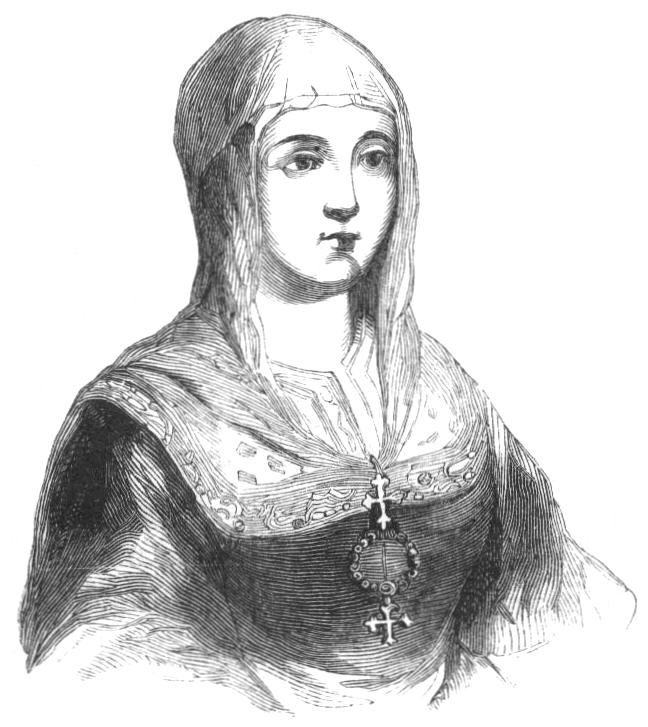
—Is it true that you traveled all the time to dispense justice yourself?
Yes! My court was never seated in the same place. It was called an itinerant court: it moved from town to town, from Segovia to Toledo, from palace to alcázar—those fortresses whose name comes from Arabic. I always carried the royal documents with me. And wherever I arrived, I listened to people, even the poorest, who came to present their complaints. Imagine a queen stopping on a dusty road to read a peasant's petition. I wanted justice not to remain locked up in castles. It had to reach the humble. That's how I conceived my job as queen.
I wanted justice to reach the humblest.
—How did you manage to command such a large kingdom all by yourself?
I was not alone, fortunately! In 1480, I enacted great ordinances in Toledo to govern better. I strengthened the Royal Council, my advisors who helped me decide. And in each city, I placed a corregidor: a man of mine, responsible for keeping order and dispensing justice in my name. Before, the great lords did pretty much as they pleased. Imagine a class without a teacher, where everyone shouts louder than the next: that was a bit like it. I restored order, gently but firmly. They say I laid the foundations of a modern state. I mainly wanted a kingdom where the law would be the same for everyone.
I wanted a kingdom where the law would be the same for everyone.
—In 1492, you took Granada. What did that city represent for you?
A dream of eight centuries, my child. For a very long time, Christian kingdoms and the last Muslim kingdom shared our peninsula. That long history was called the Reconquista, the reconquest. Granada was the very last Muslim kingdom, protected by its magnificent palace, the Alhambra. On January 2, 1492, after ten years of war, the keys to the city were handed over to us. Imagine the end of a story that began long before your great-great-grandparents were born. I was moved, proud, exhausted. But I won't hide the rest from you: this victory was also the beginning of very harsh decisions toward those who did not share our faith.
Granada was a dream eight centuries old.

—Why did you expel the Jews from your country? That's sad, isn't it?
You are right to ask this question, and yes, it is sad. I don't want to hide behind fine words. In March 1492, Ferdinand and I signed the Edict of the Alhambra. It ordered Jewish families to leave Spain or convert to Catholicism. Thousands of people had to abandon everything—their homes, their hometowns. I believed then that I was serving my faith by unifying the kingdom under a single religion. Today, this decision is harshly judged, and I understand why. A converso was a converted Jew, always watched. You know, even queens make great mistakes. We must face them, not erase them.
Even queens make great mistakes.
—What exactly was the Inquisition? That word sounds a bit scary.
You are right to shudder, my child. The Spanish Inquisition was created in 1478, at our request, with the pope's approval. It was a religious tribunal, led by a stern man, Tomás de Torquemada. Its mission: to judge those suspected of not sincerely believing in the Catholic faith. The penalties could be terrible, pronounced during public ceremonies called autos-da-fé, which means "acts of faith." Imagine a tribunal that wants to read people's hearts: that was it, and it was frightening. I thought I was protecting the unity of the faith. But this tool caused a lot of suffering, long after my death. History has not forgotten.
A tribunal that wanted to read people's hearts.
—If we looked at your day, what did you do in the morning when you got up?
I rose at dawn, before the sun. My first thought was for prayer, in my small chapel, with my ladies-in-waiting. I heard Mass every morning, often said by my confessor, Cardinal Cisneros. Then work began: reading reports, listening to ambassadors, signing decrees with my royal seal. I was a very pious woman, but also very busy! In the evening, I would join my children, whom I raised strictly, and we would read together. Do you know that I learned Latin as an adult, to better read the sacred texts? Imagine learning a difficult language while already being queen. One is never too old to learn.
One is never too old to learn.
This imaginary interview was generated by artificial intelligence from sources documented in Isabella I of Castile's profile. It dramatises what the figure might have said based on what we know about them, but does not constitute attested historical testimony. For primary sources and factual documentation, refer to the full profile.