Kids interview James Cook
by Charactorium · James Cook (1728 — 1779) · Exploration · 5 min read
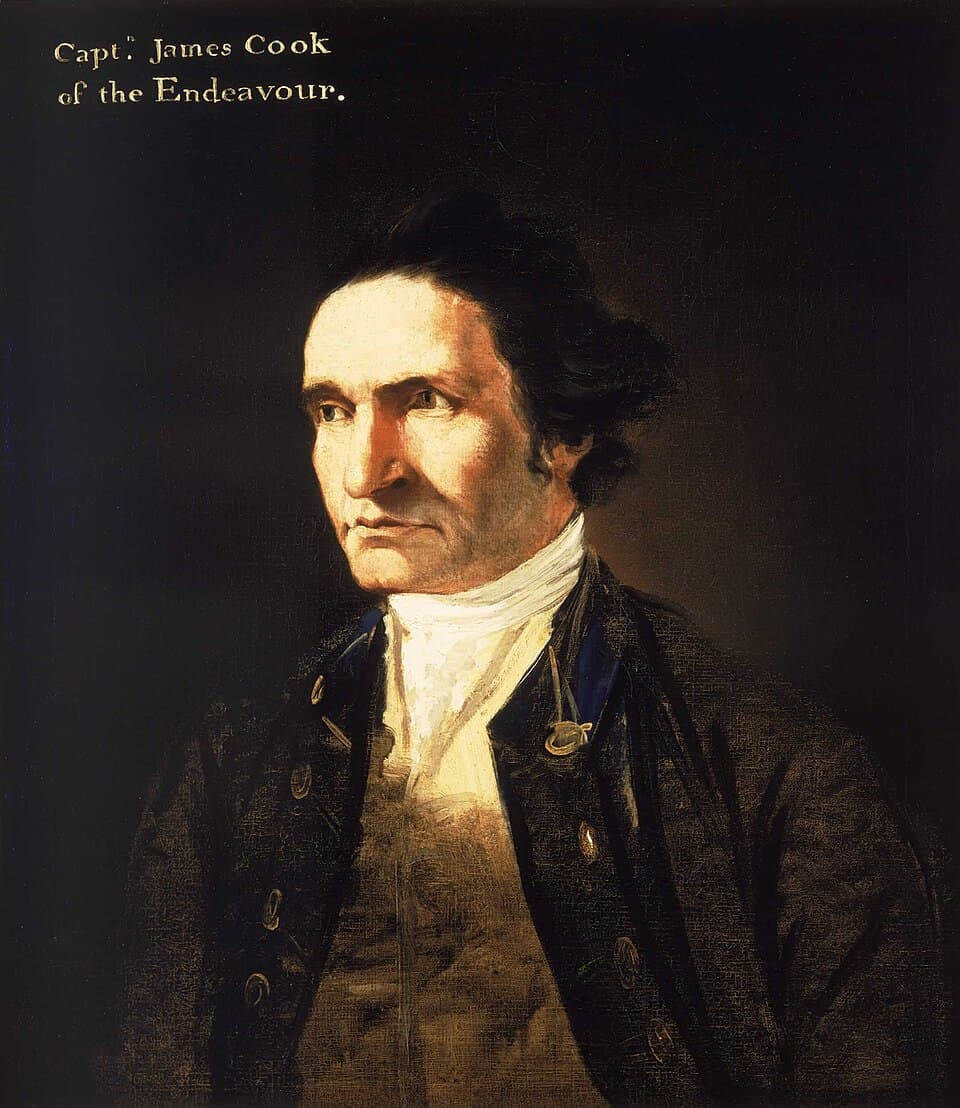
Two young visitors, aged twelve, on a school trip, stepped aboard a great wooden sailing ship. There, before a table covered with charts, a captain with a calm gaze awaited them. He had sailed around the world three times — and he agreed to tell them everything.
—How old were you when you left on your very first great voyage?
I was forty years old, my child, already a mature man. I set sail in 1768 on a ship called the Endeavour. Do you know what it was? An old collier, sturdy, that had been converted. Not a luxury vessel — a stout workhorse, built to carry loads and withstand reefs. I was entrusted with a scientific mission: to go to Tahiti, an island at the end of the world, to observe the passage of the planet Venus in front of the Sun. Imagine: weeks at sea, never seeing a coast, just water and sky. And at the bottom of my cabin, a sealed envelope I was not allowed to open. Not yet.
My first ship was just an old coal hauler — but it sailed around the world.
—What was the secret envelope? When were you allowed to open it?
Ah, the envelope! That's the real secret. The Admiralty — the high command of my country's navy — had forbidden me to open it until I had finished observing Venus at Tahiti. When I unsealed it, I understood: I was ordered to head south, in search of a mysterious land they called in Latin Terra Australis Incognita, the "unknown southern land." Scholars believed a vast continent must exist there to balance the weight of the northern lands. You see, my child, I served two masters at once: science on one hand, and my king's ambition on the other. One hand held an astronomer's telescope. The other, a map of empire.
One hand held the astronomer's telescope, the other the map of empire.
—When you arrived on an island, how did the people welcome you?
That depended, and sometimes the sky turned quickly. In Hawai‘i, on my last voyage, I arrived during a religious festival of the inhabitants. And lo, they took me for some kind of god! They covered me with honors, offered food, bowed down. Imagine the scene: a tired sailor, treated like a deity on a black sand beach. But you know, my child, these things are dangerous. One does not remain a god for very long. Elsewhere, at Botany Bay in Australia, the inhabitants watched us from afar, wary, and they had every reason to be. A strange sail appearing on the horizon is never a small matter for those who live there.
One never remains a god for very long.
—On the ships, sailors fell ill. How did you treat them?
You touch on my greatest pride there, perhaps more than my charts. In my time, a terrible disease decimated crews: scurvy. It happens when you go too long without fresh fruits and vegetables — teeth fall out, the body bleeds, and you die. I refused that. I forced my men to eat sauerkraut, that slightly sour fermented cabbage, and citrus fruits at every stop. Some grumbled, so I ate it in front of them to set the example. On the Resolution, not a single man died of scurvy. Not one! The Royal Society, our great academy of scholars, awarded me a medal for that in 1776.
Saving a crew sometimes comes down to a plate of cabbage.
—What did you eat, Captain? The same as the sailors?
Exactly the same, my child, and that was deliberate. Many captains dined on fine dishes while their men gnawed hardtack. Not me. I shared their table: sauerkraut, fermented malt, and whatever fresh food we could buy in ports — vegetables, unfamiliar fruits. I even tasted island foods that no one else dared touch, just to check they were safe to eat. You see, a captain who asks his men to eat strange sour cabbage must eat it first. Otherwise, why would they obey you? In the morning on board, I rose before dawn, and the stomach came after the work.
A captain who orders sour cabbage must swallow the first spoonful.
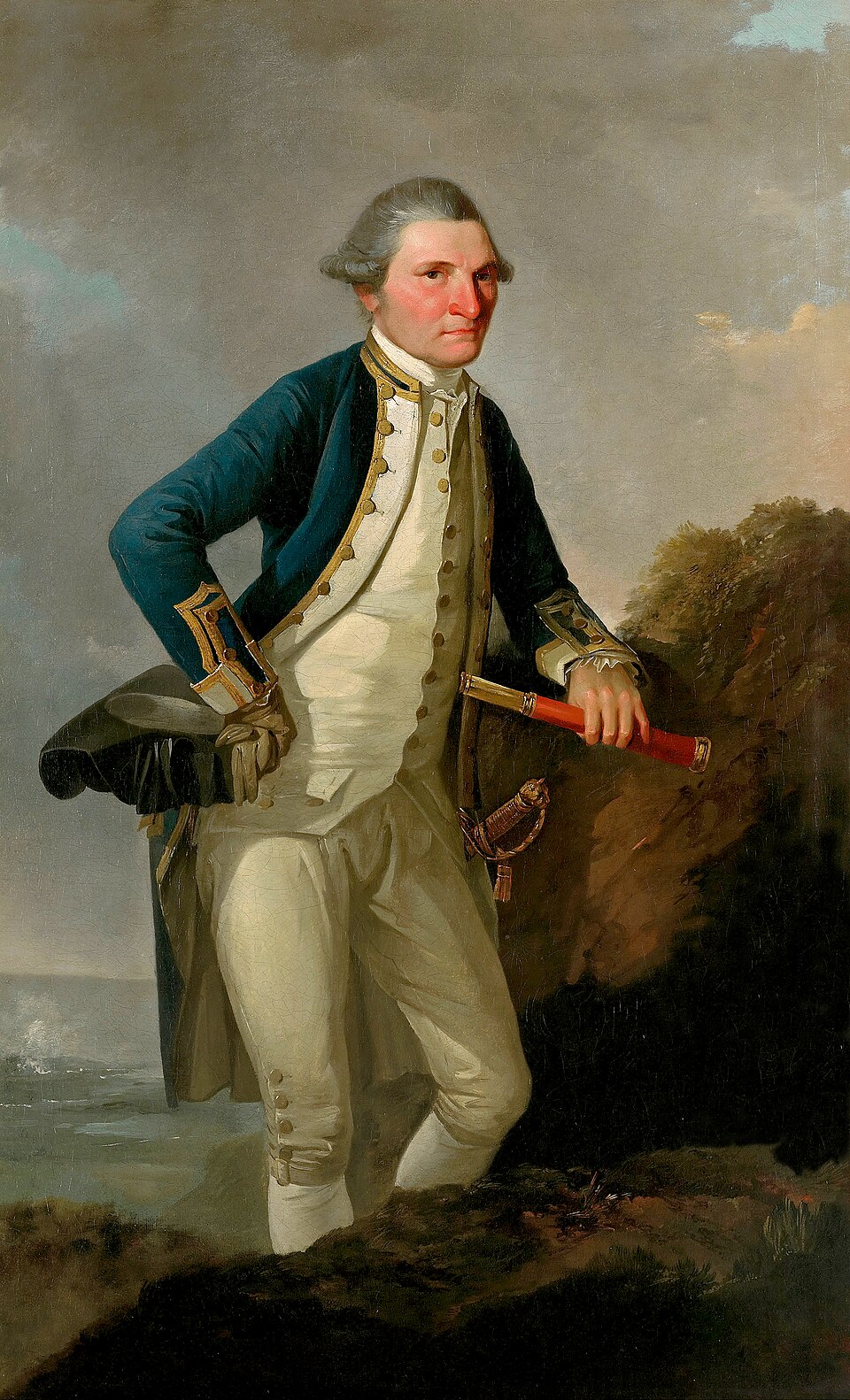
—A map is just a drawing. Why was it so hard to make?
Ah, if only it were just a drawing! Charting a coast that no one has ever seen is painstaking work. I spent my afternoons bent over my sextant, an instrument that measures the height of stars and the Sun to know where you are. I had the water sounded with a lead on a rope to know the depth and avoid running aground. My charts of New Zealand, drawn in 1769, I made by sailing all around both islands, angle by angle. Do you know? They served sailors for more than a hundred years after me. A good chart, my child, is a lifetime of patience folded onto a sheet.
A good chart is a lifetime of patience folded onto a sheet.
—How did you know where you were, in the middle of the ocean?
That's THE great question of my time, and it drove entire navigators mad! Finding your north-south position, latitude, was fairly simple with the Sun. But knowing whether you were farther east or west — longitude — was nearly impossible. We sailed by dead reckoning, calculating speed and course, and often missed by hundreds of miles. On my second voyage, I brought a marvel: a copy of a special clock, Harrison's chronometer, which kept exact time despite storms. With the correct time, I could finally find my longitude. Imagine a watch so faithful it was worth a treasure — well, it was one.
A faithful clock at sea was worth all the gold of a kingdom.
—Did you sail in ice? Weren't you too cold and scared?
Oh, cold I had to the bone! On my second voyage, in January 1773, I took the Resolution and the Adventure farther south than anyone before me. We crossed the Antarctic polar circle — the first in history to do so. Imagine floating mountains of ice, taller than the masts, and fog, and silence. Scared? A captain has no right to show it, but yes, danger was everywhere. We were searching for that famous southern continent. And you know what I found? Nothing. Just ice. I concluded that if any land existed there, it was frozen and uninhabitable.
At the end of the south, I found neither continent nor treasure — only ice and silence.
—How did it feel to prove that continent didn't exist?
A strange feeling, my child, mixed with pride and a little sadness. For centuries, geographers had dreamed of that Terra Australis, a vast and rich land. Many sailors wanted to believe in it. I sailed all around the southern ocean, in high latitudes, and I was able to write in my journal that there remained no room for such an accessible continent. I told all this in my account, A Voyage towards the South Pole, in 1777. You see, sometimes an explorer's work is not to discover a land — it's to prove a dream was false. Erasing a legend from a map counts as much as adding an island.
Erasing a legend from the map counts as much as adding an island.
—And after all those voyages, did you finally return home?
That's the sad part of my story, and I owe you the truth. Between my voyages, I returned to London, to a modest house, with my wife Elizabeth and our children. But the sea always called me back. On my third voyage, I went back to Hawai‘i, to Kealakekua Bay. There, where I had been welcomed as a god, a quarrel broke out — over a stolen boat. On February 14, 1779, on that beach, I fell in the scuffle. I was not yet fifty-one years old. Remember, my child: you can cross all the oceans of the world and meet your end on a beach, over so little.
You cross all the oceans, and the end sometimes waits for you on a beach.

This imaginary interview was generated by artificial intelligence from sources documented in James Cook's profile. It dramatises what the figure might have said based on what we know about them, but does not constitute attested historical testimony. For primary sources and factual documentation, refer to the full profile.