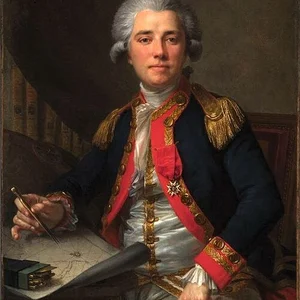

A French naval officer and explorer of the 18th century, La Pérouse led a major expedition across the Pacific Ocean (1785–1788). The voyage produced important cartographic surveys and scientific studies, but the expedition mysteriously disappeared in 1788.
Jean-François de La Pérouse(1741 — 1788)
Jean-François de La Pérouse
France
8 min read
Frequently asked questions
Key Facts
- 1785: Departure of the La Pérouse expedition from Brest with two ships (La Boussole and L'Astrolabe)
- 1786–1787: Exploration and mapping of the North Pacific coasts (Alaska, California, East Asia)
- Scientific and ethnological explorations in Oceania, particularly in Polynesia
- 1788: Last reported contact at Samoa; disappearance of the expedition at sea
- Discovery of the expedition's remains in 1826 on the Vanikoro Islands (Melanesia)
Works & Achievements
Scientific voyage around the world commissioned by Louis XVI, aimed at completing Cook's explorations. The expedition produced major cartographic surveys and scientific observations of the Pacific.
Four-volume work edited by Milet-Mureau from the journals brought back by Lesseps, including an atlas and engraved plates. Translated into several languages, it became a landmark reference in 18th-century exploration literature.
Collection of maps and illustrated plates accompanying the publication of the Voyage, depicting the coastlines surveyed, the peoples encountered, and the natural species observed.
Military operation led by La Pérouse during the American War of Independence, demonstrating his qualities as a commander and earning him a promotion to ship captain.
Survey of the strait separating Sakhalin from the island of Hokkaido (Japan), which has since borne his name. These surveys filled a significant gap in European maps of East Asia.
Anecdotes
During the Battle of Hudson Bay in 1782, La Pérouse captured three British trading posts with only two ships. True to his sense of honor, he left the English prisoners enough provisions to survive until help arrived — a rare gesture in wartime that earned him a reputation for generosity even among his enemies.
When departing from Brest in August 1785, Louis XVI was personally involved in preparing the expedition and revised its instructions himself. The king, passionate about geography, had studied the maps with La Pérouse and suggested certain destinations to explore — an exceptional royal collaboration for a scientific mission.
In April 1786, the expedition reached the coast of Alaska. During an attempted landing in Lituya Bay, three longboats were swallowed by violent currents, taking 21 men with them. La Pérouse, devastated, named the place 'Port des Français' and dedicated several pages of his journal to mourning his lost sailors.
Before disappearing, La Pérouse entrusted his logbooks and charts to Barthélemy de Lesseps at Petropavlovsk-Kamchatka in 1787, so that he could bring them back to France overland. This messenger crossed all of Siberia and Europe on foot and by sled, arriving at Versailles in October 1788 — a few months after the expedition's disappearance.
For more than forty years, the fate of La Pérouse remained a national mystery. It was the explorer Dumont d'Urville who, in 1828, found wreckage from the ships at Vanikoro (Solomon Islands). Subsequent investigations revealed that survivors had lived on the island for several months before setting off again on a makeshift boat, with their final fate never established with certainty.
Primary Sources
We recognized, to our great satisfaction, that the natives of this island were gentle, hospitable and unsuspecting; they brought us fruits, roots and fresh water with an eagerness that deeply moved us.
His Majesty desires that the astronomers, geographers, botanists, naturalists and other scholars accompanying the expedition employ all their zeal in gathering the most useful observations for the advancement of science and the commerce of the nation.
I arrived at Botany Bay on 26 January 1788. I found the English already established and well advanced in their works; they appear intent on making a serious colony of this country.
The wind strengthened considerably during the night of the 13th to the 14th; we had to furl the topsails and pay out the tow line. The south-westerly swell is very heavy and has been hampering our manoeuvres since leaving the strait.
Key Places
La Pérouse's birthplace, where he grew up in a minor noble family. A national museum dedicated to the explorer is located there.
Major military port from which the expedition set sail on August 1, 1785, with the Boussole and the Astrolabe. Brest was the main arsenal of the French Royal Navy.
Site of the tragedy of July 13, 1786: three longboats and 21 men were swallowed up by treacherous currents. La Pérouse named the site 'Port des Français' in memory of his sailors.
Port where La Pérouse stopped in 1787 and entrusted his precious journals to Barthélemy de Lesseps to be carried overland back to France.
The expedition's last known port of call in January–February 1788, where La Pérouse observed the establishment of the first British colony. His letter from Botany Bay is the last document ever received from him.
Island in the South Pacific where the wrecks of the Boussole and the Astrolabe were found in 1828 by Dumont d'Urville, ending forty years of mystery surrounding the fate of the expedition.
Typical Objects

Navigation instrument used to measure the altitude of celestial bodies to determine latitude and longitude. La Pérouse and his astronomers used it daily to draw precise charts of unknown coastlines.

High-precision clock carried aboard the Boussole, used to calculate longitude by comparing local time to the reference meridian time. It was a recent technology, essential to the great expeditions of the late 18th century.

Pen-annotated nautical charts that La Pérouse corrected and updated as the voyage progressed. These documents constituted the expedition's primary scientific output.

Blue coat with red and gold facings, gold epaulettes, tricorn hat: the uniform distinguished the commander before his crews and during encounters with local populations or foreign authorities.

Daily register kept by La Pérouse himself, recording meteorological observations, contacts with peoples encountered, navigation incidents, and personal reflections. These journals are the primary source on his expedition.

Fabrics, iron tools, mirrors, and trinkets carried aboard to establish peaceful relations with Pacific populations. La Pérouse had received precise royal instructions to treat the peoples encountered with respect and fairness.
School Curriculum
Vocabulary & Tags
Key Vocabulary
Daily Life
Morning
La Pérouse rose at dawn to inspect the deck, consult the watch officers, and check the navigation instruments. He supervised the position readings taken by the expedition's astronomers using the sextant and chronometer.
Afternoon
Afternoons were devoted to scientific observations: depth soundings, coastal cartographic surveys, and the collection of natural specimens by the botanists and naturalists on board. During stopovers, La Pérouse organized exchanges with local populations.
Evening
In the evening, La Pérouse wrote his ship's log in his cabin by candlelight, carefully recording the day's events, his geographical reflections, and his observations on the peoples encountered. He also consulted his officers to plan the following day's navigation.
Food
On board, the diet was based on sea biscuits, salted beef and pork, dried vegetables, and wine or brandy. La Pérouse made sure to replenish provisions at every stopover with fresh fruit, fish, and local meat to prevent scurvy.
Clothing
On duty, La Pérouse wore the royal blue uniform with red facings and gold braid of a ship's captain, complete with tricorn hat and sword at his side. At sea on board, he favored more practical attire: a broadcloth jacket and breeches resistant to salt and moisture.
Housing
La Pérouse occupied the great stern cabin of the Boussole, reserved for the commander: a cramped but privileged space fitted with a desk, a bunk, and shelves for charts and instruments. Ashore during official stopovers, he was lodged with governors or in colonial residences.
Historical Timeline
Period Vocabulary
Visual Style
Le style visuel évoque la France des Lumières et ses grandes expéditions : marines dramatiques, uniformes royaux bleu et or, cartes gravées avec soin, et la vastitude bleue du Pacifique explorée à la lueur des bougies.
Sound Ambience
L'univers sonore de La Pérouse est celui d'un grand voilier militaire du XVIIIe siècle : grincements de la coque, claquements des voiles, cris des officiers et chants des marins se mêlent aux bruits de la mer et du vent du large.
Liens externes & ressources
Références
Œuvres
Expédition de circumnavigation (Boussole et Astrolabe)
1785-1788
Voyage de La Pérouse autour du monde (publication posthume)
1797
Atlas du Voyage de La Pérouse
1797
Relevés cartographiques du détroit de La Pérouse
1787