Imaginary interview with Jane Austen
by Charactorium · Jane Austen (1775 — 1817) · Literature · 6 min read
Chawton, in Hampshire, an autumn morning. The pianoforte has just fallen silent, and one can guess, on the little drop-front desk near the sitting-room window, a few sheets turned over. Jane Austen, goose quill in hand, agrees to answer — in a low voice, so as not to wake the household.
—How did you actually write, in this house where the family came and went constantly?
I write right here, in the sitting room of Chawton, on small sheets I keep within reach of the blotter. The slightest creak of the door, and I slide my work under it as one hides an indiscreet letter — there is a hinge in the entrance floor that warns me, and I have never had it repaired. A woman of my rank may embroider, play, keep the kitchen garden; that she writes novels, that is still considered an eccentricity barely tolerated. My little escritoire closes in an instant, and no visitor has ever surprised a page. I find, moreover, that concealment sharpens the sentence: you tighten what you must be able to hide quickly.
Concealment sharpens the sentence: you tighten what you must be able to hide quickly.
—Why did you insist on publishing anonymously rather than under your own name?
Sense and Sensibility appeared in 1811 signed only 'By a Lady,' and I never wanted more in my lifetime. Understand: a lady of the gentry who claimed her fame as an author would set all Hampshire gossiping before evening tea. Anonymity leaves me free — I can observe my neighbors, listen to their follies by the fireside, and put them into a book without anyone recognizing himself enough to resent me. My brothers knew the secret, my dear Cassandra better than anyone; that was enough for me. Let my name eventually circulate, so be it, but let me first write in peace in my sitting-room. Reputation is a commodity I distrust as much as my heroines distrust handsome officers.
—We know that Pride and Prejudice went through a long purgatory before existing. What happened?
The book was first called First Impressions, and I wrote it very young, at Steventon, in the parsonage of my childhood. In 1797, my father offered it to the publisher Cadell, in London; it was refused without even the trouble of opening it. Sixteen years! Imagine between that refusal and publication, we left Steventon, lived in Bath which I did not like, lost my father, moved again. I took up the manuscript, tightened it, renamed it, and it finally appeared in 1813. I believe the waiting served it: the young woman who began it would not have known how to cut as sharply as the one who finished it. One gains in irony what one loses in illusions.
—Do you remember the day you held the first printed copies in your hands?
February 1813. I wrote at once to Cassandra, and could not restrain myself: 'I have got my own darling child from London.' My darling child! That is how I saw that bound volume, after so many years of carrying it in secret. I read it aloud that same evening, in the family, around the table — badly, I admit, for my mother rushes the lines and spoils the silences. The incipit pleased me, however: 'It is a truth universally acknowledged, that a single man in possession of a good fortune, must be in want of a wife.' All the comedy of mothers of families lies in that sentence. Success came in a few weeks; I did not expect it, but I would be hypocritical to pretend I was not pleased.
My darling child! That is how I saw that bound volume, after so many years of carrying it in secret.
—How would you describe the scope, or the narrowness, of the world you choose to paint?
I wrote to my nephew James Edward, in December 1816, that he must not compare his great manly sketches to the 'little bit (two inches wide) of ivory' on which I work 'with so fine a brush, as produces little effect after much labour.' That is my domain: two inches of ivory. Three or four families in a country village, that is my whole England, and I maintain it suffices. I am reproached for not painting battles or empires; but look closely at a card party, a country ball, a clumsy marriage proposal: there is as much vanity, calculation, and heart in them as on battlefields. Detail, handled with a fine brush, says more than the fresco.
That is my domain: two inches of ivory, and I maintain it suffices.
—Were you ever urged to broaden your subject, to tackle grander matters?
The Prince Regent's librarian, Mr. Clarke, wanted me to write a historical novel about the illustrious royal house. I replied in April 1816: 'I am fully sensible that an Historical Romance, founded on the House of Saxe Cobourg, might be much more to the purpose of profit or popularity than such pictures of domestic life in country villages as I deal in.' That was my polite way of refusing. I know my limits as one knows the walls of one's room: outside my villages, I would stumble. Emma, which I had just finished, cost me more patience than any heroic fresco — making a heroine too sure of herself into a person one loves despite her follies, that is the real labor. Each his own ivory; I keep mine.
—It is said that you yourself refused an advantageous marriage. What would you say about that episode?
I was twenty-five. Harris Bigg-Wither, a wealthy young man, owner of fine lands, proposed and — one evening — I accepted. The night brings better counsel than well-meaning friends: by morning, I retracted. Consider what I refused: security, a house of my own, comfort for my mother and Cassandra. And yet I could not bring myself to it without esteem or affection. How could I have written afterwards about marriage if I myself had contracted the very one I blame in my pages? My heroines refuse unions of mere convenience, and I was not going to give them the lie. I preferred my goose quill and my poor independence to a good match without heart. I have never regretted it, though winter was sometimes cold at Chawton.
—Why do money and inheritance weigh so heavily in your love plots?
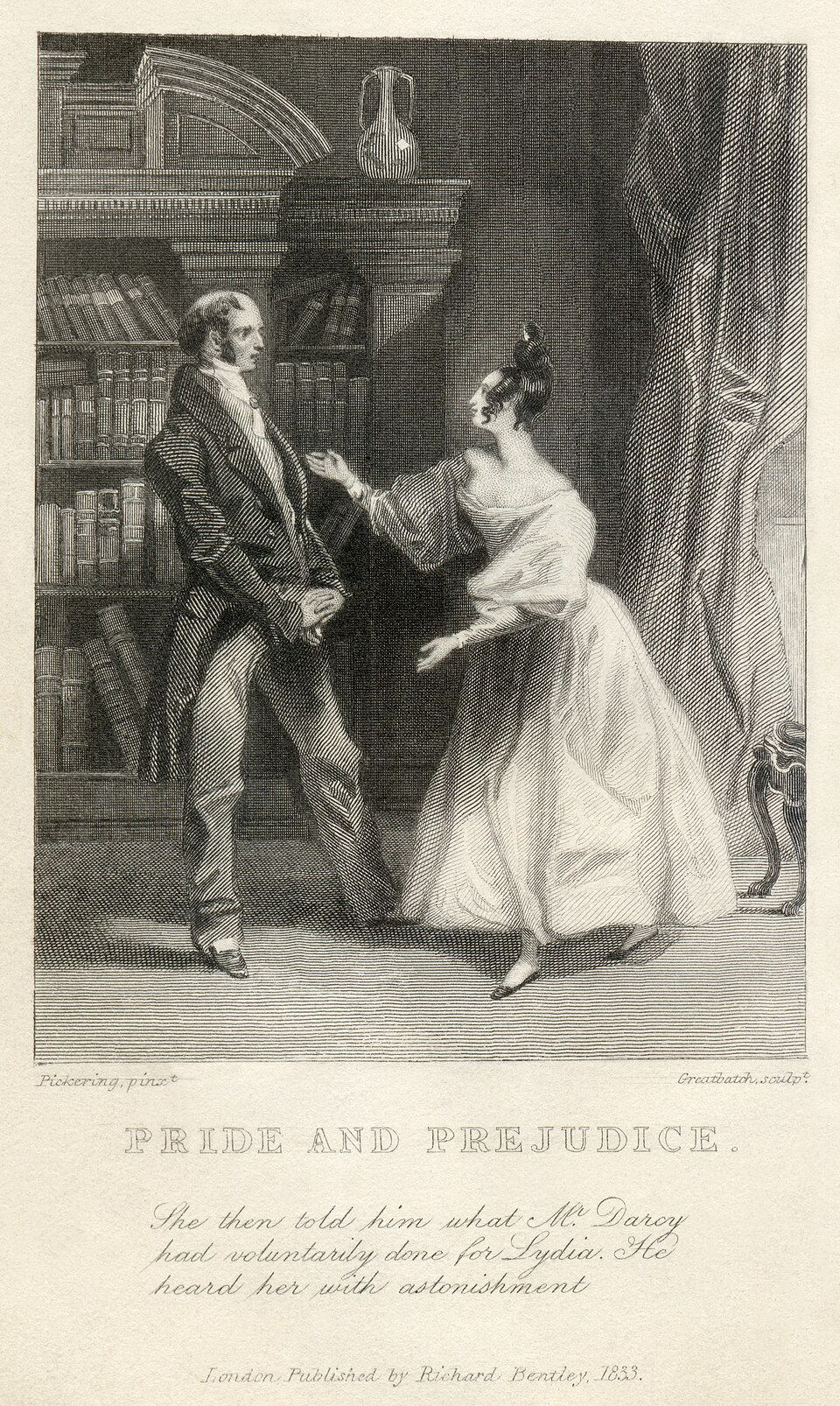
Because they weigh heavily in our lives, that is all. Take Longbourn, in Pride and Prejudice: the property is subject to the entail, that substitution which reserves it to the nearest male heir — the odious Mr. Collins — and drives the five Bennet daughters toward poverty upon the father's death. That is not a novelistic invention, it is English law before my eyes. In Sense and Sensibility, Elinor and Marianne learn harshly that one does not live on love and poetry. A woman of my station has, to secure her bread, only marriage or a brother's charity. To paint love without painting the money that thwarts it would be to lie like the cheap novels. I prefer irony: it tells the truth while making one smile.
—What is your view of the manners of your time, those balls and drawing-rooms you constantly describe?
We live under the Regency, and everything is ceremony: a young girl's coming out, her accomplishments — music, drawing, French, embroidery — displayed like a merchant's wares to attract a husband. I laugh at it in my books, think of Miss Bingley reciting the list of a accomplished woman's talents. And then there is the militia: let a regiment settle in a country town, and all heads are turned. That is how Wickham arrives in Meryton in Pride and Prejudice, handsome, in uniform, and steals hearts before one has checked his debts. I invent nothing: I go to balls, keep my notebook, wear white gloves, and listen. My novels are merely the chronicle of what everyone sees without looking.
—You dedicated one of your novels to the Prince Regent. How did that dedication come about?
Let us say it was a favor I could well have done without. I was informed, through that Mr. Clarke I mentioned, that His Highness the Prince Regent — the future George IV — admired my books and that I might dedicate one to him. Now I had little esteem for that prince, whose conduct toward his wife and his debaucheries were the talk of the whole kingdom. But one does not politely refuse an invitation that is not one. So I dedicated Emma, in 1815, to my royal admirer, in the most ceremonious terms my pen ever traced — so ceremonious, in truth, that irony lurks within for those who can read. That is all the vengeance I allowed myself.
This imaginary interview was generated by artificial intelligence from sources documented in Jane Austen's profile. It dramatises what the figure might have said based on what we know about them, but does not constitute attested historical testimony. For primary sources and factual documentation, refer to the full profile.