Imaginary interview with Joni Mitchell
by Charactorium · Joni Mitchell (1943 — ?) · Music · Visual Arts · 6 min read
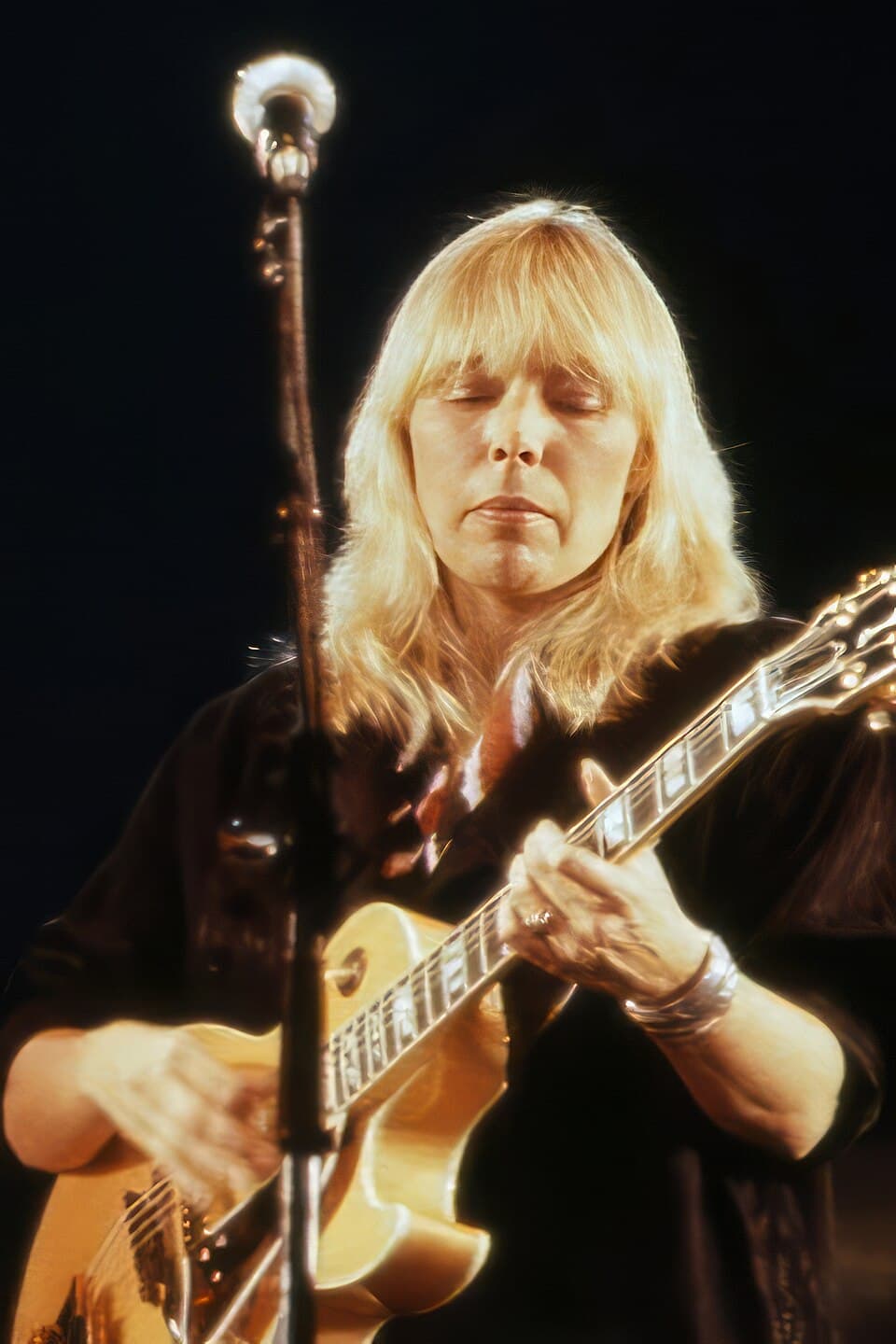
Late afternoon in a wooden house in Laurel Canyon, the smell of turpentine still lingering near an easel turned against the wall. A guitar lies flat on the couch, tuned in a way that sounds like no other. Joni Mitchell lights a cigarette, pushes aside a few canvases to make room, and agrees to trace back the thread.
—How did it all begin, this story between you and music?
It began in a hospital bed, in Saskatoon, in the winter of 1952. I was nine, polio was sweeping the Prairies, and the doctors said I might not walk straight again. So, to keep from dying of boredom, I started singing in the dark — it was that or cry. The disease left me with a lazy left hand, fingers that wouldn't bend like other people's. When I picked up a guitar years later, standard tuning was almost impossible. So I twisted the strings until they suited me, and ended up inventing over fifty of them, my own tunings. People see a signature; I see first a disability I learned to make sing.
The disease left me with a lazy hand; I twisted the strings until they suited me.
—You speak of your tunings almost as a secret language. What do they allow you that standard playing forbids?
Each tuning is a room to which no one else has the key. When I loosen my E string, the guitar starts to sound like an instrument I've never heard, and I have to explore it by touch, without landmarks, like moving through a house plunged into darkness. That's where the songs come: in that disarray. I grew up with open tunings from Appalachian folk, then kept twisting them until I got suspended harmonies, a bit lopsided, that never quite settle. That weakness in my fingers, a remnant of polio, barred me from ease — and in art, prohibition is often better than a gift. I don't look for beautiful positions; I look for ones my hand can hold.
—Let's talk about Blue. Many see it as the invention of the confessional song. What were you thinking in 1971?
I wasn't thinking anything, precisely — I was raw. In 1971, I stood before the microphone with no skin, without the varnish one usually puts between oneself and the listener. I sang about heartbreak, loneliness, a daughter I had to give up, everything you're supposed to keep to yourself. Neil Young, whom I loved dearly, told me I was too unguarded, and he was right, but that was the price. To a radio friend I said there is no distance between me and the song: there is no distance between me and the song. When I sing it, I relive it — that's the gift and the bill at once. Blue is not an album I wrote; it's an album I bled.
Blue is not an album I wrote; it's an album I bled.
—Didn't that total exposure ever frighten you?
Of course it frightened me. You don't show your wounds without trembling. But I've always thought that polite lying was worse than nakedness. When Neil found me too unguarded, it wasn't a reproach, it was a friend's worry: he feared the public would devour me. Yet it was precisely that lack of guard that made Blue, in 1971, something more than just another record. I write my own life, there's no character between the text and me; so every night on stage, I reopen the same wounds. People think it's courage. It's mostly an inability — I don't know how to pretend. A song that lies is heard immediately, like a wrong note in a tuning you know by heart.
—You've often defined yourself not as a musician, but as a painter. Why this insistence?
Because it's true, and because no one wants to believe it. I'm a painter first and a musician second — I'm a painter first, musician second; music only pays the rent. I painted before I knew how to hold a chord, at the Saskatoon Technical Collegiate, and I never stopped: I make my own album covers, and my oil canvases hang in galleries on both sides of the Atlantic. In the morning, before even touching a string, I sit at the easel — painting unties my thoughts, it opens the door through which songs then enter. The two notebooks, one for sketches and one for lyrics, lie side by side on the same table. I've always seen myself as a painter that circumstances derailed into the record industry.
I'm a painter first, musician second; music only pays the rent.
—How does your painter's eye transform the way you write songs?
A painter thinks in colors, planes, light — and I listen to music exactly the same way. A tuning has a tint; some are slate blue, others ochre, and I choose according to the atmosphere I want to spread on the sound canvas. On Court and Spark, in 1974, I began mixing jazz harmonies like layering glazes, coat upon coat, until I got a depth that a simple folk chord doesn't give. When I released Turbulent Indigo in 1994, I even painted the cover as Van Gogh with a severed ear — self-mockery, yes, but also a way of saying that the musician and the painter are the same wounded body. I don't compose songs: I paint with time instead of painting with space.
I don't compose songs: I paint with time instead of painting with space.
—What did that house in the hills of Laurel Canyon represent for you in the late 1960s?
An open-air collective workshop. I lived in that wooden house from 1968 to 1975, one room turned into a painting studio, and the canyon all around buzzed with musicians: Crosby, Stills and Nash a bit lower down, James Taylor, Neil Young passing through. In the afternoon, we'd drop in on each other with a guitar, improvise, trade chords like others trade recipes. In the evening, it turned into gatherings around impromptu concerts, and I, often, listened more than I played — I collected stories, phrases, others' sorrows to feed my lyrics. What was later called the Laurel Canyon sound, those rich vocal harmonies and introspective lyrics, wasn't a school: it was a neighborhood.
What was called the Laurel Canyon sound wasn't a school: it was a neighborhood.
—You say you listen more than you play. What did you seek from others?
A phrase I wouldn't have found alone. An artist thinks he draws from himself, but the essential is gathered outside, in a late conversation, in a friend's travel story. In the canyon, between two cups of coffee and too many cigarettes, I watched people like a painter watches a model. That's how Woodstock was born: I didn't go, but Graham Nash came back from the festival with his eyes full of images, and I stole them to make a song. My sketchbook and my lyric notebook never parted; one drew my neighbors' faces, the other noted their words. Solitude I kept for writing; the material always came from the common table.
—Speaking of Woodstock: how do you write the anthem of an event you didn't attend?
By watching television, ironically. In August 1969, my manager, David Geffen, convinced me not to cancel an appearance on the Dick Cavett Show — he feared I'd get lost in the mud and crowd of a festival whose scale no one yet grasped. So my friends went to Woodstock and I stayed in a New York hotel room, imagining what I was missing. Graham Nash told me everything upon his return, and that distance, that lack, made me more lucid than if I'd been there. Sometimes you see something better from afar, like a landscape you only understand once you step out of the painting. I wrote a festival I never saw with my own eyes — and maybe that's why it sounds like a dream rather than a report.
I wrote a festival I never saw; that's why it sounds like a dream.
—You often seem to create from a slight detachment, on the margins of events. Is that a position you claim?
Movement is the only remedy I know for certain sorrows, so yes, I prefer the road to the center of the party. An entire generation, the one called the Woodstock generation, wanted to be at the heart of the blaze; me, my best work was born on the sidelines. Hejira, in 1976, I wrote it while driving, on the highway, fleeing some sadness, with Jaco Pastorius's fretless bass sliding like the landscape past the window. Being a little apart lets you watch. The painter in me knows it: you only paint well what you contemplate at the right distance. Whether it's a festival, a breakup, or an entire generation, I've always needed to step back one pace to finally see the whole canvas.
My best work was born on the sidelines, not at the heart of the blaze.
This imaginary interview was generated by artificial intelligence from sources documented in Joni Mitchell's profile. It dramatises what the figure might have said based on what we know about them, but does not constitute attested historical testimony. For primary sources and factual documentation, refer to the full profile.