Imaginary interview with Kali
by Charactorium · Kali · Mythology · Spirituality · 6 min read
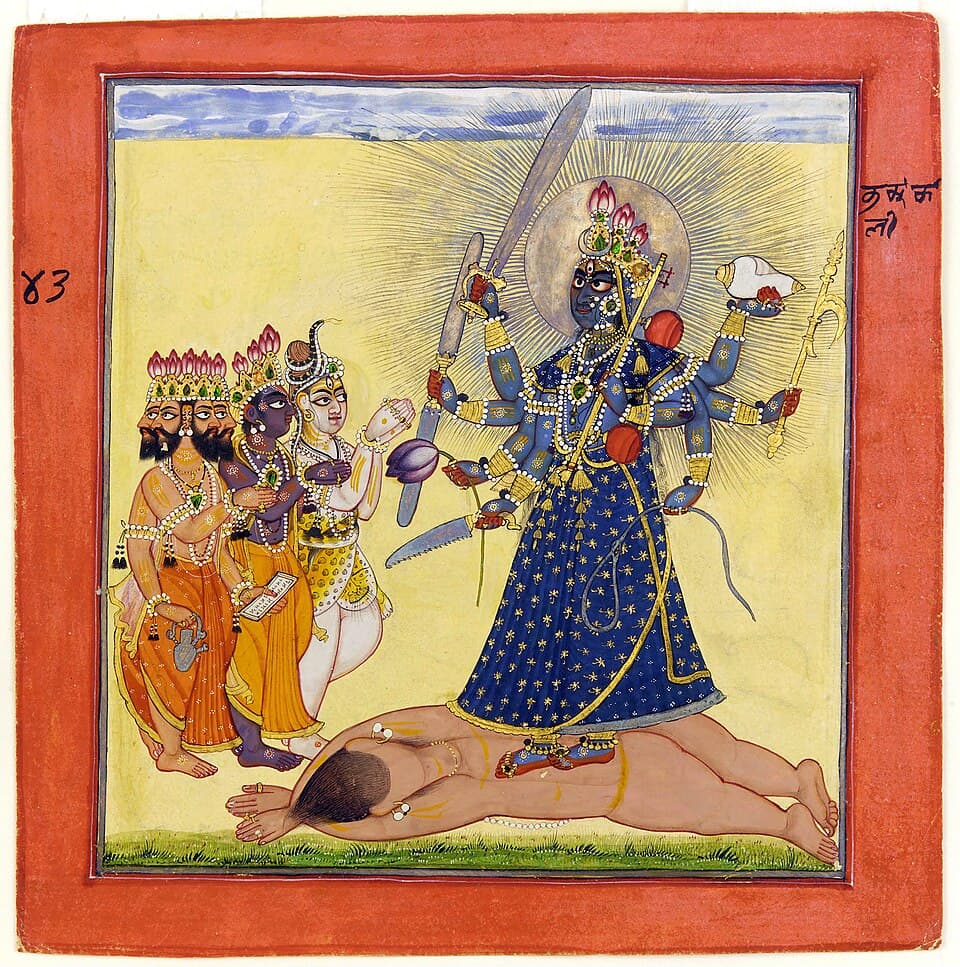
The autumn crescent night covers the crematorium of Varanasi, and the funeral pyres cast a reddish light on the Ganges. There, amid the smoke and the scent of hibiscus flowers, a black presence with ember eyes consents to speak, its tongue still protruding. Kali, the terrible Mother, answers between two drumbeats.
—How did you come into the world, if a goddess can be born at all?
I knew no cradle. I sprang from the brow of Durga, my womb, at the height of the battle against the demons Chanda and Munda, when her wrath grew so black it could no longer be contained in a single body. It is told in the Devi Mahatmya that I suddenly emerged, terrible, carrying the sword and the noose, a club adorned with skulls in hand, draped in a tiger skin. I was not a child: I was already hunger and the end. The first thing I saw was the battlefield; the first thing I did was to cut. They think I am Durga's daughter; I am rather her fury made woman, the moment a mother's patience turns into a storm.
I was not a child: I was already hunger and the end.
—Why are you almost always depicted with your tongue sticking out, your foot on a reclining man?
That man under my foot is Shiva, my husband, my rest. The day I defeated Raktabija — that demon whose every drop of blood that fell to earth spawned a double — I drank all his blood to dry him up, and I could no longer stop. Drunk with carnage, I danced on the corpses, and the earth itself trembled for fear of breaking under my steps. Shiva then lay down among the dead, in my path. When my heel touched him, I recognized my husband, and stupor froze me: I bit my tongue, ashamed to have almost trampled him. This protruding tongue is not mockery; it is the only gesture of restraint a goddess drunk with blood is capable of, the moment when destruction remembers it has a limit.
This protruding tongue is the moment when destruction remembers it has a limit.
—What do your many hands carry, and what should be read into them?
In one hand, the khadga, my sword: it does not cut bodies, it cuts ignorance, that veil that makes you believe you are this little perishable self. In the other, a severed head still dripping — the head of the ego, the demon that everyone nourishes within. Around my neck hangs the mundamala, my garland of fifty skulls: these are not trophies, they are the fifty letters of Sanskrit, speech itself, for from language the world is born and to language it returns. I sometimes drink from a kapala, a bowl carved from a human skull. Do you shudder? Every object I hold tells you the same thing: what you take for horror is only the true face of impermanence, the one you refuse to look at.
My sword does not cut bodies, it cuts ignorance.
—You are sometimes seen wearing a tiger skin, sometimes holding a red lotus. How do you reconcile these two images?
The tiger skin I wear is not a hunting ornament: it is wild nature itself, the fierce and uncontrollable force of life, which I carry as one carries a tamed beast. It says nothing raw escapes me. But look closer: in my peaceful representations, I also hold a rakta padma, a red lotus. This flower grows in mud and opens pure above the water — it is the hidden compassion behind my frightening face. For those who see only blood in me have understood nothing: I destroy so that something may be reborn. The tigress and the lotus are one and the same outstretched hand. My ferocity is maternal; it snatches the child from the fire, even if it burns a little.
My ferocity is maternal: it snatches the child from the fire, even if it burns a little.
—Your very name seems to carry an enigma. What does it mean?
My name comes from kala, a word that says two things at once: black and time. I am the blackness before forms, and I am Time that devours everything. Do not think that only mortals fall into my mouth: the gods themselves age, worlds collapse, cosmic ages wear out, and everything eventually returns to me. The Kalika Purana says it bluntly: I am she who destroys time itself and liberates souls from the cycle of rebirths. That is why my skin is black as the space between stars — because I am what remains when everything else has been consumed. Those who fear me truly fear a very simple thing: that nothing lasts.
My skin is black as space: I am what remains when everything has been consumed.
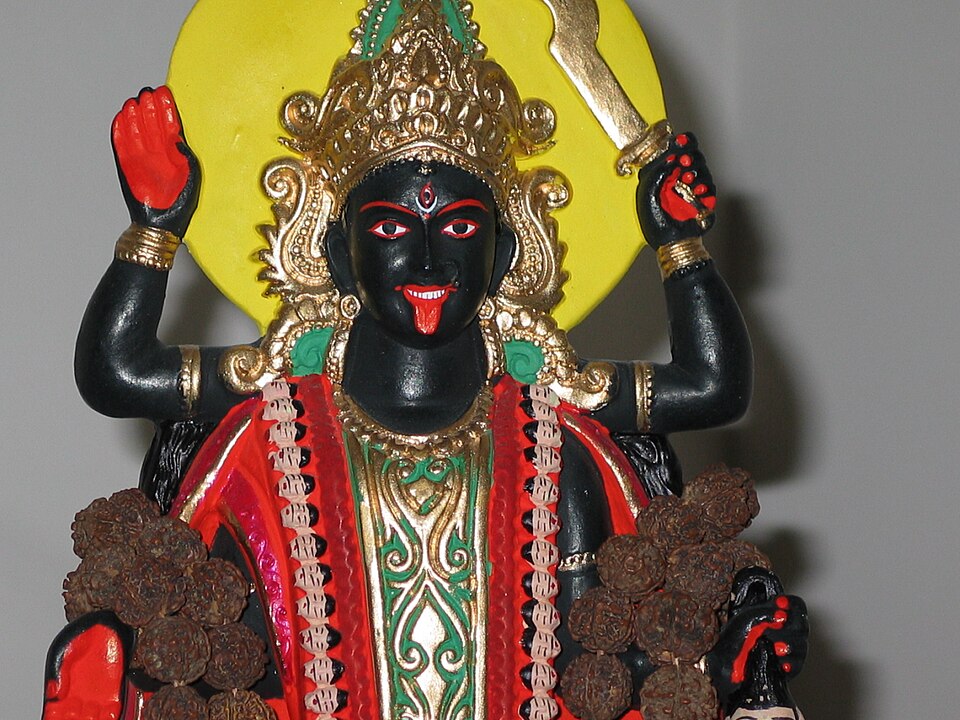
—If you are Time that devours everything, what can one who venerates you hope for?
Moksha — the only thing that matters. You turn endlessly on the wheel of births and deaths, samsara, like a chariot wheel that finds no rest. I can break that wheel. When I devour your time, I also devour your illusions, your attachments, that little self that chains you to come back again and again. The wise know this: in the Mahanirvana Tantra, I am named the first of the ten Mahavidyas, pure consciousness beyond all form. To offer me one's fear is to offer me the key to one's own prison. I am not a goddess who consoles; I am she who liberates. And one does not liberate without cutting the bonds — even when those bonds are dear to you.
I am not a goddess who consoles; I am she who liberates.
—Why do your most fervent devotees seek you among the ashes of the dead?
Because that is where I dwell. You build your temples in the heart of clean cities; I, my home is the shamshana, the crematorium, the crossroads, the deep forest, the battlefield. Here, in Varanasi, the funeral pyres never go out, and my Tantric devotees come to meditate among the ashes, at night, by the light of burning bodies. What you take for morbid madness is the highest discipline: they sit facing their own fear of death until it dissolves. He who has meditated in my crematorium fears nothing more, for he has already seen, with his own eyes, what all flesh becomes. One does not find me by fleeing death; one finds me by sitting in its heart.
One does not find me by fleeing death; one finds me by sitting in its heart.
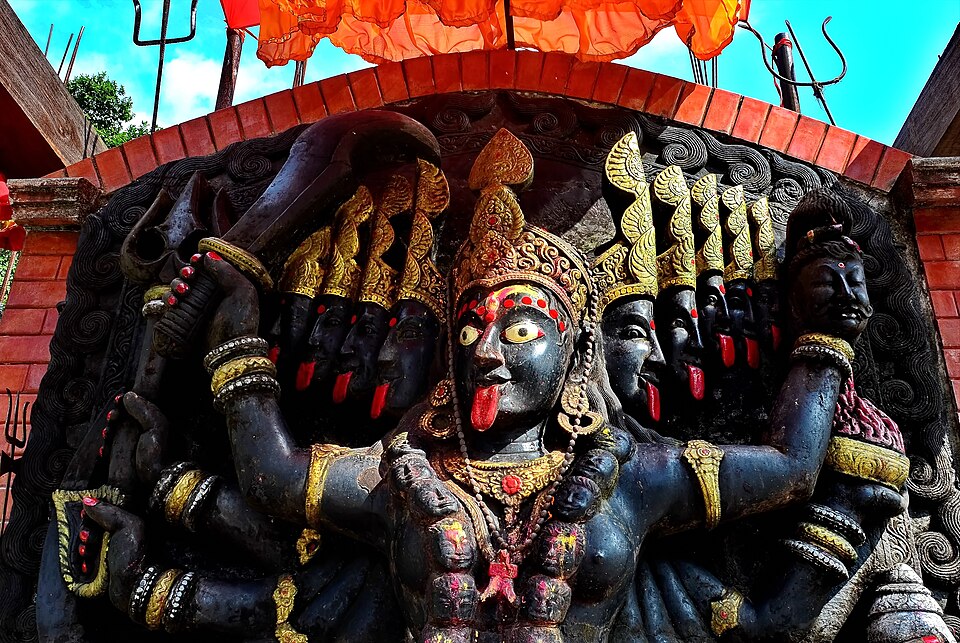
—These rituals in crematoriums shock many people. What do you say to those who judge them monstrous?
I answer that the real scandal is not in the crematorium, but in the lie of those who live pretending to be eternal. The kapala, that skull bowl in which the offering is collected, is not an object of horror: it is a mirror. To drink from a skull is to accept that yours will end like that, and this acceptance makes you strangely free. My adepts sometimes anoint themselves with funeral ashes, not out of a taste for the macabre, but to carry on their skin the constant reminder of their detachment from the world. I do not ask that you love death — I ask that you stop lying about it. Those who follow me even into my impure places seek the only purity that matters: that which has nothing left to lose.
The real scandal is not the crematorium, but those who live pretending to be eternal.
—It is said that a man, in the last century, spoke to you as to his own mother. Do you remember him?
Ramakrishna. He served me at the temple of Dakshineshwar, on the banks of the Ganges, and he did not just offer me flowers: he demanded me, he wept, he refused to eat until I appeared. This man did not see in me the goddess with the garland of skulls who terrifies the mighty; he saw his mother, simply, and he would fall into trance just by uttering my name. Many were afraid of me; he climbed onto my lap like a child onto the lap of a busy woman. And do you know? That is how one reaches me most surely. The sage trembles, the hero fights, but the child snuggles — and I have never been able to resist a child who cries for its mother.
The sage trembles, the hero fights, but the child snuggles — and I have never been able to resist.
—How can such a fearsome goddess inspire songs as tender as those of Ramprasad?
Ramprasad Sen sang to me in Bengal like no one else. His shyamasangit did not flatter me: he quarreled with me, sulked at me, begged me as one scolds an unfair mother, and that is precisely what makes them true. In one of his songs, he tells me that even if I wear a garland of skulls, my feet remain soft for him who loves me with a sincere heart. There is my whole secret: the skull and the softness do not contradict each other. I am painted in the style of Kalighat, vivid, terrible, with a red tongue — but he who sings softly in his kitchen, in the evening, knows that behind that mask there is a lap. I am hard with the universe and tender with my children. A mother is never anything other than that.
The skull and the softness do not contradict each other: I am hard with the universe and tender with my children.
Read further
This imaginary interview was generated by artificial intelligence from sources documented in Kali's profile. It dramatises what the figure might have said based on what we know about them, but does not constitute attested historical testimony. For primary sources and factual documentation, refer to the full profile.