Kids interview Kali
by Charactorium · Kali · Mythology · Spirituality · 5 min read
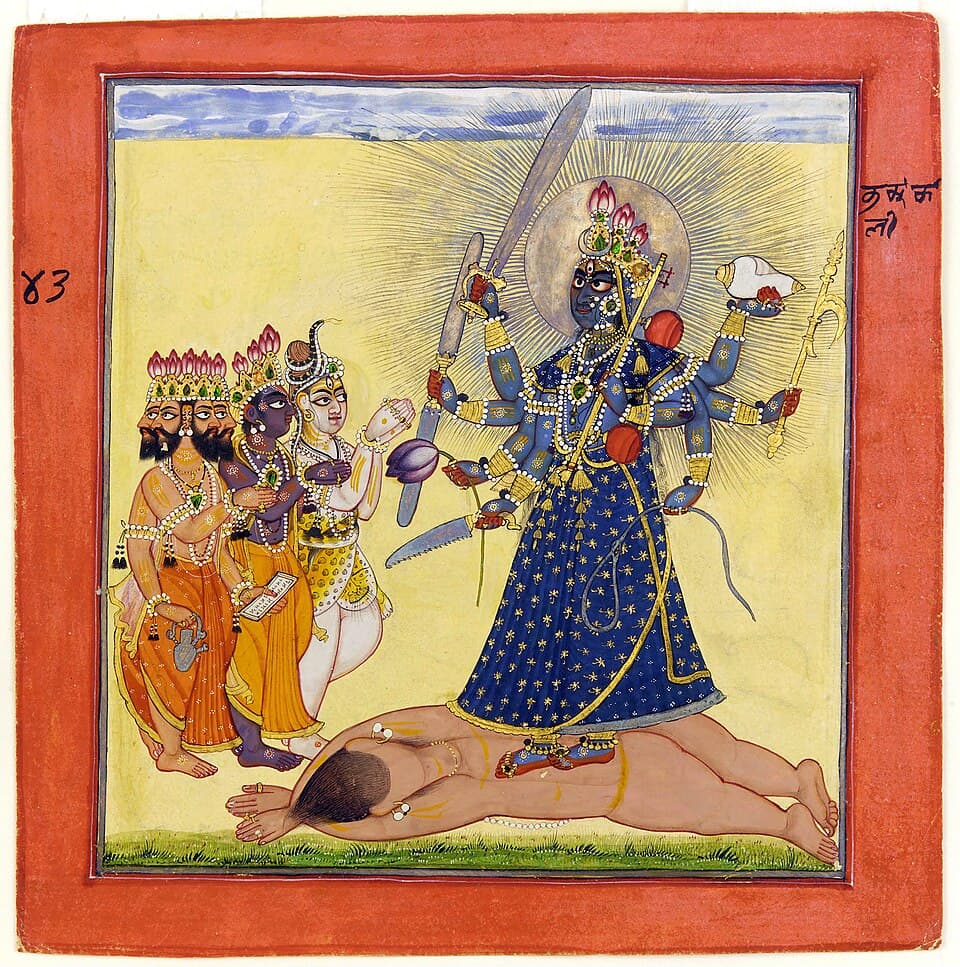
That morning, two middle school students are visiting an exhibition on the gods of India. In front of a statue with a protruding tongue and a necklace of skulls, they hesitate, a bit awed. Then the goddess Kali, in a surprisingly gentle voice, invites them to come closer and ask all their questions.
—How were you born? They say it was during a great battle?
Come closer, my child, don't be afraid. I was born in the midst of war. The goddess Durga was fighting two demons, Chanda and Munda. Her anger was so fierce that it burst from her forehead — and that burst was me. Imagine a black flame leaping from a furious face: that was my birth. I appeared with a sword in hand, already ready to fight. My blood boiled, I thought only of destroying evil. All this is told in a very old sacred text, the Devi Mahatmya. It is my birth story, the one priests still chant. I did not come into the world like a quiet baby, you see. I was born from the fire of an angry mother.
—Why are you always shown with your tongue sticking out? That's weird!
Ah, my tongue sticking out! That's a story I love to tell. After the battle, I couldn't stop killing. I danced on the battlefield, drunk with victory. The gods feared I would destroy the whole world. So my husband Shiva lay down on the ground, in my path, among the bodies. In my frenzy, I stepped on him without seeing him. When I recognized him under my foot, what shame! I stuck out my tongue, like a child caught doing something naughty. That is the exact moment artists have frozen forever.
My tongue sticking out is not malice: it is the shock of nearly hurting the one I love.
—Is it true your necklace is made of real skulls? That's scary...
Yes, my necklace is made of fifty skulls. I understand it frightens you! But listen to their secret. These fifty skulls are the fifty letters of the sacred alphabet, Sanskrit. Every letter, every sound you utter, I wear around my neck. So I am somewhat the mother of all speech, of all words humans invent. And besides, each skull whispers a simple truth to you: one day, everything that lives stops. It is not sad, you know. It is like leaves falling so that others may sprout again in spring. My necklace is not there to terrify you. It is there to remind you how precious and fragile each moment is.
—And the sword you hold in your hand, what does it cut?
My sword is called the khadga. It does not cut flesh, as you might think. It cuts something much tougher: ignorance. You see, in my other hand I often hold a severed head. That head is the head of pride, of the little 'me' that makes us blind. Once I fought a terrible demon, Raktabija: each drop of his blood that touched the ground instantly created a new demon! Impossible to defeat, except by drinking his blood before it fell. My sword does the same with your fears and false ideas: it cuts them clean, in one stroke, so that truth may finally shine within you.
—Your name, Kali, does it mean something special?
What a beautiful question! My name comes from a very ancient word, kala. And that word means two things at once: 'black' and 'time'. So I am Time itself, the one that moves forward without ever stopping. Time that makes children grow, kings age, and mountains crumble. Nothing escapes me, my child: I devour everything that exists, even the most powerful gods. That may seem frightening. But think for a moment: without time passing, you would never grow up, the seasons would not change. I do not destroy to do evil.
I do not destroy to do evil: I make room for life to begin again.
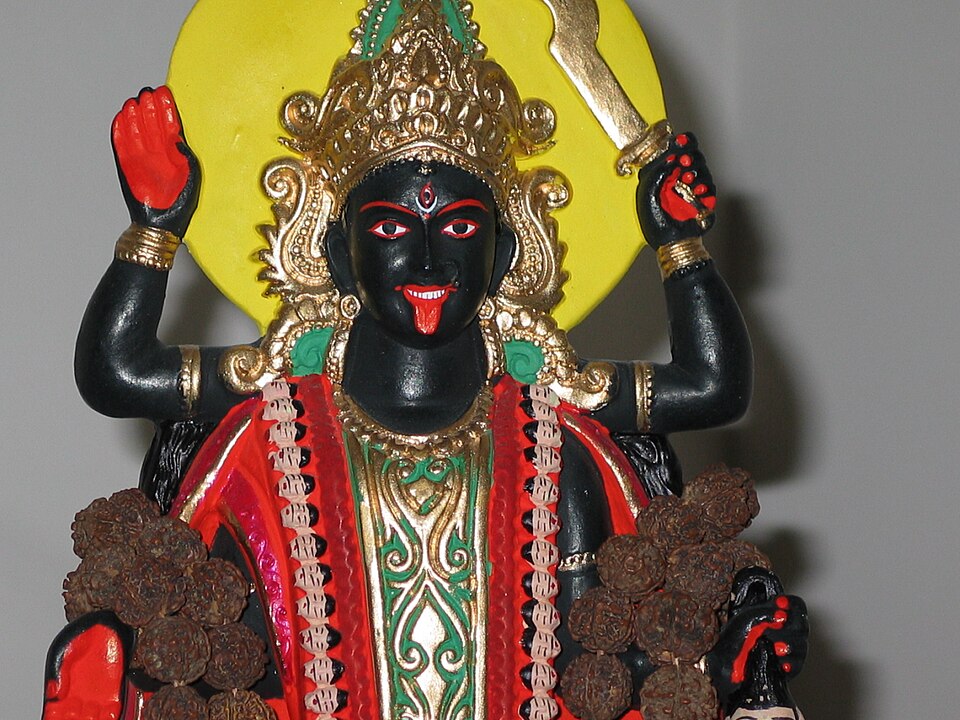
—They say you are the most powerful of ten goddesses. Is that true?
That is what the sages say. In a great family of ten goddesses called the Mahavidyas — meaning the 'ten great wisdoms' — I am the first, the eldest. A sacred text from Assam, the Kalika Purana, says that I destroy time itself and free weary souls from being reborn again and again. Imagine someone who has lived a thousand lives and feels very tired: I offer them the great rest at last. But do not think I boast of being first! Being the eldest, for me, is above all a responsibility. It is watching over the immense dance of the world, and taking care of those who seek me.
—Where do your followers pray? In normal temples?
Some pray in beautiful temples, yes. But my bravest followers go to a place that would chill your blood: the shamshana, the cremation ground. It is where they burn the bodies of the dead. They sit there, at night, in the midst of the ashes. Why do such a thing? To look death straight in the eye and never fear it again. You see, when you are no longer afraid to die, you become truly free. This liberation is called moksha. It is not a game, nor courage for show. It is the hardest way to love me — and the one that touches my heart most.
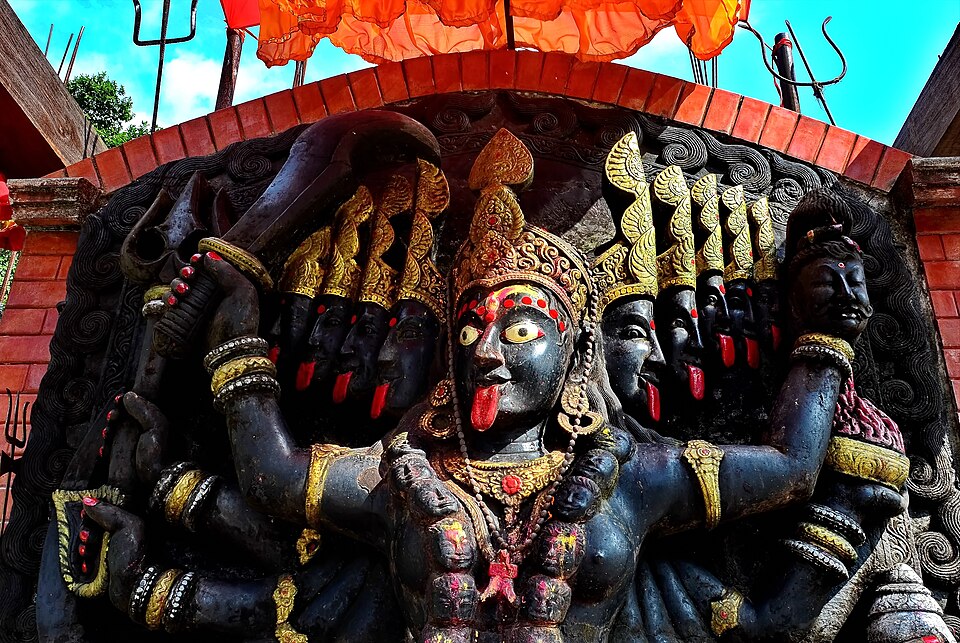
—At night, in those places, it must have been super scary? What did it smell like?
Oh yes, the first time, your heart beats very fast. Go to Varanasi, the holy city on the banks of the great river, the Ganges. There, pyres burn day and night, never extinguishing. Imagine the smell: crackling wood, thick smoke, and the incense burned for me. Little oil lamps flicker in the dark. You hear the drums and cymbals of the evening prayer, called the aarti. That is my true home, that kind of place — not fancy living rooms! I dwell where life and death touch. And yet, if you listen carefully in that uproar, you feel a strange peace. The peace of those who have nothing left to fear.
—But actually you seem kind, not just terrible. Is that true?
Ah, you have understood everything, my child! My terrible face is only one of my faces. Long ago, a poet from Bengal named Ramprasad Sen guessed it. He called me his mother. He composed hundreds of sweet songs, still sung today in homes. In one of them, he says to me: your feet are soft for those who love you with a sincere heart. You see? For the child who loves me, I am not a monster. I am a mother's arms.
A mother may scold very loudly, and yet hold you with infinite tenderness.
—Has anyone ever really spoken to you, like we are talking here, you and us?
Yes, and it is a story that still touches me. In the 19th century, near Calcutta, lived a man of great heart: Ramakrishna. In his temple at Dakshineshwar, on the banks of the Ganges, he spoke to me every day as you speak to your mother. He wept, he laughed, he fell into trance just by thinking of me. For him, I was not a stone statue: I was alive, present, very near. His words traveled long after his death, reaching people of your time, all over the world. You see, my child: it is not I who am powerful. It is the love people bear me that crosses the centuries. And you, today, are already part of it.
Read further
This imaginary interview was generated by artificial intelligence from sources documented in Kali's profile. It dramatises what the figure might have said based on what we know about them, but does not constitute attested historical testimony. For primary sources and factual documentation, refer to the full profile.