Imaginary interview with Leibniz
by Charactorium · Leibniz (1646 — 1716) · Philosophy · Sciences · 6 min read
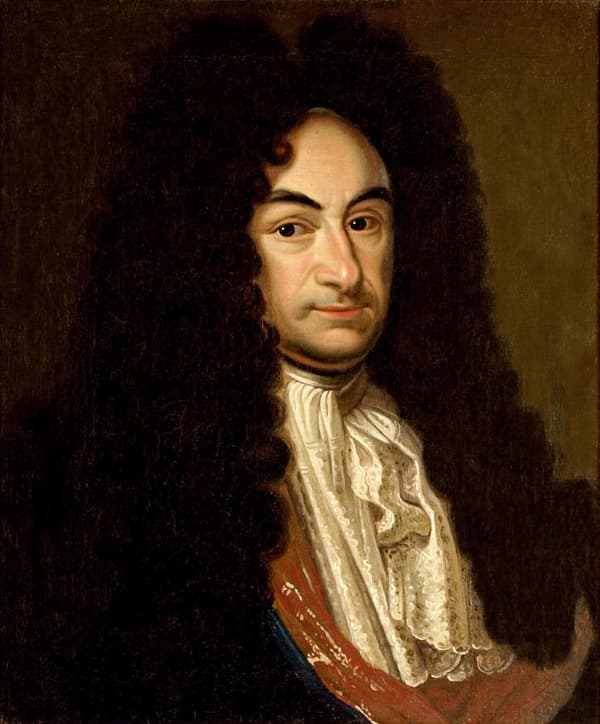
Hanover, autumn 1715. In a low room cluttered with loose sheets, a man in a large gray wig receives us, a quill still in hand. All around, bundles of letters pile up to the windows — remnants of a correspondence that spans all of Europe.
—There is much talk, even in London, about this quarrel over the invention of calculus. How did you experience it?
Like a wound that never heals. I developed my notation — that dx, that dy — as early as 1675, in Paris, and I presented it to the public in 1684 in the Acta Eruditorum of Leipzig, under the title Nova Methodus pro Maximis et Minimis. These are symbols that all of continental Europe writes today without even thinking. And now they tell me that I stole his method from Mr. Newton! He discovered his fluxions on his own, I do not deny it; but I discovered mine on my own. Two men can climb the same mountain by opposite slopes without having stolen each other's path. The English scholars have made it a matter of national pride rather than truth, and it will haunt me, I fear, to the grave.
Two men can climb the same mountain by opposite slopes without having stolen each other's path.
—You are currently exchanging bitter letters with Clarke, Newton's mouthpiece. What exactly are you arguing about?
Nothing less than the nature of space and time. Mr. Clarke, speaking for Newton, wants an absolute space, a kind of vast empty container where God placed the world like a piece of furniture in a room. I consider this a fantasy. Space is merely an order of coexisting things, time an order of successive things; remove the things, and no container remains. If nothing distinguished one point of space from another, why would God have placed the universe here rather than three feet away? Yet nothing happens without a sufficient reason. This correspondence exhausts me, but I will not yield an inch of ground to convenient ghosts.
—Your Theodicy affirms that we live in the best of all possible worlds. How can you maintain that in the face of so much suffering?
I am credited with a foolishness I never wrote. In my Essais de Théodicée, published in 1710 — the only major book I allowed to appear in my lifetime — I do not at all say that evil does not exist. I say that God, being perfect, chose among an infinity of possible worlds the one where good outweighs evil the most. I even coined the word theodicy, from the Greek theos and dikè, the justice of God, to name this task: to justify the Creator without lying to Him. A universe without any shadow would be a universe without freedom, and thus lesser. Evil is not a being, it is a privation, just as darkness is only the absence of light. Believe me, I know what the scoffers will one day make of it.
Evil is not a being, it is a privation, just as darkness is only the absence of light.
—You say you foresee mockery. Which ones do you fear?
Those of quick minds who will take my formula of the best of all possible worlds for a satisfied courtier's phrase, when it is the fruit of an austere reasoning on the principle of sufficient reason: nothing exists without there being a reason for its existence rather than another. I already see the jokester who, in the face of an earthquake or a plague, will throw my words back in my face as an insult. He will have an easy time, for it is easier to mock a thesis than to understand it. But let them read me to the end: I do not console the unfortunate by denying his pain, I only defend that the total order of the world exceeds in goodness everything that our narrow view can grasp.
—It is said that you built a machine capable of calculating on its own. What did you hope for from such an object?
To free men from slavery. I presented my arithmetic machine to the Paris Academy of Sciences around 1675: a mechanism of toothed wheels that adds, subtracts, multiplies, and divides without the mind having to wear itself out. It is unworthy, you see, that excellent men waste hours, like slaves, doing calculations that an instrument could do for them. Let the toil be given to the wheel, and leisure will be given to thought! This calculator is only half of my dream. The other half, vaster, would be a characteristica universalis: a writing of concepts so exact that, on the day of a dispute, two philosophers would only have to take up the pen and say to each other: let us calculate.
Let the toil be given to the wheel, and leisure will be given to thought!
—This universal language you dream of — what would it look like?
Like an algebra of reason. Imagine that one could assign to each simple notion a character, as geometers assign letters to magnitudes, and combine these characters according to rules as certain as those of calculation. The quarrels of theology, law, and morality, which spill so much ink and sometimes so much blood, would be no more than errors of computation, corrected with a stroke of the pen. That is the very spirit of my differential notation, that dx which says so much in so little, extended to all thought. They will find me fanciful, I know. But think what humanity would be if men disputed as one checks a multiplication: without anger, and with the certainty that at the end there is an answer.
—Let us return to your youth. What was that long stay in Paris, from 1672 to 1676, for you?
A second birth. I had come as a diplomat, tasked with diverting Louis XIV's ambition toward Egypt rather than our German lands — a mission that came to little. But Paris gave me far more than I sought. I met the finest minds in Europe, I immersed myself in Pascal's manuscripts, whose sheets on indivisibles opened dizzying perspectives to me. It was there, in that city buzzing with mathematics, that my calculus took shape and that my calculating machine found its audience at the Academy. I arrived a somewhat dabbling jurist; I left a geometer. When I finally had to go to Hanover to serve the Dukes of Brunswick, I left Paris like one tears oneself away from a home where one has learned to think.
I arrived a somewhat dabbling jurist; I left a geometer.
—On the way back, you stopped in The Hague to meet Spinoza. What remains of that conversation?
A disturbance I have never quite dispelled. In 1676, in The Hague, I spent several days with this man whose writings scandalized all of Christendom. We spoke of God, of substance, of the necessity of all things. His intelligence was of a frightening rigor, like a geometry applied to the soul. But where he saw only one substance, and a God merged with all of nature, without freedom or design, I could not follow him. For me, God chooses; He is not chained to His work like a blind cause. This conversation was a touchstone for me: in measuring my thought against his, I felt how much I held to a universe where divine wisdom deliberated, and did not merely unfold.
—You are said to be tireless, working all night. How do your days unfold here in Hanover?
Badly regulated, to tell the truth, for someone who loves order as I do. I sleep little, often in my armchair itself, and I wake with my head already full of what I will write. The day belongs to the Duke: audiences, legal consultations, care of the library, projects for the history of the House of Brunswick that I have dragged along like a ball and chain for years. But in the evening, when the court falls asleep, I finally belong to myself. By candlelight, I resume my mathematics, my metaphysics, my dreams of a universal language. I note everything on loose sheets that I pile around me, for I think by writing; my thoughts would be lost if my pen did not run to capture them. This quill has blackened, they say, more than fifteen thousand letters.
I think by writing; my thoughts would be lost if my pen did not run to capture them.
—You write to all of Europe, but about what exactly? Your subjects seem infinite.
That is my vice and my wealth. On the same day, I can write to a prince about a succession matter, to a mathematician about an infinite series, to a Jesuit missionary about Chinese characters, to a naturalist about the origin of mountains. Everything is connected, you see; law, theology, geology, languages are but windows opening onto the same edifice. My correspondents sometimes complain that I reply late — it is because the sheets pile up faster than I can sort them. They will reproach me for having published almost nothing, for having scattered my genius across a thousand drafts. Perhaps. But I have always preferred to think something new than to perfect something old, and all of Europe was my study.
—You speak of the grave without hesitation. How do you imagine you will be remembered?
With ingratitude, I fear, at least here. I have served the House of Hanover for decades, and I already feel that the court has tired of the old scholar who drags out his history of the Guelphs and neglects his duties for his speculations. On the day of my funeral, I wager no great lord will trouble himself, and I will be buried like a piece of cumbersome furniture. So be it. If I could imagine that I would still be read in a century, I would wish that they remember less the disgraced man than the signs he left: that dx on paper, that idea of a reason that calculates. Princes forget quickly; but a good notation, it does not die. It continues to think for those who use it.
A good notation does not die; it continues to think for those who use it.
Read further
This imaginary interview was generated by artificial intelligence from sources documented in Leibniz's profile. It dramatises what the figure might have said based on what we know about them, but does not constitute attested historical testimony. For primary sources and factual documentation, refer to the full profile.