Kids interview Leibniz
by Charactorium · Leibniz (1646 — 1716) · Philosophy · Sciences · 5 min read
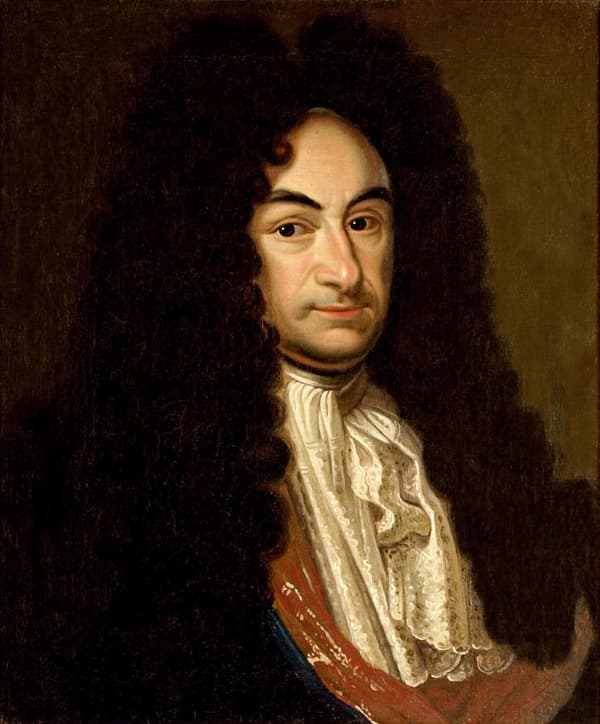
That morning, two young visitors of twelve years old pushed open the door of a study cluttered with books and papers. An old man with a large wig welcomed them with a smile: he was touched that children had come to listen to him. Gently, he invited them to sit down and ask all their questions.
—How old were you when you started reading big books?
You know, I was very small. My father had a large library in Leipzig, the city where I was born in 1646. I entered it like a forest of words. I devoured Aristotle, Descartes, everything I could get my hands on. Imagine a child alone, surrounded by books taller than himself, learning Latin almost without a teacher. Other children played outside; I wanted to understand how the world was made. That taste never left me. All my life, I had the same hunger: to read, to note, and to connect ideas together.
—And when did you sleep, if you worked all the time?
Not much, I admit! Often I dozed off in my armchair in the middle of the night. When an idea came to me, I quickly wrote it on a little sheet, then placed it around me. In the end, I was surrounded by mountains of papers! I wrote more than fifteen thousand letters to scholars all over Europe. Imagine a table covered with quills, inkwells, and overflowing drafts. The calm of the night was my best friend: no noise, just the candle. That's when my wildest thoughts came.
—Is it true that you built a calculating machine?
Yes! And I was as proud as can be. I presented it to the scholars of Paris in 1675. It was a box full of gears, capable of adding, subtracting, multiplying, and even dividing. In my time, calculating took hours and tired the eyes. I said to myself: why exhaust a great mind with boring accounts? A machine can do that for us. Imagine toothed wheels turning and delivering a correct result. I wanted to free scholars so they could dream and invent. A very simple idea, but it was dear to my heart.
Why exhaust a great mind with boring accounts?
—Why did you quarrel with Newton?
Ah, that quarrel... it hurt me, I admit. You see, Newton in England and I had discovered almost the same thing, each on our own: a new way to calculate very small variations. It's called infinitesimal calculus. But each wanted to be first. English scholars defended their man, ours defended me. Imagine two schools throwing stones at each other across the sea for years! We never reconciled, he and I, until death. It's sad, because deep down we had both found it.
—What was your way of writing calculations?
I invented little signs to write things simply. In 1675, I created the notation dx and dy — two letters to say "a very small difference." And a long S, the sign ∫, to add an infinity of tiny pieces. I published them in 1684 in a scholarly journal in Leipzig. You know what? Those signs are still written today, everywhere. Imagine: you draw a d and an x, and there you are speaking the same language as thousands of scholars. I was convinced that good writing makes thought easy.
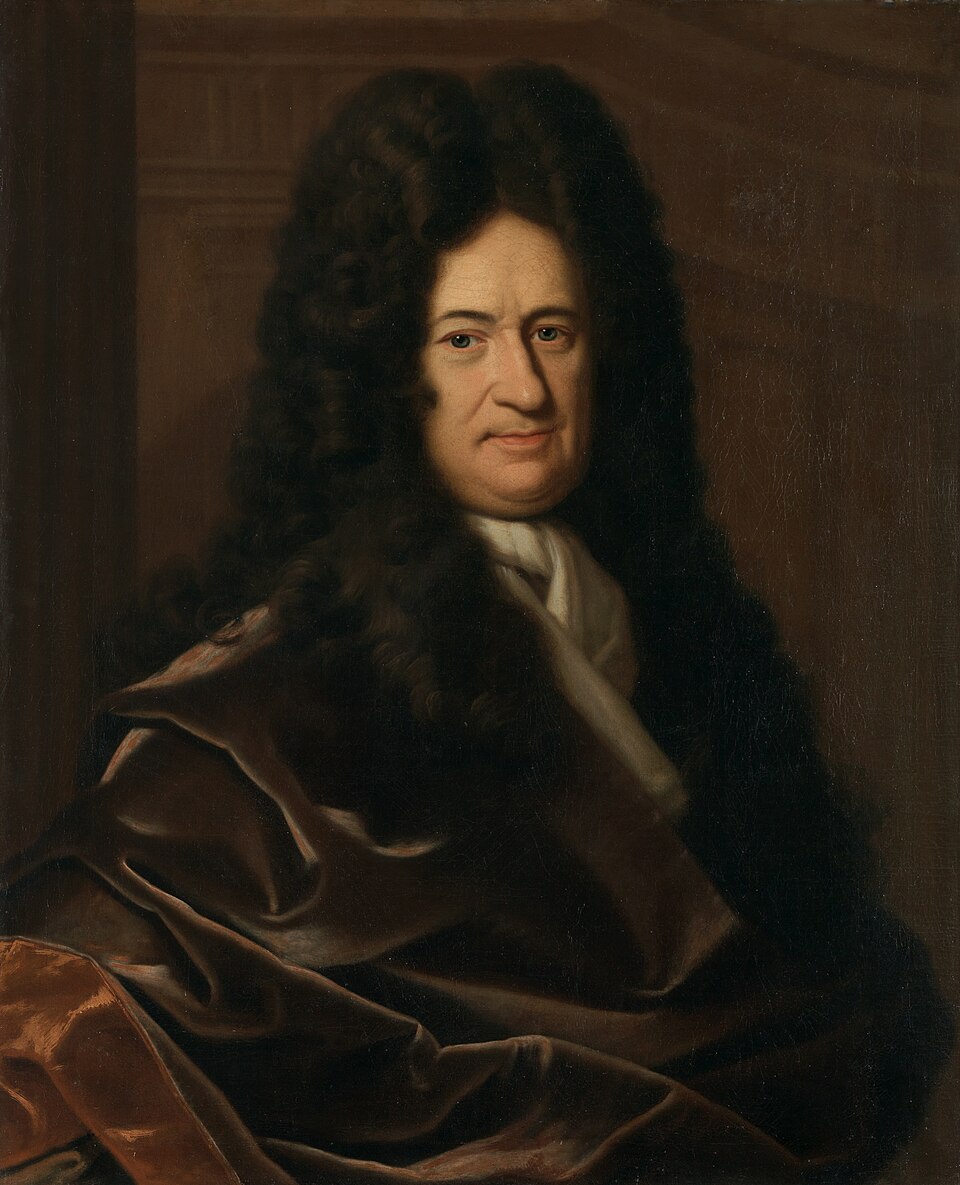
—You said the world is made of 'monads', what are they?
Good question, my child! Monads is a word I invented. Imagine that everything, absolutely everything, is made of tiny living grains, so small you can't cut them in two. Each one is like a little mirror that reflects the entire universe in its own way. I wrote all this in my Monadology, in 1714. And here's the strangest part: these grains have no windows. Nothing enters, nothing leaves. Each follows its own path, alone. And yet, everything fits together perfectly. It is my dearest idea, the one that resembles me the most.
—But then how do your body and mind communicate, without windows?
Ah, you ask the real question! I thought that the soul and the body are like two clocks. Imagine two beautiful watches set by a clockmaker so skillful that they always chime together, without ever touching. That's what I called pre-established harmony. God, the great clockmaker, tuned them from the beginning of the world. When you raise your arm, your soul wills it and your body does it — not because one pushes the other, but because they are tuned. I first explained this in 1695. A gentle idea, I think: everything is in harmony.
The soul and the body are two clocks that always chime together.
—If God is kind, why is there misfortune in the world?
That is the question that occupied me most. I answered it in my book Essays of Theodicy, in 1710 — the only major work I published in my lifetime. I even invented that word, theodicy: it combines the Greek for 'god' and 'justice.' My idea? God, who is perfect, looked at all possible worlds and chose the best. Not a world without any evil — that is impossible — but one where good wins most often. Imagine a painter who adds a shadow to make the light stand out. Misfortune exists, but the light prevails.
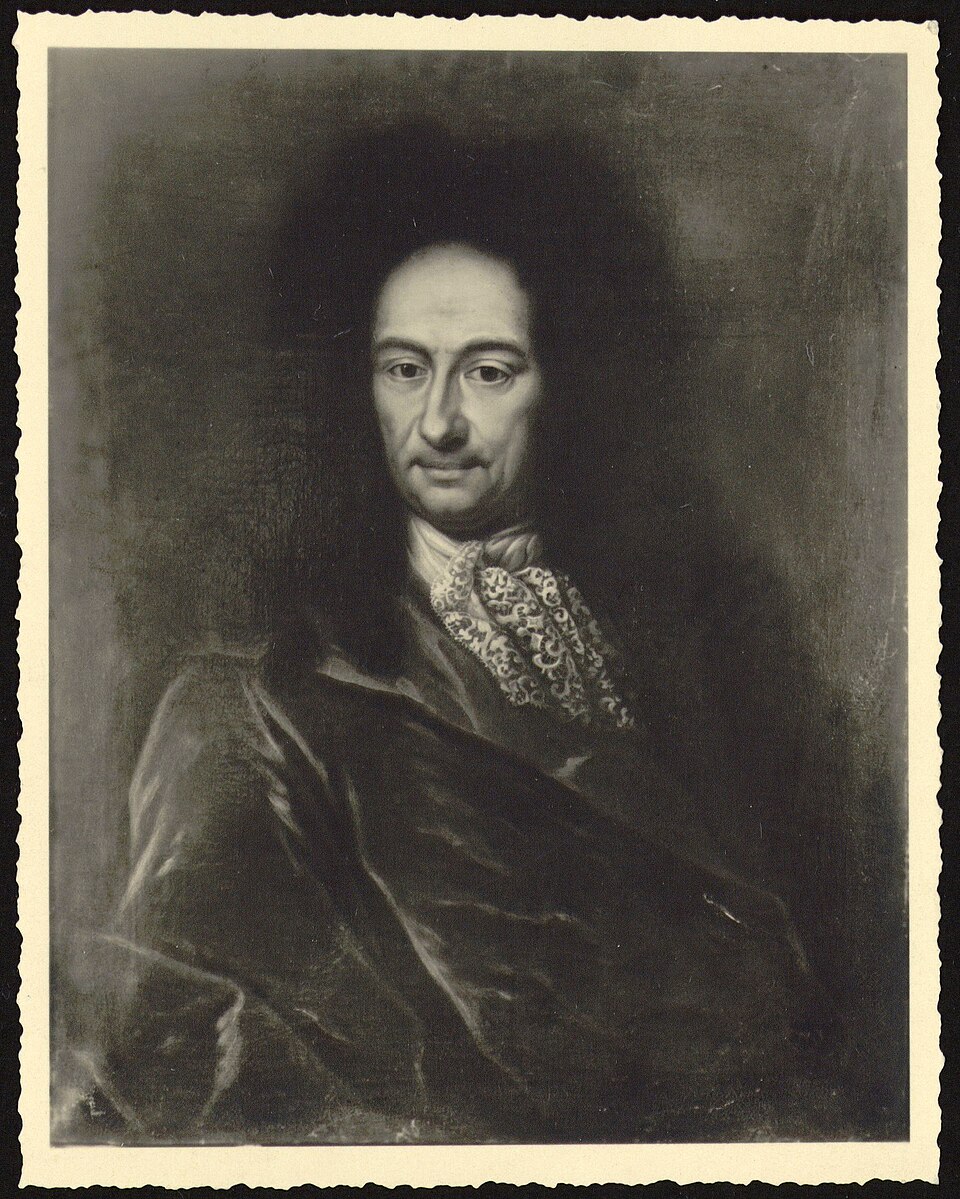
—Someone made fun of that idea, didn't they?
Oh yes! And not just anyone. A very clever French writer, Voltaire, found my 'best of all possible worlds' a bit too pretty. He wrote a story to mock it, where a poor boy repeats that everything is for the best while misfortunes rain down on him. I was no longer there to answer him, mind you. You know, I understand laughter. When you suffer, hearing 'this is the best of worlds' sounds bad. But I wasn't saying everything is rosy. I was saying that deep down, despite everything, the universe has meaning.
—Did you dream of a language that everyone would understand?
Yes, that was my greatest dream! I called it the characteristica universalis, a language made of logical signs. Imagine that, instead of arguing, two scholars in disagreement simply say: 'Let us calculate!' And hop, the calculation gives the answer, like for an addition. No more misunderstandings, no more squabbling. I never managed to finish that language: it was too big for a single life. But the idea traveled after me, and it helped, much later, to build modern logic. Sometimes, a dream too big sows seeds for centuries to come.
—Is it true that no one came to your funeral?
It is true, and it still pains me to tell you. I had served the Dukes of Hanover almost all my life, as librarian and counselor. I had traveled, founded an Academy in Berlin in 1700, written to all of Europe. And yet, when I died in 1716, no great lord came. I had fallen somewhat into disgrace, you see. Only one of my close ones followed my coffin. But you know what? My thousands of sheets survived. They are still kept in Hanover today.
The powerful forgot me quickly; my ideas are still here.
Read further
This imaginary interview was generated by artificial intelligence from sources documented in Leibniz's profile. It dramatises what the figure might have said based on what we know about them, but does not constitute attested historical testimony. For primary sources and factual documentation, refer to the full profile.