Imaginary interview with Madame de La Fayette
by Charactorium · Madame de La Fayette (1634 — 1693) · Literature · 6 min read

One winter evening, on Rue de Vaugirard, the candles burn low in the salon of the Comtesse de La Fayette. The last visitors have left; she consents, for once, to speak of herself rather than listen to others. Here is the imaginary interview of a woman who spent her life telling the truth of hearts without ever signing her own.
—How did a young girl from a good family find herself, barely out of childhood, introduced at court?
I was presented to Queen Anne of Austria in 1651, when I was not yet twenty and the Fronde still rumbled at the gates of Paris. As a lady-in-waiting, I spent my days observing more than appearing — I always preferred the corner of a window to the center of a room. It was Henriette d'Angleterre, the king's sister-in-law, who took me into her friendship and truly opened the doors of the court to me; I became her confidante, and later the keeper of her memory. Believe me, I learned there less the art of pleasing than that of watching: how a face betrays what a mouth conceals, how galanterie masks the coldest calculations. Everything I have since put into my books, I first saw there, in the silence of the antechambers.
—What happened, when evening came, in your salon on Rue de Vaugirard?
When night fell, the candles were lit in my townhouse on Rue de Vaugirard, and conversation began. Madame de Sévigné, whom I have loved since childhood, came with her letters and her laughter; one would meet learned abbés, poets, sometimes Racine or Boileau when they consented to set aside their pride. There we debated morality as much as news from Versailles. I did not keep a salon like one keeps a shop — I liked neither noise nor overdone préciosité. What I sought was a just word, a thought that illuminates without dazzling. Many pages of my novels were born from those evenings, from a remark dropped between two candles, which I kept within me to bring out again, transformed, under the pen of a character.
I did not keep a salon like one keeps a shop.
—Do you remember what your long friendship with La Rochefoucauld meant to you?
Of La Rochefoucauld, I will first say this: for nearly twenty years, we saw each other almost every day. It was not a passion — I was past the age of inclinations, and he past that of illusions — but something rarer, a shared intelligence. He would arrive in the afternoon, his copy of the Maxims sometimes under his arm, and we would read, correct each other, and argue. He found me too indulgent toward my heroines; I found him too severe toward the human heart. When he died, in 1680, I wrote to my friends that I no longer knew to whom to confide what occupied my mind. One loses a friend as one loses a part of one's own thought — the part that contradicted the other, and kept it awake.
One loses a friend as one loses a part of one's own thought.
—How did your friend's Maxims nourish your way of writing?
La Rochefoucauld believed that self-love hides behind our finest virtues, and that no feeling is entirely pure. I never wanted to write maxims — that dry stroke that closes a truth did not suit me — but I wanted to turn them into novels. Where he stated a maxim, I placed a woman in a room, torn between her duty and her inclination, and let the reader draw the lesson himself. On my table, near the quill pen, there was always some book of morals, most often his, those Maxims published in 1665 that I reread endlessly. My characters reason no better than real living people: they lie to themselves, they betray themselves, they believe they choose vertu when it is pride that leads them.
—Why did you imagine a woman confessing to her husband that she loves another?
Because it is the most extraordinary and the truest thing I could conceive. Consider: a virtuous woman, married to an honest man she esteems without loving, seized by an inclination she did not seek. What to do? Lie, like everyone at court? She chooses the confession — she tells the truth, at the risk of losing everything. I was reproached for this scene as improbable; I hold it, myself, to be the very heart of the book. La Princesse de Clèves appeared in 1678, set in the Valois court that I erected there as a mirror of our own. I open the novel with a beauty who appears and draws all eyes; but the entire drama is inward, in that struggle between a woman's gloire and her passion. Virtue, in my work, is never tranquil.
Virtue, in my work, is never tranquil.
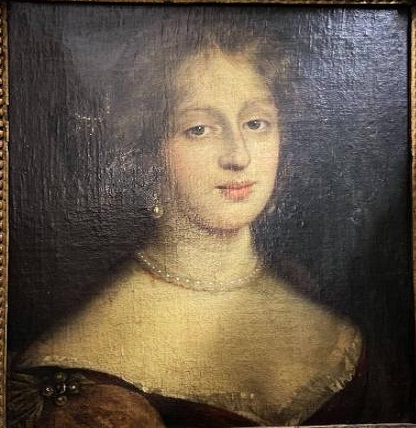
—How did the public debate that this scene sparked across Paris inspire you?
I did not expect that. The Mercure galant took it upon itself to consult its readers: was the princess right to confess her passion to her husband? And there was all Paris divided into two camps, the ladies against the gallants, debating a paper heroine as if a matter of state. Never had such a thing been seen for a novel. I confess a certain secret pleasure in seeing serious people quarrel over the conduct of a woman I had drawn from nothing. But the substance touched me more: if everyone was so inflamed, it was because the question was not about a novel, but about life. Bienséance commands silence; the heart, sometimes, demands to speak. My book only posed the question — society took it upon itself to answer, without ever agreeing.
—Why did you publish this novel without putting your name on it?
A woman of my rank does not sign a novel — it is not done, and I had no desire to flout convention. La Princesse de Clèves therefore appeared anonymously, in 1678, as La Princesse de Montpensier had sixteen years earlier, and as Zaïde had appeared under the name of Segrais. Writing was my most secret pleasure; to make it known would have spoiled it. And then there was gloire — not the kind one seeks, but the kind one fears: that I would be looked at differently, that people would seek in my heroines the confessions of my own heart. I always preferred that the book be talked about rather than the author. That my name floated in uncertainty did not displease me; it left the work alone, naked, to defend itself before the public.
I always preferred that the book be talked about rather than the author.
—Did you really deny being the author of La Princesse de Clèves?
I am credited with this novel, and no doubt rightly so. Yet, when I sent the little book to Lescheraine, secretary of Madame Royale de Savoie, in April 1678, I wrote him those words for which I am now reproached: “I do not acknowledge it as mine, and I find it too gallant and too full of things for me.” Was it coquetry, prudence, or truth? I leave you to judge. A woman learns early not to give herself entirely, to keep a door ajar through which to escape. To acknowledge the work was to expose myself; to half-deny it was to protect it and protect myself together. The curious, I am told, will debate it for a long time yet — let them debate. I wrote what I wanted to write; the rest no longer belongs to me.
A woman learns early not to give herself entirely.
—You also wrote about the court itself, not just novels — why?
Because I saw the court so closely that I would have been wrong to keep nothing of it. For my friend Henriette d'Angleterre, who died so young and so cruelly, I wrote her story — I wanted something other than rumor to remain of her. I said that her natural grandeur and majesty struck one immediately, without ever diminishing the sweetness of her manner. And later, in my Mémoires de la cour de France, I noted what I saw: that everyone sought to advance themselves, and that one counted only in proportion to the favors wrested from the king or his ministers. The novelist invents to tell the truth; the memoirist, for his part, is content to watch — but the gaze, too, chooses. At Versailles, I learned that power is a comedy in which no one fully knows his role.
The novelist invents to tell the truth; the memoirist is content to watch.
—What would you like to be remembered for, beyond your time?
That is a question that bienséance would almost forbid me to consider. But since you dare: I care little that my name be remembered, which matters little to me, but that the thing be remembered. That one can, in a novel, look into a woman's heart as one looks into one's own, and find the same struggles — that is what I wanted. In the evening, in my townhouse on Rue de Vaugirard, Madame de Sévigné told me that my books would last; I dared not believe her. If by some impossibility I were still read in a century, I would want people to see there, not the writer, but the truth of feeling — that part of us that hesitates, that resists, that sometimes confesses. The rest, the quarrels over my name, let it all turn to dust.
The confession of a soul, for its part, does not age.
Read further

This imaginary interview was generated by artificial intelligence from sources documented in Madame de La Fayette's profile. It dramatises what the figure might have said based on what we know about them, but does not constitute attested historical testimony. For primary sources and factual documentation, refer to the full profile.