Imaginary dialogue between Antonio Pigafetta and Magellan
by Charactorium · Magellan (1480 — 1521) · Exploration · 5 min read
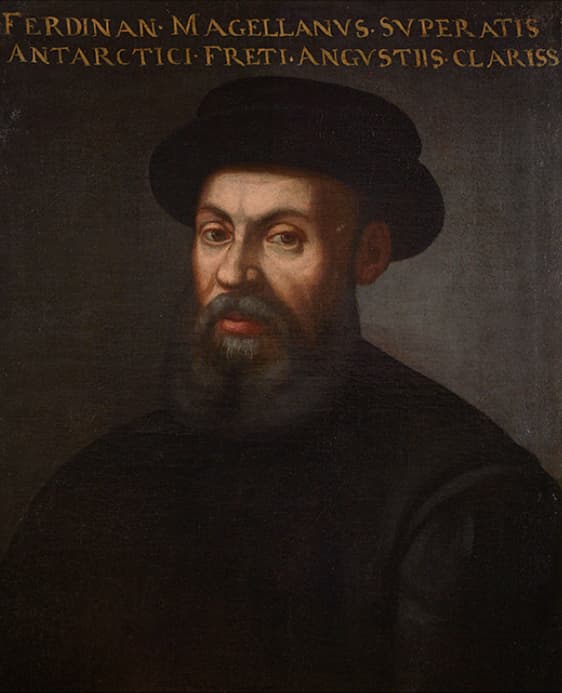
It is aboard the Victoria, in the warm dimness of the captain general's cabin, that I find Magellan in this month of March 1521, as the Philippines finally appear on the horizon after crossing the Pacific hell. The smell of damp wood and tallow mingles with the creaking of the yards, and the candle trembles over the spread-out charts. I, Antonio Pigafetta, who record each day the wonders of this voyage since Sanlúcar, come seeking the man behind the commander. He receives me with that gravity he maintains even in the joy of having survived.
—Captain, you who welcomed me in Seville before the departure, tell me: how does a gentleman of Portugal come to serve the crown of Castile?
Antonio, you who saw me fold my charts in the room in Seville, you can guess what it cost me. I served my king of Portugal for years, all the way to the Indies and Malacca, and I was repaid with an infamous accusation: illicit trade with the Moors. They sullied my honor without proof, they closed all doors in Lisbon to me. A man wounded in his name does not beg twice. I took my project to the young Charles I, who embraced it in 1518. It was not treason, but necessity: my land had renounced me, I offered my knowledge to whoever would hear it.
A man wounded in his name does not beg twice.
—You have often spoken to me of the Spice Islands during the long watches. Why risk so much to reach the Moluccas by the west, defying the partition of Tordesillas?
Because Portugal holds the eastern route as one holds a fortress, and the line drawn at Tordesillas in 1494 leaves a door open through the west. I saw with my own eyes, in Malacca, cloves and nutmeg worth more than gold in the holds. If we can reach those islands by rounding America, then they may fall under the obedience of Castile, without ever crossing a Portuguese ship. You who record our accounts, you know that this entire voyage rests on that idea: an unknown sea is better than a road guarded by the enemy.
An unknown sea is better than a road guarded by the enemy.
—At Port Saint-Julien, I saw your captains rise against you. How does a Portuguese command a fleet of Spaniards who secretly hate him?
You saw rightly, Antonio, and you saw the worst. In that icy Patagonian bay, my own Castilian captains thought a foreigner could not lead them to death in winter. They armed the revolt. I had to strike, and strike hard: the ringleaders paid with their heads. Believe me, nothing is heavier than punishing the men you lead. But a leader who hesitates on the deck loses the entire fleet. The solitude of foreign command is a burden no king rewards; I was entrusted with ships only to be solely responsible for them.
Nothing is heavier than punishing the men you lead.
—When we finally passed through the southern strait, after thirty-eight days of anguish, what did you feel seeing that long-sought passage open before us?
I wept, Antonio, and I do not hide it from you who were near me. So many men swore that this passage did not exist, that I was leading the fleet to its doom at the edge of the inhabited world. Thirty-eight days in those black waters, between mountains of ice and fires burning on the southern shores. When the Concepción reported that the sea finally opened to the west, I knew that God had not willed my shame. A deserter fled to Spain with a ship, but the strait was there, real, and no one can deny it anymore.
So many men swore that this passage led the fleet to its doom at the edge of the world.
—You named that sea mar pacifico. But you, my captain, know as I do what we endured during those long months. Was the name well chosen?
The name describes the first impression, not the truth, Antonio. After the storms of the strait, those waters seemed supernaturally calm to me, and I called it a peaceful sea. God forgive me that lightness. Nearly four months without land, without fresh fruit. You wrote it better than I: the biscuit reduced to powder and full of worms, smelling of rat urine. The men ate the leather from the yards soaked in seawater, and rats sold for half a ducat. Scurvy consumed gums and life. Peaceful for the waves, perhaps; for our bodies, it was purgatory.
Peaceful for the waves, perhaps; for our bodies, it was purgatory.
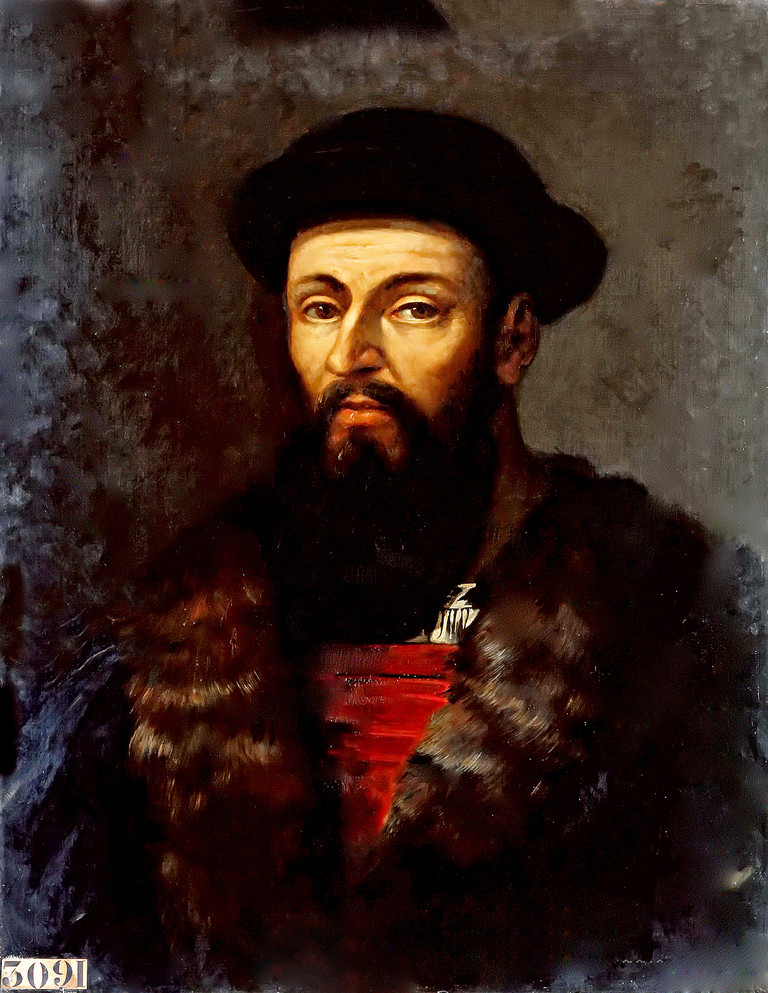
—During that crossing, you saw so many men die. How did you sustain your soul and that of the crew when the horizon remained desperately empty?
I rose before dawn, as always, to consult the astrolabe and the compass, for a leader who maintains his composure maintains his men. But deep inside, I counted the days and the dead. I learned that hunger erodes discipline before it erodes bodies: a starving crew doubts its course as much as its bread. So I showed them the charts, I swore that Asia was near, that the Spices awaited us. You wrote our miseries for the memory of men; I had to hide mine so that the fleet would not sink into despair. Faith and obstinacy were my only provisions.
A starving crew doubts its course as much as its bread.
—You had sailed as far as Malacca in the service of Portugal. What did that first Asia teach you that you still carry within you today?
Everything, Antonio. Between 1505 and 1512, I fought and traded in the Indies and Malacca, and there I saw the heart of the mercantile world. I understood that spices do not grow everywhere, but in a handful of islands that the Portuguese covet like treasure. I learned the winds, the routes, the exact value of a quintal of cloves. It was there, too, that I took Enrique, my slave from Malacca, who speaks the languages of those seas. Without that first Asia, I would never have dared promise a king that one could reach it from the other side of the Earth.
I understood that spices grow only in a handful of islands coveted like treasure.
—That Enrique who has served as our interpreter since we arrived in these islands seems to understand the language of the inhabitants. What do you make of that, captain?
It troubles me, I admit. Enrique followed me from Malacca to Europe, then all around the Earth by the west. And now in these islands, the local people answer him as to a brother. Think of this wonder, Antonio: a man who left the East with me, who has circled the entire globe, finds his mother tongue at the end of the voyage. If these islands touch the Malay world he left, then the loop of the Earth closes here, before our eyes. A slave may have girdled the globe before any prince or captain. God delights in such ironies.
A slave may have girdled the globe before any prince or captain.
—You are about to support chief Humabon against Lapulapu, at Mactan. Why risk your person in a quarrel that is not ours, captain?
Because an alliance is only worth if it is paid in blood, Antonio. Humabon converted to Christianity, gave us food and friendship; betraying him would lose all credit with these peoples. By striking Lapulapu of Mactan, I show our allies the strength of Spain and the Cross. I will go with only a handful of men, because I want them to see that a few Christians are worth an army. You find me imprudent, I read it on your chronicler's face. But a captain who spares himself loses the soul of those who follow him. What I promised Humabon, I will keep in person.
I want them to see that a few Christians are worth an army.
—And if fortune abandons you on that shore, captain — if you are not to see the Moluccas or the return, what would you have my pen remember of you?
Hush that omen, Antonio, and yet I want to answer you. If I fall before the completion, let your pen say this: a man sought a passage that no one believed in, and he found it. The rest belongs to those who survive — to you, to Elcano perhaps, to those sailors who will bring back the spices and the proof that the Earth is round and entirely navigable. Little matters the name carved at the end of the voyage. I opened the road; others will close it. Write only that I never retreated before the sea, and that will suffice for eternity.
I opened the road; others will close it.
Read further
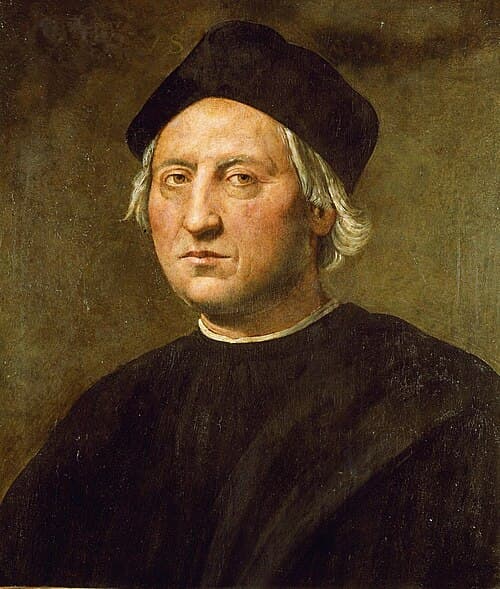
This imaginary interview was generated by artificial intelligence from sources documented in Magellan's profile. It dramatises what the figure might have said based on what we know about them, but does not constitute attested historical testimony. For primary sources and factual documentation, refer to the full profile.