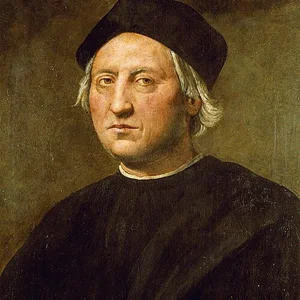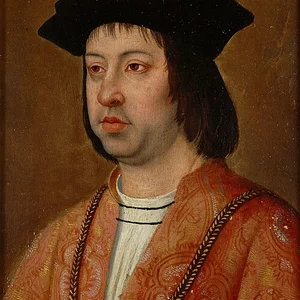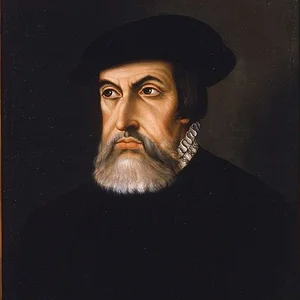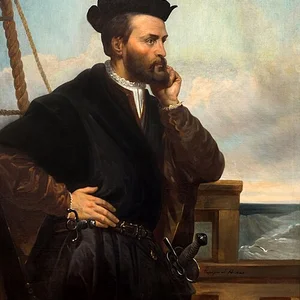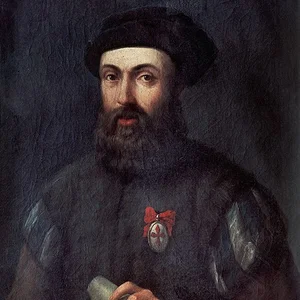

Portuguese navigator and explorer in the service of Spain (1480–1521). Magellan organized the first expedition to complete the circumnavigation of the globe, proving the true extent of the Earth and the existence of a passage to the Pacific Ocean. He died in the Philippines in 1521, but his voyage revolutionized European geographical knowledge.
Magellan(1480 — 1521)
Ferdinand Magellan
royaume de Portugal
7 min read
Frequently asked questions
Key Facts
- 1480: Born in Portugal
- 1505–1515: Takes part in several Portuguese expeditions to Asia and Africa
- 1517: Enters the service of the Spanish Crown following a dispute with the King of Portugal
- 1519–1522: Organizes the circumnavigation expedition; he dies in the Philippines in April 1521 before its completion
- 1522: The expedition returns to Spain, completing the first voyage around the world
Works & Achievements
Although he did not survive to complete it, Magellan organized and led the expedition that demonstrated for the first time that the Earth could be circumnavigated by sea, revolutionizing world geography and cosmography.
Magellan discovered the maritime passage connecting the Atlantic to the Pacific south of America, opening a new route to Asia independent of the areas controlled by Portugal.
Upon entering the Pacific through the southern strait, Magellan became the first European to sail this ocean from the American coastline, estimating its immense dimensions after a crossing of 98 days.
Before his great voyage, Magellan took part in Portuguese military and commercial campaigns in Malacca and the Indies, gaining firsthand knowledge of Asian maritime routes and the Spice Islands.
Magellan convinced the King of Spain of the geopolitical merits of reaching the Moluccas from the west to bypass the Portuguese monopoly, leading to the Capitulation of Valladolid in 1518.
Anecdotes
Magellan had served the King of Portugal for years, but after being falsely accused of illicit trade with the Moors, he fell out of favor. Wounded in his honor, he renounced his Portuguese nationality and proposed his circumnavigation project to the young King of Spain Charles I, who accepted with enthusiasm in 1518.
The name 'Pacific' was given by Magellan himself to the ocean he crossed in November 1520. After the violent storms of the southern strait that now bears his name, he was struck by the extraordinary calm of those waters and exclaimed that it was a 'mar pacifico', a peaceful sea.
During the crossing of the Pacific, the crew suffered horribly from hunger and scurvy for nearly four months without finding provisions. The men were forced to eat the leather of the yardarms, the ship's rats, and sawdust mixed with seawater to survive.
Magellan died on April 27, 1521 in the Philippines, during the Battle of Mactan, while attempting to impress his local allies by attacking the chief Lapulapu with only 49 men. He was killed by Philippine warriors and his body was never recovered. It was his captain Elcano who completed the circumnavigation of the globe.
On board the expedition was a Malay man named Enrique, Magellan's slave interpreter. When the fleet reached the Philippines, Enrique was able to communicate with the local inhabitants in his own language. Some historians consider him to have been the first human being to truly complete a circumnavigation of the world.
Primary Sources
We sailed in the Pacific Sea for three months and twenty days without tasting any fresh food. We ate biscuit reduced to powder and full of worms, which smelled strongly of rat urine.
The Catholic Monarchs and the King of Portugal agreed upon a demarcation line drawn from the Arctic Pole to the Antarctic Pole, three hundred and seventy leagues west of the Cape Verde Islands.
We, Charles I, grant to Ferdinand Magellan and Ruy Faleiro the grace of discovering within the limits of our dominion the lands and islands as well as the spices found therein.
The captain-general Magellan, in dying, had accomplished such great things that his renown shall remain immortal. He was more valiant than any other navigator of the past or the future.
Key Places
Andalusian port from which Magellan set sail on September 20, 1519 with his fleet of five ships. It was also there that Elcano's Victoria returned three years later, completing the first circumnavigation of the globe.
Maritime passage at the southern tip of South America, discovered and navigated by Magellan in November 1520 over 38 days. Stretching 560 km long, it is today named after him in tribute to this landmark discovery.
Archipelago where Magellan forged alliances with the chieftain Humabon and where he met his death during the Battle of Mactan on April 27, 1521. This is where the explorer's personal journey came to an end.
The expedition's final destination, these islands were the heart of the global spice trade (cloves, nutmeg). The surviving crew loaded a precious cargo there before returning to Spain.
Patagonian bay where the fleet wintered from March to August 1520. Magellan suppressed a mutiny by the Spanish captains there and encountered the first Patagonians, indigenous peoples of remarkable stature who fascinated the Europeans.
Typical Objects

A brass navigation instrument used to measure the altitude of celestial bodies in order to determine latitude at sea. Magellan and his pilots used it daily to find their bearings in uncharted waters.

A casing containing a magnetic needle pointing north, essential for open-sea navigation. It allowed Magellan to maintain a heading during long ocean crossings out of sight of the coast.

A medieval and Renaissance nautical chart drawn on calfskin, depicting coastlines with their ports and rhumb lines. Magellan's portolan charts were partially inaccurate for the Pacific, which was then entirely unknown to Europeans.

An instrument measuring time at sea through the flow of sand, typically set to half an hour. Lookouts used it to estimate the ship's speed using the log-line technique.

A sturdy three-masted ship type used for major Atlantic explorations. Magellan's five vessels were Spanish naos of approximately 80 to 130 tons, suited for long voyages on the open sea.

Commodities of extraordinary value in Europe, the source of the wealth of Arab and Venetian merchants. It was to reach the Spice Islands directly by sailing westward around the Americas that Magellan undertook his voyage.
School Curriculum
Vocabulary & Tags
Key Vocabulary
Tags
Époque
Daily Life
Morning
Magellan rises before dawn, as was customary for navigators of his era. He consults nautical charts, astrolabes, and navigation instruments in his study, while receiving reports from his officers and planning trade routes or expeditions.
Afternoon
The afternoon is devoted to administrative and diplomatic tasks: correspondence with sovereigns, negotiations for voyage funding, and discussions with merchants, cartographers, and other navigators. He also oversees ship preparations and expedition provisioning.
Evening
In the evening, Magellan dines modestly according to Portuguese and Spanish Renaissance customs. He spends time studying navigation texts, accounts of previous voyages, and personal correspondence with influential figures at the royal court.
Food
His diet consists of bread, roasted or boiled meats, fresh or salted fish (depending on the season and location), fruits, and vegetables. As a man of high social standing, he has access to exotic spices, wine, and imported cheeses.
Clothing
Magellan wears the typical attire of a Portuguese gentleman of the early 16th century: a fitted doublet, hose, a cape or cloak, and a beret-style hat. At sea, he adopts more practical clothing suited to the climate and sailing conditions.
Housing
As a Portuguese nobleman in the service of the Spanish crown, Magellan lives in comfortable urban residences in Lisbon and Seville, equipped with studies for his navigation work. His lodgings reflect his social status, with access to libraries of maps and scientific instruments.
Historical Timeline
Period Vocabulary
Visual Style
Style Renaissance maritime, mêlant la peinture flamande et l'illustration cartographique portugaise du XVIe siècle, avec des tonalités dorées, des bleus profonds et des contrastes dramatiques évoquant l'aventure des mers inconnues.
Sound Ambience
Ambiance sonore d'un navire de la Renaissance en haute mer, mêlant les bruits du bois et des voiles aux voix des marins portugais et espagnols, des tempêtes australes au silence oppressant du Pacifique.
Liens externes & ressources
Références
Œuvres
Première circumnavigation du globe (1519-1522)
1519-1522
Découverte et franchissement du détroit de Magellan
Octobre-novembre 1520
Découverte européenne de l'océan Pacifique depuis l'Amérique du Sud
Novembre 1520
Participation aux expéditions portugaises en Asie du Sud-Est
1505-1512
Proposition du projet de circumnavigation à Charles Ier d'Espagne
1517-1518