Imaginary interview with Mansa Musa
by Charactorium · Mansa Musa (1280 — 1337) · Politics · Economics · Spirituality · 6 min read
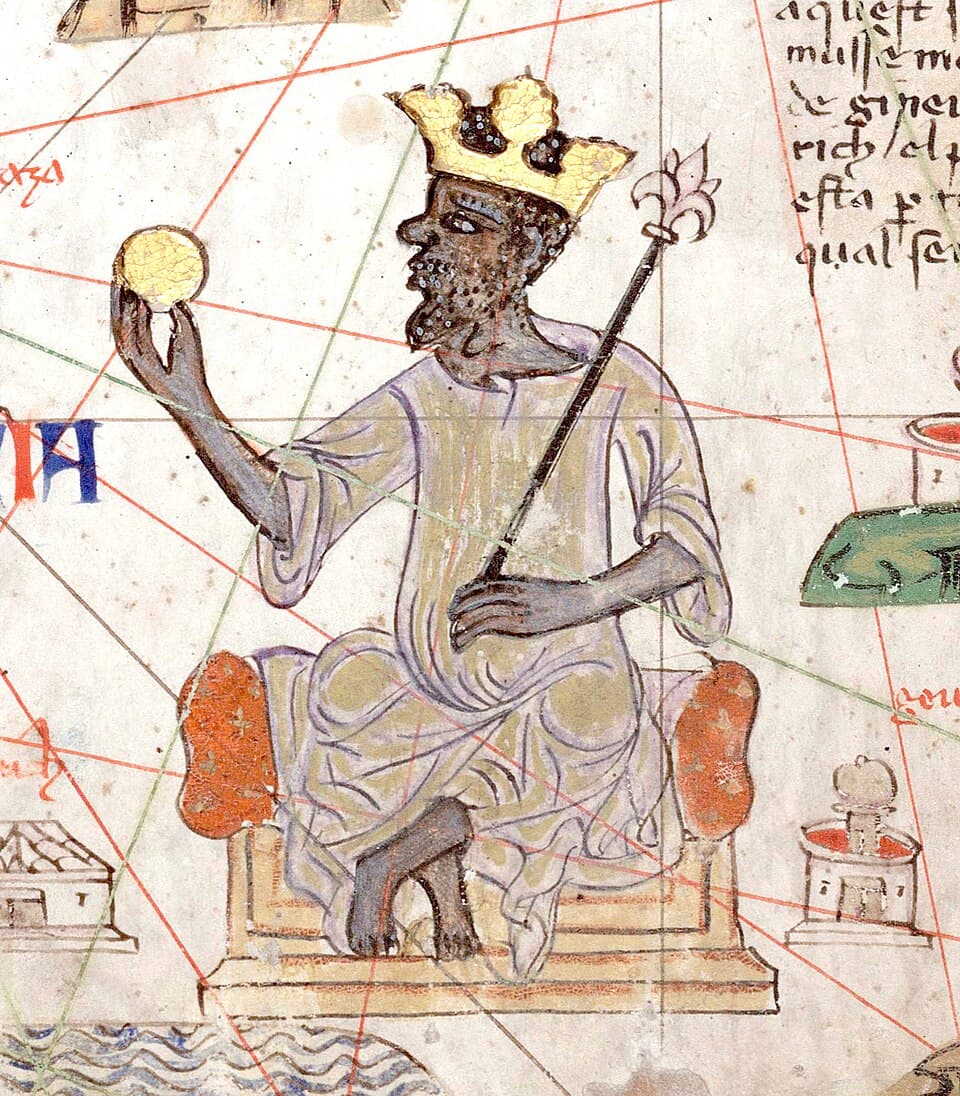
We meet Mansa Moussa in the great courtyard of the Djinguereber Mosque in Timbuktu, its banco walls still faintly warm from the Saharan afternoon. Around us, scholars in white robes pass between lesson circles, and from the direction of the Niger a caravan is entering the city. It is perhaps 1330, three years after the mosque's completion, and the emperor of Mali — at the apex of his reign — speaks with the unhurried deliberateness of a man who has crossed the Sahara and returned knowing precisely what he built and why.
—Your days begin before the muezzin calls — what does that first hour of the morning tell us about how an empire of a million square leagues is actually governed?
I wake before the sun touches the Niger, and the first act of that waking is prayer. Fajr is not merely devotion; it is the hinge on which all authority turns. A mansa who does not kneel before God cannot ask others to kneel before him. After prayer, the reports arrive: a farin from the eastern territories with news of tribute collected at Gao, another from the salt roads near Taghaza with word of a delayed caravan. The palace at Niani fills early with voices — military governors, heads of trading clans, sometimes an ulama who spent the night wrestling with a difficult passage of Islamic law. I do not rule alone from a great chair. I rule through a thousand hands that trust the one pair at the center, and the discipline of those hands begins here, before dawn, in silence.
—What compelled you to undertake the Hajj — was it faith alone, or did you also understand the journey as something the world would be watching?
The Hajj is a pillar of the faith, not a deliberation one enters or exits. For a sovereign, however, the question of when and how carries a weight I cannot entirely govern. By 1324, the empire was at peace — the routes secured, the farins trusted, the harvests sound. I had waited seventeen years on the throne before I judged I could leave without inviting catastrophe at home. But I will not deceive you: a mansa who crosses the Sahara with sixty thousand souls is also saying something to every sultan and merchant who will one day hear the story. I did not manufacture that audience — it was already assembled, listening. I simply chose to walk toward it with the full weight of Mali at my back. And every Friday on that road, we halted and raised a mosque, because worship does not pause for travel, not even across a thousand leagues of sand.
Worship does not pause for travel, not even across a thousand leagues of sand.
—When your caravan reached Cairo and your distribution of gold destabilized the metal's price across the eastern Mediterranean for years afterward — did any part of you foresee that consequence?
No man alive could have foreseen it, and I will tell you why: we ourselves could barely count what we carried. The gold came from Bure, from Bambuk, from tributaries so deep in the forest that their names barely reached my court. When I met the sultan Al-Nasir Muhammad in Cairo with the full protocol his rank deserved, the gifts flowed as they must between sovereigns of equal standing — naturally, abundantly. I did not set out to weaken the markets of Egypt and Syria. Yet accounts gathered later suggest the price of gold remained depressed for more than a decade across the region. I have turned that fact over many times. It tells you less about my generosity than about the astonishing distance between what the world north of the Sahara imagined Mali to be, and what it actually was.
—Gold made your empire famous, but your chronicles speak equally of salt. How did those two commodities fit together in the architecture of your power?
Gold and salt are not two things — they are two halves of a single mechanism. The mines of Bure give us wealth the northern world can see and covet; the mines of Taghaza, deep in the Sahara, give us something the southern world cannot live without. Salt is more intimate than gold. A man can die of salt-hunger long before he ever feels the absence of gold. The Wangara merchants — those Dyula traders who threaded their way across my empire — carried both commodities in opposite directions, and every transaction strengthened my treasury. I secured the routes, posted soldiers along the most dangerous crossings, negotiated with the Tuareg clans whose cooperation no caravan could do without. Control the salt and you feed the people; control the gold and you build the mosques and pay the scholars. Together they are the two hands of empire.
Salt is more intimate than gold. A man can die of salt-hunger long before he ever feels the absence of gold.
—You brought Es-Saheli back from Arabia — a poet and architect who had never seen a Sahelian city. What did you ask him to build, and why did that matter to you?
Abu Ishaq al-Sahili was not merely an architect; he was a man who understood that a building can carry a sentence longer than any decree. When I returned from Mecca in 1326, I knew that Tombouctou needed a mosque that would announce, in its very walls, that this empire belonged among the great civilizations of the world. The banco — red earth mixed with water and straw — is not a lesser material than stone; it is the material of our soil, and Es-Saheli learned to make it speak differently. The Djinguereber Mosque was completed in 1327, and I watched it rise knowing that Friday prayers there would draw scholars and pilgrims from distances I would never travel myself. A ruler's true reach is not measured by armies but by the buildings that stand long after him.
A ruler's true reach is not measured by armies but by the buildings that stand long after him.
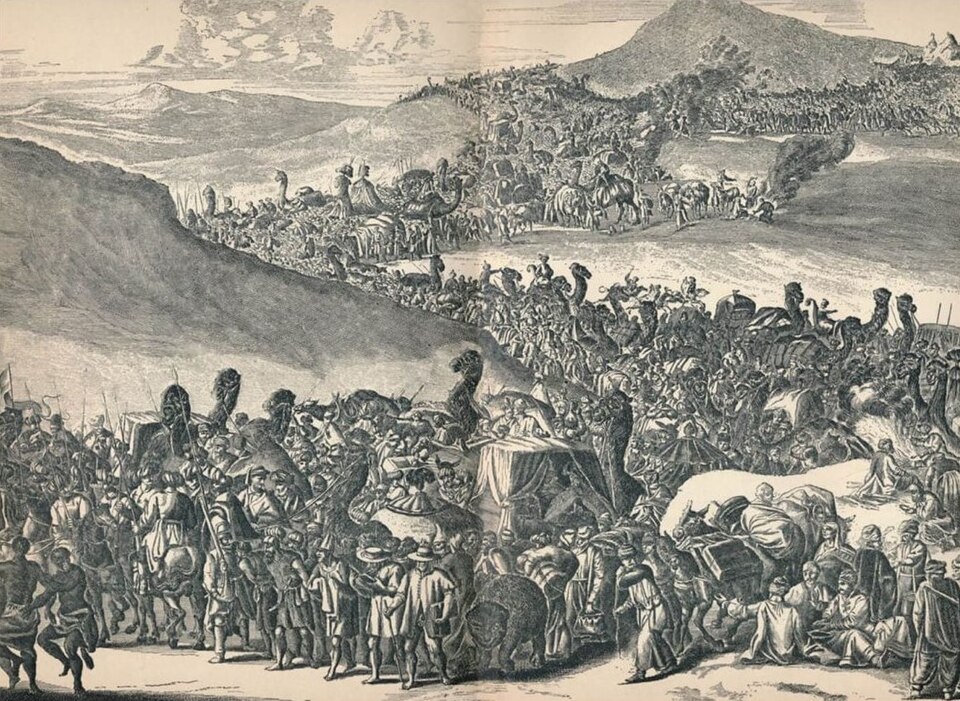
—Sankore drew students from Arabia, Andalusia, and Egypt — twenty-five thousand at its peak, some accounts say. What did you hope that concentration of learning would accomplish for Mali?
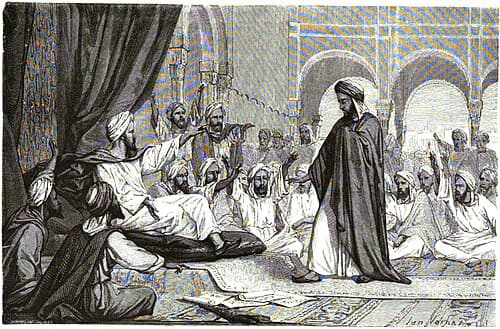
Knowledge and power are not enemies, as some rulers believe — they are the same river seen at different points. At Sankoré, the ulamas taught theology and jurisprudence, but also mathematics, astronomy, medicine, the calculation of flood seasons. A man who understands Islamic law can administer a province; a man who reads the stars can anticipate the rains on which the millet harvest depends. I encouraged scholars to gather in Tombouctou because an empire held only by armies dissolves when those armies lose. An empire sustained by learning — preserved in the manuscripts now filling the libraries of the city — can survive defeats, changes of dynasty, the erosion of decades. I gathered scholars not as ornament but as roots.
—The trans-Saharan routes your empire controlled — how did you think about maintaining them? Was that primarily a military problem, a diplomatic one, or something else entirely?
It was all three, and none of them separately. The caravans moving between Tombouctou and the Maghreb were not simply trading expeditions — they were the veins through which the empire breathed. Gold moved north; salt, copper, and horses moved south; books, spices, and craftsmen moved in both directions. The farins I posted along the key crossings were there not only to collect tribute but to settle disputes and remind smaller territorial chiefs that their peace had a cost. In the deep desert, however, no standing army holds ground long — there you must negotiate. A caravan arriving intact in Fez or Cairo with our gold was worth more to my authority than a hundred punitive expeditions. Sustained commerce is the most persuasive argument a sovereign can make.
—When you met the Mamluk sultan Al-Nasir Muhammad in Cairo, what did you most want him to understand about the empire you governed?
That we were not a rumor. Travelers from north of the Sahara sometimes spoke of our gold as though it fell from trees, untended — the windfall of some fortunate wilderness rather than the product of organized sovereignty. I wanted Al-Nasir Muhammad to understand that Niani had a court, that our administration reached from the forests of the south to the edge of the desert, that our scholars corresponded with those of Cairo and Fez as intellectual equals. The encounter was also practical: I needed an ally who could protect my pilgrims on roads beyond my own borders, and Egypt was the last great power before the holy cities. Diplomacy and faith are not two separate journeys; they travel the same road, and a wise mansa keeps his hand on both reins at once.
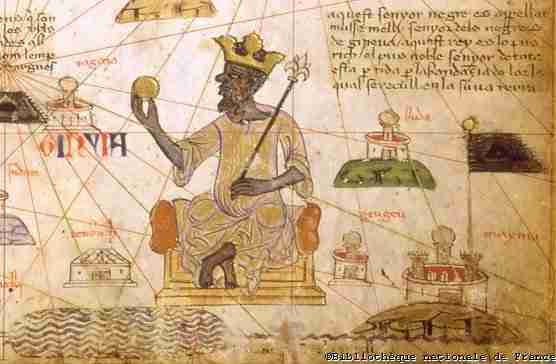
—Your image — a crowned sovereign holding a great nugget of gold — was eventually captured on maps drawn in distant lands you had never visited. How did you understand the way the world beyond your borders imagined Mali?
I understood it through the only instruments available to me: the reports of merchants who traveled and returned, the letters of foreign sultans, the demeanor of their envoys when they stood before me in Niani. The world north of the Sahara had long imagined Africa as a source of gold and little else — a place, not a civilization. When I moved through Cairo in 1324 with sixty thousand souls and met the sultan as an equal, I was insisting, without needing to say it aloud, that there was a political order here worthy of diplomatic respect. What cartographers in cities I have never visited might one day draw of me — that I cannot govern. I can only ensure that every ambassador who returns home carries a truthful account. The rest belongs to God.
—The Kouroukan Fouga — the founding covenant of Mali — lives in the mouths of your griots, not on parchment. What do those oral historians mean to your authority?
The djeli is not a court musician, though music is part of his art. He is the dynasty's memory made flesh and voice. Each morning, before the farins arrive with their reports, I hear the lineage recited: the deeds of Soundiata Keïta at Kirina in 1235, the covenant of the Kouroukan Fouga that bound the great clans to the throne and bound the throne to its obligations. A mansa who neglects his griots is a mansa who has chosen to forget who he is. My authority rests not only on military strength or on the gold of Bure — it rests on the accumulated legitimacy of nine sovereigns before me, stored in human voices, rehearsed nightly, ready to be called forth whenever my right to rule is questioned. That is a form of power no army can seize and no treasury can purchase.

This imaginary interview was generated by artificial intelligence from sources documented in Mansa Musa's profile. It dramatises what the figure might have said based on what we know about them, but does not constitute attested historical testimony. For primary sources and factual documentation, refer to the full profile.