Imaginary dialogue between Ibn Battuta and Mansa Musa
by Charactorium · Mansa Musa (1280 — 1337) · Politics · Economics · Spirituality · 6 min read
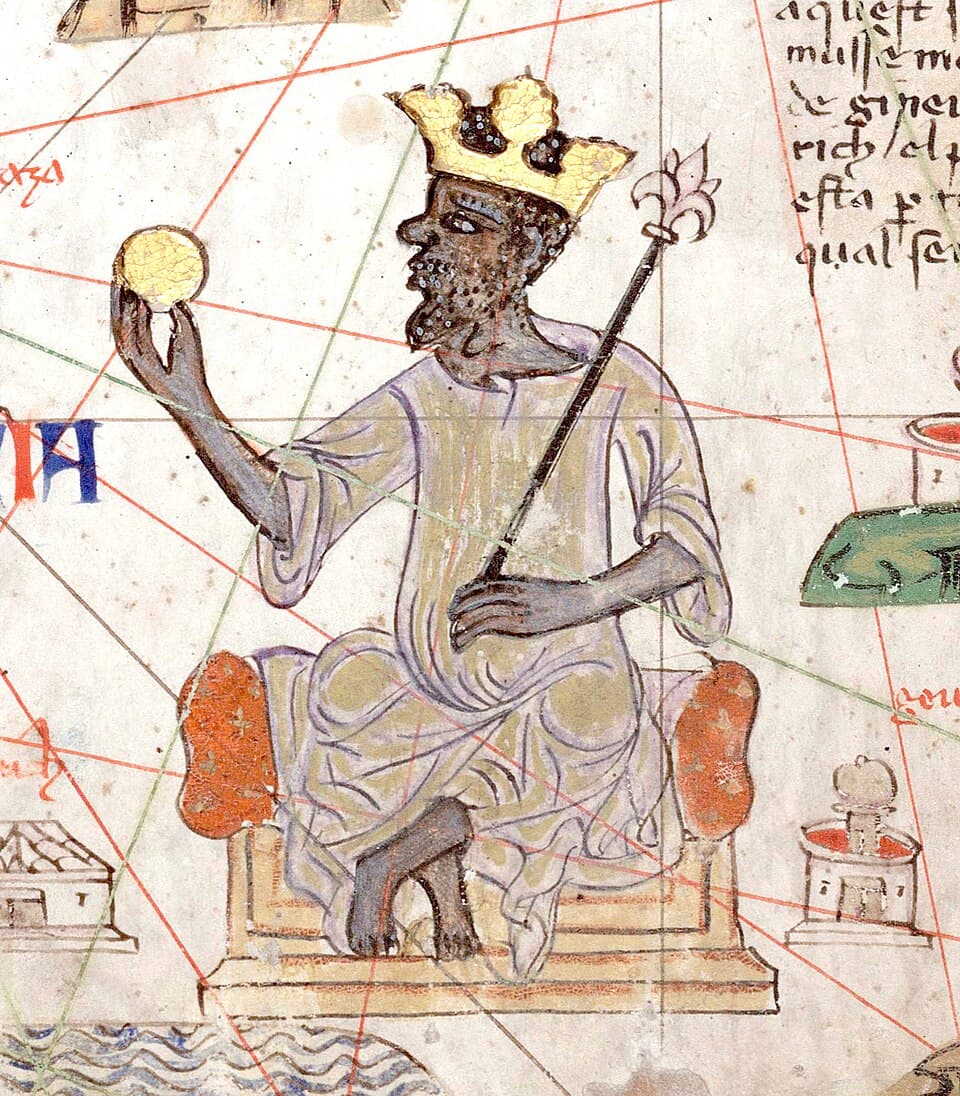
It is in the shadow of the freshly plastered banco walls of the Djinguereber mosque that Ibn Battuta comes to sit with Mansa Moussa on a late afternoon in 1330, three years after the great minaret was completed. The air carries damp earth and sandalwood; the echo of the Asr prayer still hangs over the rooftops of Timbuktu. Ibn Battuta — twenty-six, already a veteran of the Hajj and the courts of Cairo — has followed the rumours of this sovereign halfway across the known world. He arrives with his reed pen and the careful attention of a man who knows that what he writes here will matter long after the ink dries.
—Sovereign — three days at your court, seven languages in a single market row. How does a man hold a million square kilometers together?
A mansa does not hold an empire the way a fist holds water — he aligns it. I rely on the farins, my provincial governors, who carry my authority to every frontier with the weight of my name and the surety of my armies. But armies alone exhaust themselves; it is the ulamas who give my rule its permanence. When a scholar at Sankoré teaches a young man that the law of God and the law of the mansa point in the same direction, that man becomes my subject without a single soldier ever visiting his village. And beneath all of this runs the Kouroukan Fouga — the great charter of our clans, spoken by griots since the time of Soundiata Keïta. An empire, Ibn Battuta, is a conversation between memory and power. Cut either thread and the whole cloth unravels.
An empire is a conversation between memory and power. Cut either thread and the whole cloth unravels.
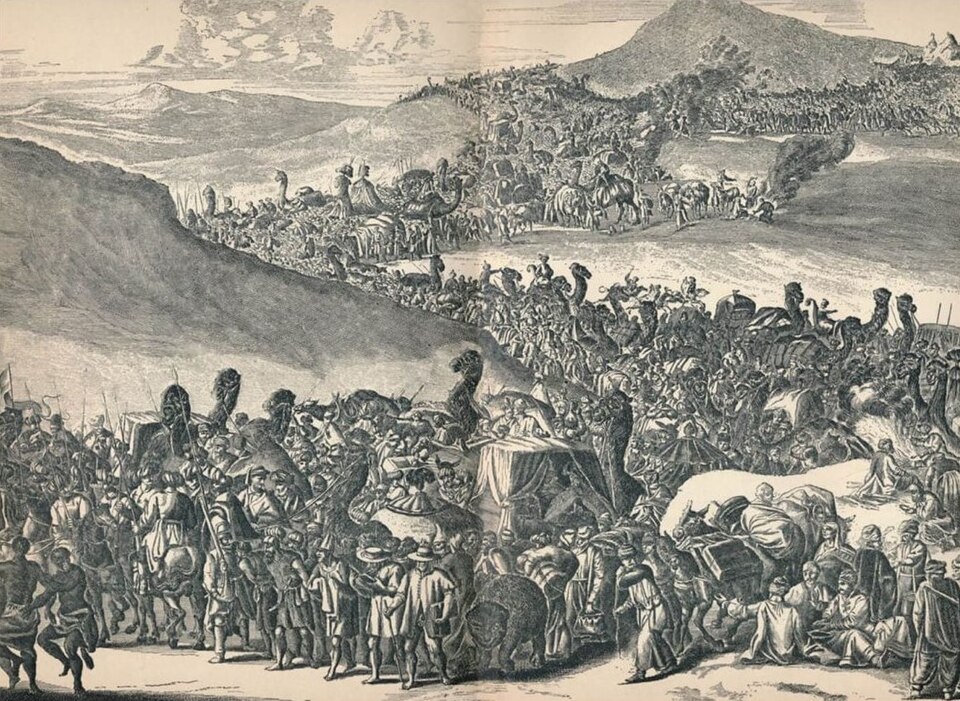
—Sixty thousand souls and twelve tonnes of gold crossing the Sahara. What drove you to make the Hajj at such a scale?
The Hajj itself demands nothing of that scale — God asks only for sincerity, not pageantry. But a mansa who crosses the Sahara with three servants is not a mansa when he arrives; he is merely a rich man nobody has heard of. My sovereignty had to travel with me, intact and legible to every sultan and emir I would meet between Niani and Mecca. The gold served as my letter of introduction across three thousand miles of roads I did not control. That said, I confess to you, Ibn Battuta, that the sheer abundance of what we distributed surprised even me. My treasurers had loaded the camels in Niani, and I had not counted every ingot. When you command an empire that sits atop Bure's mines, you can lose count of wealth the way a river loses count of its drops.
—The Egyptians I spoke with say the gold price did not recover for more than a decade. Did you foresee that consequence?
You who have sat with scholars in Cairo know that no gift is entirely without consequence. I gave freely because the faith demands it — zakat is not diminished by being performed on a grand scale. But no, I did not foresee that my alms could reach so far into the markets of Alexandria, of Damascus, of Aden. The price of gold is a thread woven through every merchant's table from the Nile to the Maghreb; pull it sharply enough and every loom shakes. What I understood afterward is that a sovereign's smallest gesture is, in truth, never small. The hand that gives can break without knowing it. I prayed for those affected. Whether prayer repairs a market, God alone can say.
A sovereign's smallest gesture is, in truth, never small. The hand that gives can break without knowing it.
—You led me through this mosque at dawn today. How did an Andalusian poet come to raise it from desert earth?
Abu Ishaq al-Sahili — Es-Saheli as we call him — was a gift I did not plan to receive. I found him in Mecca on my return journey, a poet and architect from Granada whose words moved me as much as his buildings. I invited him to travel back with me; he accepted, I believe, because curiosity speaks the same language in every tongue. What he built here is not Andalusia transplanted to the Sahel — it is something neither of us could have imagined alone. He taught my craftsmen his techniques; they taught him the banco, the earth, the heat. The Djinguereber belongs to that exchange between two worlds. When I stand here after the Fajr prayer and feel the walls still warm from yesterday's sun, I think: this is what it looks like when faith travels and takes root somewhere it has never been before.
—Sankoré draws theologians, mathematicians, physicians — from Egypt to Andalusia. Is it a house of God or a house of knowledge?
For me, that question dissolves before it can be asked. The ulamas who debate jurisprudence and the scholars who compute the motions of stars are doing the same thing: reading God's creation at different scales. I funded the manuscripts, the teachers, the ink — not to ornament my reputation, but because a sovereign who rules bodies without nurturing minds governs a people who will forget why they obey him the moment he dies. Timbuktu must outlast me. It must be the kind of city that, fifty years from now, a young scholar like yourself — and I believe you will be a great one, Ibn Battuta — will still wish to visit. The books accumulating in our libraries are the only monuments that do not crack in the heat.
The books accumulating in our libraries are the only monuments that do not crack in the heat.
—Bure's gold to the south, Taghaza's salt to the north — you hold both ends of the desert's commerce. Inheritance or design?
Both, and neither would have sufficed alone. My predecessors held the gold mines; the salt routes were older than memory. What I inherited was the gap between them — half-secured roads, competing chieftains taking tolls on every caravan, merchants who preferred a shorter road to danger over a longer road to safety. I spent years closing those gaps: garrisoning the wells, appointing governors who understood that a merchant paying taxes year after year is worth more than one robbed once and never returning. The Wangara traders understood this arithmetic before I did. When you travel with them, Ibn Battuta, you travel with people who have been calculating desert risk for three generations. I simply gave their calculations the protection of a state. Wealth is not a possession — it is a system. The mansa who forgets that inherits only ruins.
—I arrived here partly with Wangara merchants who spoke your name like a law of nature. What do you owe them?
Everything runs on mutual need, and I will not pretend otherwise. The Wangara move goods I cannot move myself — they know the desert's temper, speak every dialect from the Niger bend to the Atlas foothills, and hold credit networks that reach places my army cannot. Without them, my gold stays in the ground and my salt stays in Taghaza, useless to everyone. In return, I give them roads that do not kill them, courts that settle disputes without taking everything they own, and a currency of trust that makes their word good from Niani to Marrakesh. An empire's wealth is not the gold in its vaults — it is the gold in motion. Motion requires trust. Trust is my most carefully managed resource.
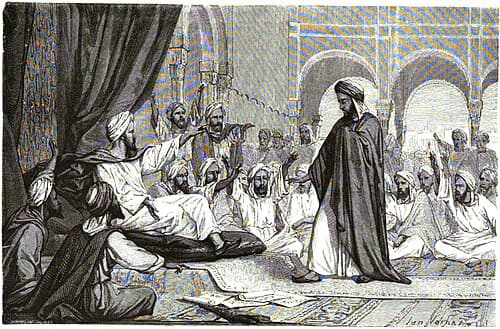
—At the audience where you received me, the griot recited before the qadi spoke. Which voice truly governs in this empire?
You observed with care, Ibn Battuta — that ordering is deliberate. The griot speaks first because the farins, the clan chiefs, and the elder warriors need to hear that I stand in the line of Soundiata Keïta before they hear anything else. Legitimacy here is first a matter of blood and memory, then of law. But the qadi speaks second because my scholars, my merchants, and every Muslim emir beyond the Sahara need to know that I govern by the sharia as well. One voice says: I am yours because my ancestors were yours. The other says: I am just because God commands justice. A sovereign who can speak both languages rules a larger country than his maps show.
—Sovereigns in Egypt and Morocco already call you the greatest lord in the world. Does such fame unsettle a man of faith?
A man of faith should be unsettled by it, and I confess I am not always unsettled enough. When envoys from Cairo address me with titles that crowd the page, I feel something closer to a builder's satisfaction than to pride — the wall still stands after the rains. But I remind myself that the fame travels only because the gold traveled first, and all veins of gold eventually run dry. What I hope outlasts both the gold and the fame is Sankoré — the students, the manuscripts, the disciplines they will carry forward. A name spoken by merchants in distant courts is a fragile kind of immortality. A school that teaches the children of those who taught your teachers — that is a different matter altogether.
—Wrapped in the ihram at Mecca, you stood equal to the humblest pilgrim. After ruling a million square kilometers, was that liberation or trial?
Both, on different days — sometimes on the same day. The ihram strips the sovereign of everything that makes him legible to other men: no silk, no gold, no retinue, only white cloth and bare intention. On the first morning I wore it, I felt something close to fear. Without the weight of everything that had defined me since childhood, I was not certain I knew who was walking toward the Kaaba. By the seventh day, I understood the gift. God was not asking me to become someone else; He was showing me who I had always been beneath the titles. I returned from Mecca not humbled in the way courtiers perform humility — but clarified. The Hajj did not diminish the mansa. It showed him why the mansa mattered.

This imaginary interview was generated by artificial intelligence from sources documented in Mansa Musa's profile. It dramatises what the figure might have said based on what we know about them, but does not constitute attested historical testimony. For primary sources and factual documentation, refer to the full profile.