Kids interview Martin Luther
by Charactorium · Martin Luther (1483 — 1546) · Spirituality · 4 min read
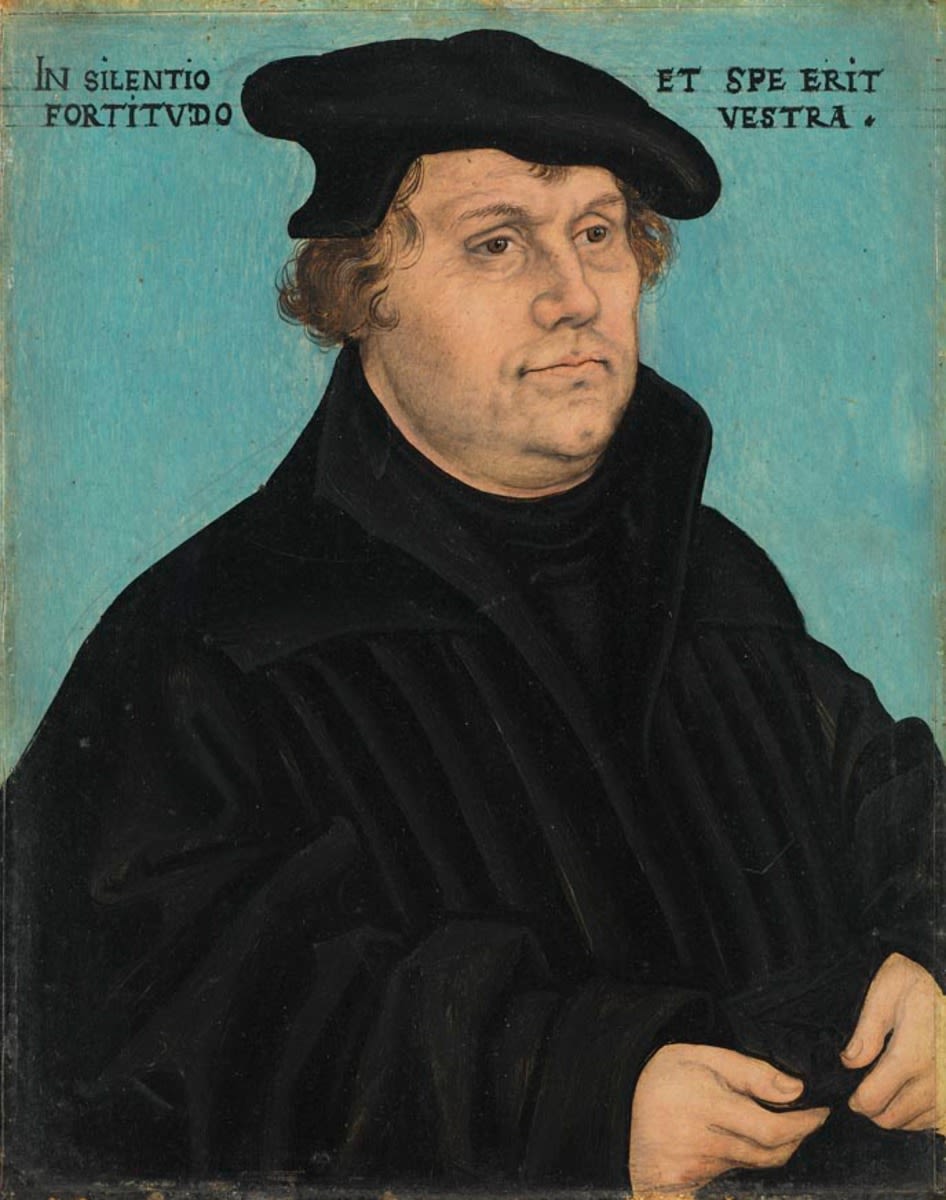
Two young visitors of twelve push open the heavy door of the old Wittenberg monastery. An old man in a black robe waits near his desk, a quill in hand. He smiles: 'Come closer, my little ones, and ask your questions.'
—What was it like the day you nailed your theses to the door?
You know, it was October 31, 1517, a cold autumn evening. I walked to the door of the Castle Church in Wittenberg, my papers in hand. Imagine a large wooden door that served as a sort of bulletin board for scholars. I nailed my 95 Theses to it. I was just an angry monk, not a hero! I only wanted a discussion. But the next day, printers copied my text. Within weeks, it was running all over Europe. I hadn't planned any of that. A simple nail, and the world trembled.
A simple nail on a door, and the world began to tremble.
—What exactly was an indulgence, that it made you so angry?
My child, an indulgence was a paper sold by the Church. They promised that by paying coins, your sin would be erased, or even that of a dead loved one. Imagine being told: give your money, and your grandmother will get out of her punishment up there faster. It turned my stomach. God's forgiveness is not a commodity you buy at the market! They were emptying the pockets of poor people with a false promise. That's why I took up my pen. Heaven is not for sale for coins.
God's forgiveness is not a commodity you buy at the market.
—Were you afraid when you stood alone before the emperor at Worms?
Oh yes, I was afraid! In April 1521, I was summoned to the Diet of Worms — a great assembly of princes and bishops from all over the Empire. Imagine a huge hall, filled with powerful men, and in the middle, me, a lone monk. The emperor Charles V himself was looking at me. They demanded I recant everything, say I was wrong. My hands trembled. But I answered that my conscience was captive to the Word of God, and I could not recant. 'Here I stand, I can do no other.' After that, I became an outlaw.
Here I stand, I can do no other.
—What did it mean to be an outlaw in those days?
You'll shiver, my child. Being placed under the imperial ban, after my excommunication — that is, being expelled from the Church — meant a terrible thing. Anyone could kill me in the street without punishment. No judge would defend me. Imagine walking down a road knowing that the first person you meet has the right to make you disappear. I could no longer go home peacefully. That's why my friends had to hide me in secret. Truth, you see, sometimes costs a great deal to the one who speaks it out loud.
Truth sometimes costs a great deal to the one who speaks it out loud.
—Is it true you disguised yourself as a knight to hide?
Ha! That's absolutely true, and it still amuses me. After Worms, a friendly prince, Frederick the Wise, had me secretly abducted by his horsemen — for my own good! They took me to the Wartburg Castle, perched on its hill. There, I let my beard and hair grow. I was called Junker Jörg, Sir George. No one recognized the monk under the sword and the fine cloak. Imagine living almost a year hidden, under a false name, in a fortress. It was strange and lonely. But there I did my greatest work.
Under the false name of Junker Jörg, the monk had disappeared behind a knight's beard.
—Did you really translate the whole Bible into German all by yourself there?
The New Testament, yes, and in just eleven weeks! You see, in my time, the Bible was written in Latin. But the common people did not understand a word of Latin. Imagine a sacred book that no one around you can read! That seemed unjust to me. So, in my little room at the Wartburg, I translated the Scriptures into German, the vernacular language, the one spoken at the market and at home. I looked for simple words, those of a mother speaking to her child. Thus, every peasant could finally read God's word for himself.
A sacred book that no one can read enlightens no one.
—Why did your marriage cause such a scandal across Europe?
Ah, my dear marriage! In 1525, I married Katharina von Bora. Now Katharina was a former nun, and I a former monk. We had both promised never to marry! Can you imagine the scandal? All of Catholic Europe cried out. A monk marrying a nun, how horrible for them! But I believed that marriage was a gift from God, beautiful and permissible, even for a churchman. I had already abandoned my old black monk's habit the year before. Our home became a model for pastors after us.
A monk marries a nun, and all Europe trembled with scandal.
—What did your big house smell like, with all those people around?
What a good question! Our house was the former Augustinian monastery, a huge building the prince had given us. Imagine hallways where our six children ran, students lodged in every corner, visitors from all over Europe. It smelled of rye bread, vegetable soup, and the good beer that Katharina brewed herself! In the evening, around the table, we laughed and discussed everything. These talks were called the Table Talk. It was not a silent monastery, no. It was a living house, full of noise and warmth.
It was no longer a silent monastery, but a house full of children and laughter.
—Is it true you loved to sing and play music?
With all my heart, my child! I played the lute in the evening, sometimes with my dear Katharina by my side. For me, music was the finest gift of God, just after theology. You see, I found it unfair that only priests sang in church, in Latin, while the people remained silent. So I composed hymns in German, so that everyone could sing together. The most famous is A Mighty Fortress Is Our God. A song, you see, brings faith into the heart better than a long sermon.
Music is the finest gift of God, just after theology.
—If we could spend a day with you, what would we do in the morning?
We would get up very early, around five o'clock! You might grumble a bit, and I would smile. Imagine a room lit by a single candle, for the sun is not yet up. I would begin with prayer, then open my Bible to study it — I read it in Hebrew and Greek, the ancient languages. In the afternoon, I would give my lectures at the University of Wittenberg, where many students came. And all day long, I would dictate letters, sermons, treatises. They say I wrote over four hundred works! My pen never rested for long.
My pen never rested for long.
This imaginary interview was generated by artificial intelligence from sources documented in Martin Luther's profile. It dramatises what the figure might have said based on what we know about them, but does not constitute attested historical testimony. For primary sources and factual documentation, refer to the full profile.