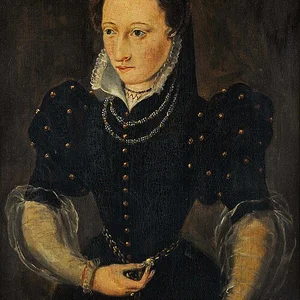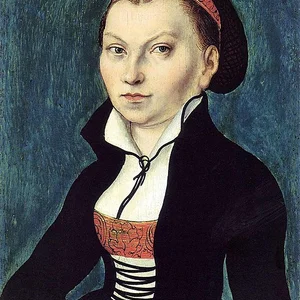

A former Cistercian nun, Katharina von Bora escaped from her convent in 1523 and married Martin Luther in 1525. Running the Luther household, she became the model of the Protestant pastoral couple and of the pastor's wife.
Katharina von Bora(1499 — 1552)
Katharina von Bora
Saint-Empire romain germanique
6 min read
Frequently asked questions
Key Facts
- Born in 1499 in Saxony, placed at a young age in a Cistercian convent
- Escaped from the convent of Nimbschen in 1523, hidden in a cart of herrings
- Married Martin Luther on 13 June 1525, breaking with monastic celibacy
- Managed the large estate of the Augustinian monastery in Wittenberg, transformed into a family home
- Died in 1552, having outlived Luther (who died in 1546)
Works & Achievements
The founding act of her secular life, a symbol of the liberation from monastic vows championed by the Reformation.
A union that became the model of the Protestant pastoral household and a public assertion of the legitimacy of clerical marriage.
Running a vast household, farm, brewery, and student boarding house, making her an exemplary manager.
Her table, the origin of Luther's famous “Table Talk,” was an intellectual hearth of the Reformation.
Katharina lastingly embodies the figure of the pastor's wife, an active partner in both ministry and domestic life.
Anecdotes
In 1523, Katharina von Bora escaped from the convent of Nimbschen along with eleven other nuns, hidden in a merchant's wagon among barrels of herring. The escape was organized by a tradesman who had embraced the ideas of the Reformation.
When the time came to marry her off, Katharina rejected the first suitors proposed and declared that she would marry no one but Nikolaus von Amsdorf… or Martin Luther himself. Luther, at first reluctant to marry, eventually wed her in June 1525.
Katharina managed the vast household of the former Augustinian monastery in Wittenberg, which had been turned into a family home: she raised livestock, tended a vegetable garden, brewed her own beer, and lodged students and boarders. Luther affectionately called her “the morning star of Wittenberg” and “lord Käthe.”
Luther trusted her so completely that in 1542 he made her the sole heir and executor of his will — a very rare thing for a woman of the time, when a widow was normally expected to be placed under male guardianship.
After Luther's death in 1546, and then fleeing the plague and war, Katharina endured difficult years. She died in 1552 in Torgau from the aftermath of a wagon accident, and is said to have declared: “I will cling to Christ as the burr clings to the cloak.”
Primary Sources
I would not give up my Katharina for France nor for Venice, first because God has given her to me and has given me to her; and second because I have often found that there are more faults in other women than in my Käthe.
To the holy and anxious lady Katharina Luther, doctor, brewer, and judge of the pig market of Wittenberg, my gracious and dear wife.
Marriage is the most spiritual state there is, because it tests a person and trains them in all the works of faith and charity.
Seeking aid after the death of her husband, the widow writes to obtain the financial support promised to the Luther family.
Key Places
Cistercian monastery near Grimma where Katharina was placed as a child and took her vows, before escaping in 1523.
Former Augustinian monastery given to the Luther couple, which became their family home and a gathering place for students and thinkers of the Reformation.
Church where Katharina and Martin Luther married publicly in 1525, the first place of worship of the Reformation.
Region of the minor Saxon nobility from which her family came and where her birth is placed around 1499.
Town where Katharina, fleeing the plague, died in 1552 from the aftermath of a cart accident. Her tomb is located in St. Mary's Church.
Liens externes & ressources
Références
Œuvres
Évasion du couvent de Nimbschen
1523
Mariage avec Martin Luther
1525
Gestion du Lutherhaus
1525-1546
Accueil des étudiants et hôtes de Wittenberg
1525-1546
Modèle de la femme de pasteur
XVIe siècle