Imaginary interview with Mary Wollstonecraft
by Charactorium · Mary Wollstonecraft (1759 — 1797) · Philosophy · 5 min read
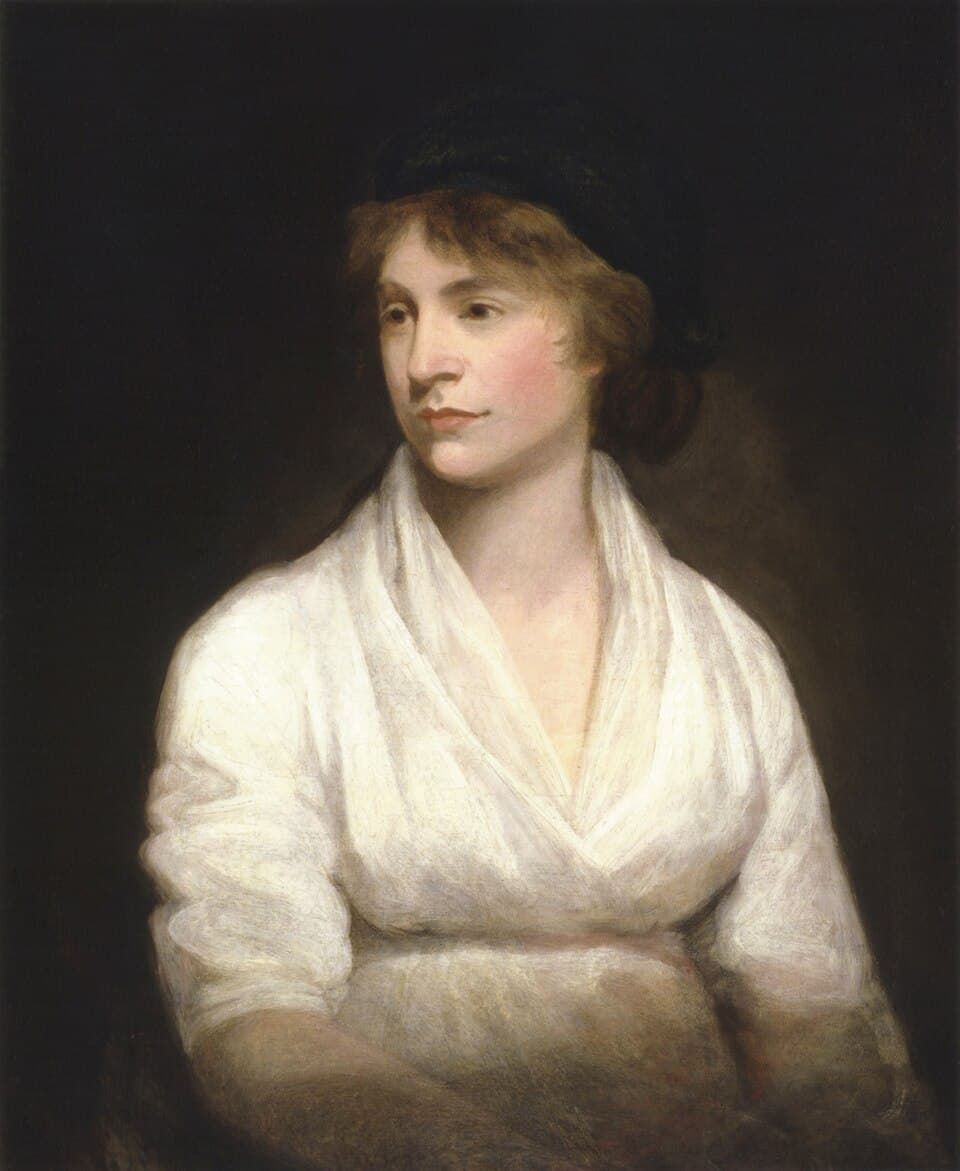
London, autumn 1796. In a small lodging in Somers Town cluttered with annotated books and papers, a goose quill dries at the edge of an inkwell. Mary Wollstonecraft, a woolen shawl over her shoulders, has just returned from Scandinavia; she agrees to look back, for us, on a life lived against the current.
—How did you come, so young, to the certainty that a woman should be able to do without a man to live?
It did not come to me through books, but through fear. I was nineteen when I left my father's house, a man whom drink made despotic and ruin made violent. I took a position as a lady's companion to an elderly lady in Bath — that humiliating status of an educated woman without fortune, housed and fed like a useful piece of furniture. I understood there, in those antechambers, that a dependent woman is never quite a person: she is a commodity. It was during those years of polite servitude that I swore to earn my own bread, even by candlelight, late at night, when at last no one commanded me.
A dependent woman is never quite a person: she is a commodity.
—That flight from home cost you dearly: what did it teach you about the education of girls?
That we cripple their minds before we cripple their lives. At Newington Green, where I opened a school for girls with my sister Eliza and my dear Fanny Blood, I saw children already trained to please: embroidery, curtsying, the art of lowering the eyes. From that I wrote my first essay, Thoughts on the Education of Daughters, in 1787. I argued something simple and scandalous: 'The mind must be strengthened before it can be truly virtuous.' You cannot make a moral creature out of a being taught only to seduce. My whole life grew out of that modest school, and the circle of the Reverend Richard Price who opened the Enlightenment to me.
—Why did you respond so quickly and so sharply to Edmund Burke?
Because Burke wept over Marie Antoinette's lace and remained dry-eyed before the misery of the people — that is a sensibility I find obscene. In 1790, his Reflections on the Revolution appeared; I took up my pen in anger and wrote in a few weeks A Vindication of the Rights of Men. It was the first time I signed my name. I reminded him that there are 'rights which men inherit at their birth, as rational creatures' — rights that no hereditary privilege could abolish. I was reproached for my impertinence: a woman dared to correct the greatest orator of the kingdom. But I was not correcting a style; I was defending an idea that the powerful found convenient to forget.
Burke wept over Marie Antoinette's lace and remained dry-eyed before the misery of the people.
—Two years later, you extended those rights to women. What exactly did you want to claim?
Reason. Nothing but reason, but all of reason. In A Vindication of the Rights of Woman, in 1792, I did not ask that power be given to us: I asked that we stop being infantilized. 'I wish to persuade women to endeavour to acquire strength, both of mind and body, and to convince them that the soft phrases, susceptibility of heart, delicacy of sentiment, and refinement of taste, are almost synonymous with epithets of weakness.' We are raised in sensibility like a fowl being fattened — for the pleasure of others. But virtue can only be a fruit of reason, never of docile obedience. Give us a liberal education, and you will see if we remain dolls.
—You left for Paris full of enthusiasm. What remains of that hope after the Terror?
A wounded hope, but not dead. I came to greet the dawn; I saw the night. From my apartment on rue Meslay, in the Marais, I heard the carts passing that carried the condemned to the scaffold — that sound of wheels on the pavement, I still hear it. The Terror of 1793 and 1794, the execution of the king, the queen, so many unknown people, taught me that a people kept in ignorance for centuries does not become virtuous in a day. I wrote a book about it, my Historical and Moral View of the French Revolution. Liberty is not decreed like opening a cage: it is learned, slowly, like everything worth learning.
—How do you reconcile your faith in the Revolution with the horror you saw with your own eyes?
By distinguishing the principle from its executioners. I never believed that the Declaration of the Rights of Man of 1789 was bad because it was born in blood — I believed it was incomplete, first because it forgot us, women. In Paris I met ardent minds, I collected engravings of those feverish days, I loved there too. But violence taught me something my radical friends refused to hear: you do not build reason on fear. My enthusiasm turned into demand. From then on I wanted a revolution of manners and education, slower, but one that would not be undone the next day.
You do not build reason on fear.
—You were one of the first women to live by your pen. How did you maintain that independence?
Line by line, and without a patron. I was fortunate to meet the publisher Joseph Johnson, who employed me at The Analytical Review: hundreds of reviews, translations from German and French, the obscure work of a journalist that pays for bread and rent. I refused literary patronage, that system where you flatter a protector to be fed — yet another disguised dependence. My goose quill was my livelihood and my weapon. I rose before dawn, I wrote before the world demanded its due, I reread Locke and Rousseau, annotating their margins with as much admiration as fury. To live by one's ideas: that is the freedom I wished for all women.
—Your sober dress without a corset has been much remarked. Was it inverted coquetry, or something else?
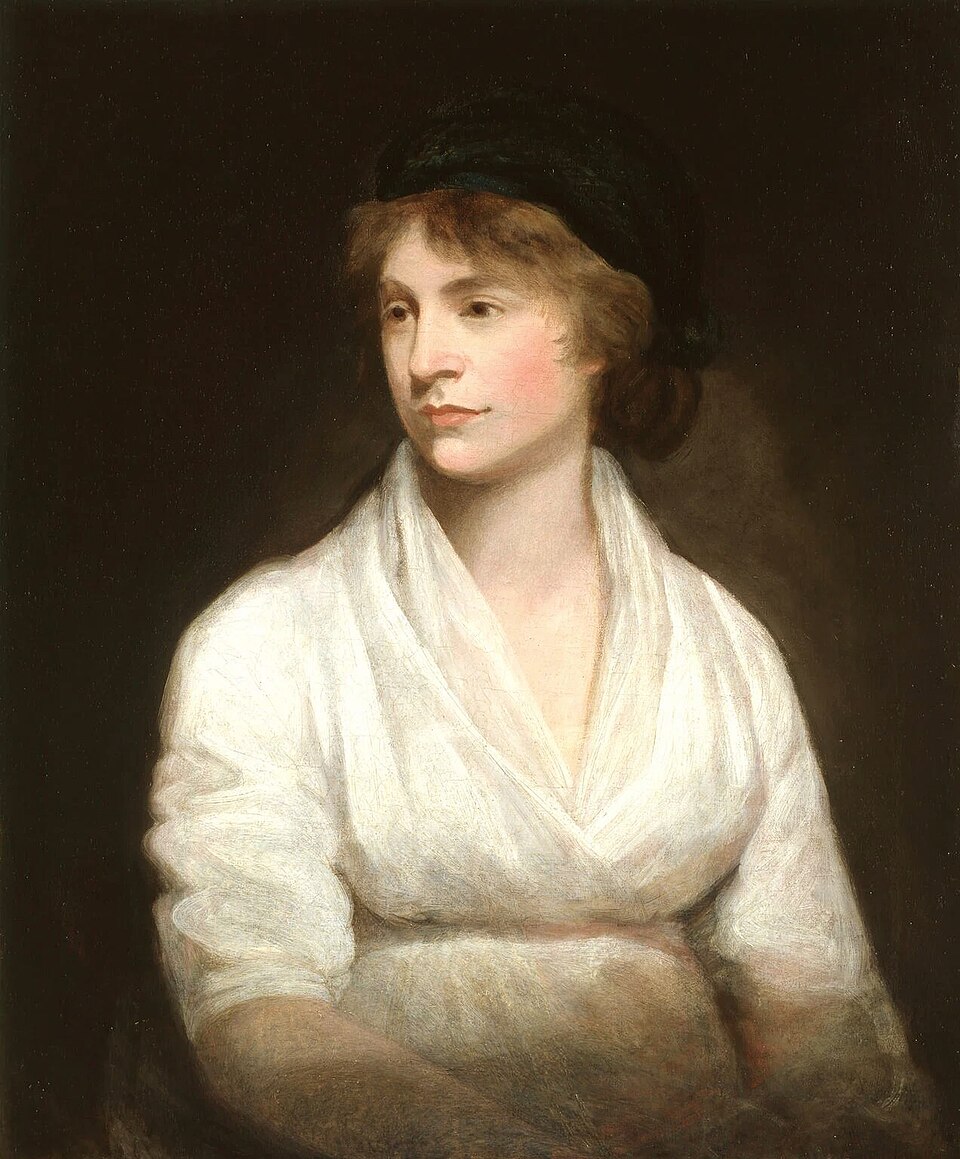
It was a declaration, worn on my back. I dressed in simple cotton gowns, a woolen shawl, an unadorned cap — no corset, no powder, none of those ornaments that make a woman a display object. Our bodies are locked in whalebone as our minds are locked in frivolity: the same gesture, exactly. The sensibility cultivated in us has its uniform, and I refused it. When I saw a young girl suffocating in her corset to appear graceful, I saw the entire condition of my sex — beautiful, constrained, and unable to breathe freely. My uncorseted gown was the most discreet of my vindications.
Our bodies are locked in whalebone as our minds are locked in frivolity.
—You have just returned from Scandinavia. What were you seeking so far away, alone with your child?
Officially, a man's business; in truth, perhaps a little of myself. I loved Gilbert Imlay to the point of losing my reason, I gave him a daughter, Fanny, out of wedlock — and he left me. After an attempt to destroy myself from which I survived, I left for Gothenburg, then Norway and Denmark, my baby against me, his commissions in my pocket. But on those deserted coasts, before those forests and waterfalls, I ceased for a moment to be an abandoned woman. I wrote letters that became a book, my Letters Written During a Short Residence in Sweden. Pain, sometimes, opens the eyes better than happiness.
—What would you say about that travel book, which was your greatest success in your lifetime?
That it is the most sincere, and therefore the most naked. I mixed politics, nature, and sorrow without separating them, because in me they were not separate. Before a northern landscape I wrote: 'my very soul diffused itself in the scene' — there was more truth there than in many treatises. Curious fate: I was read for A Vindication of the Rights of Woman as a reasoner, and I was loved for these letters as a suffering soul. Perhaps readers understood, better than I did, that there are not two Marys — one of the head, one of the heart. The reason I claim for my sex never demanded that we cease to feel; it only demands that we cease to be nothing but feeling.
There are not two Marys — one of the head, one of the heart.
Read further
This imaginary interview was generated by artificial intelligence from sources documented in Mary Wollstonecraft's profile. It dramatises what the figure might have said based on what we know about them, but does not constitute attested historical testimony. For primary sources and factual documentation, refer to the full profile.