Imaginary dialogue between William Godwin and Mary Wollstonecraft
by Charactorium · Mary Wollstonecraft (1759 — 1797) · Philosophy · 6 min read
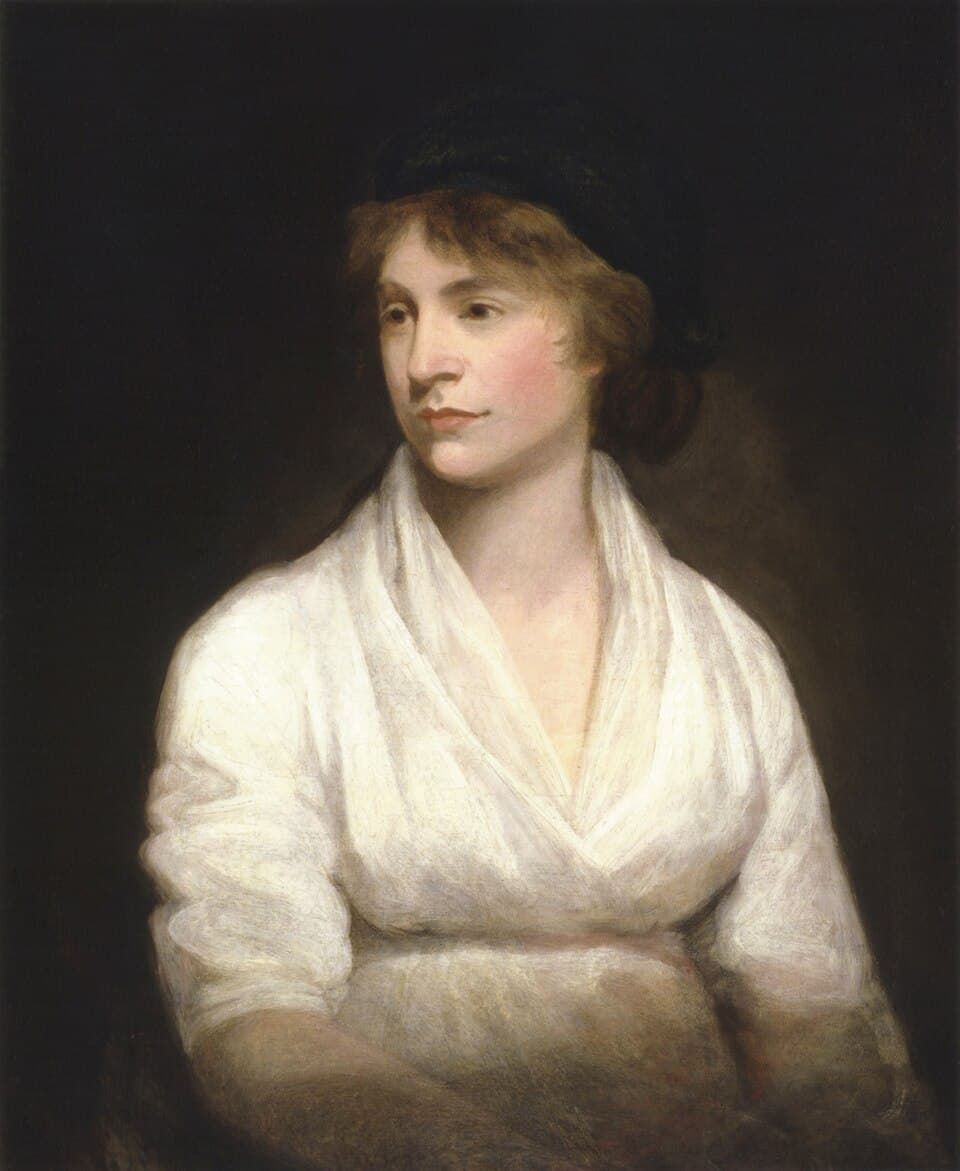
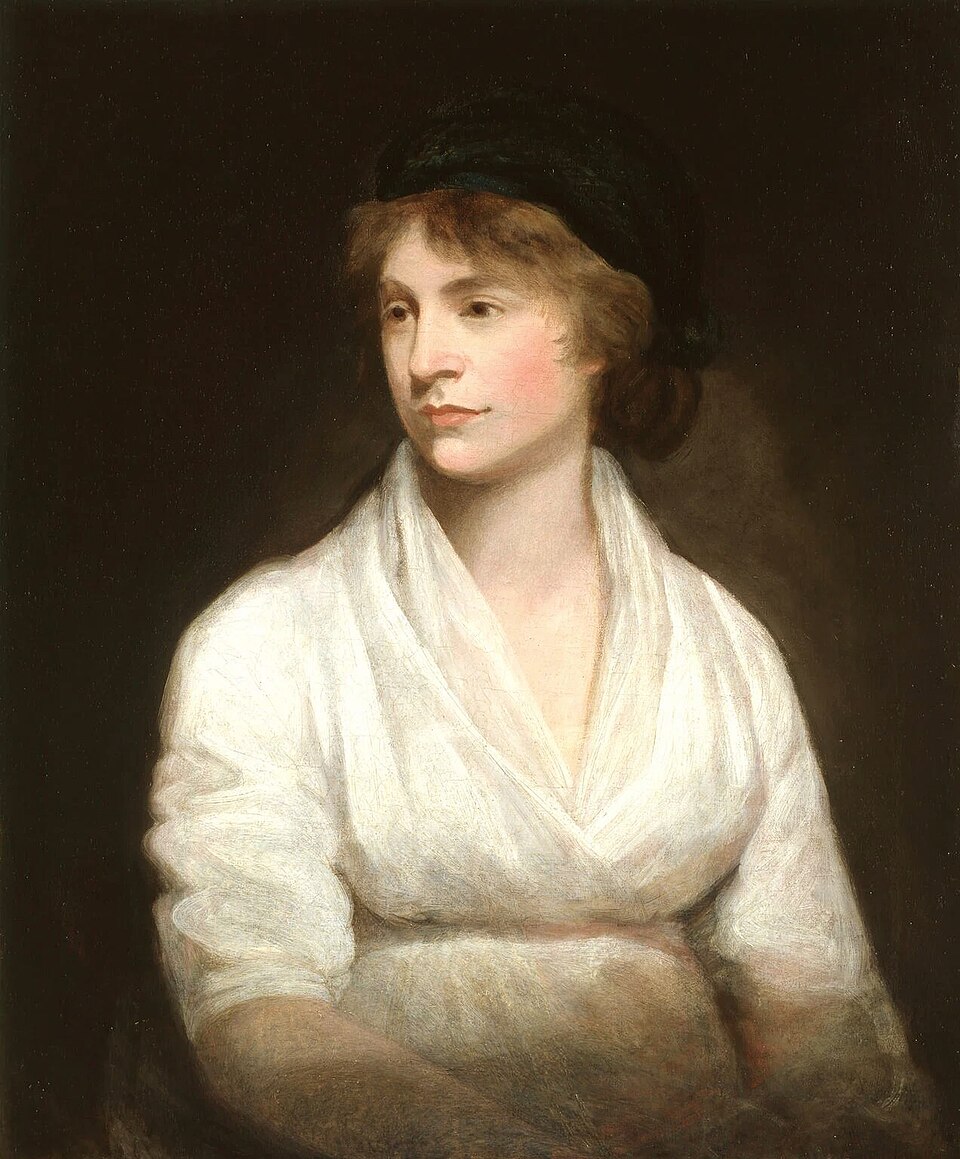
It is in the modest lodgings of the Polygon, in Somers Town, that I find Mary this summer of 1797, a few months after our marriage. The light falls obliquely on the table where her papers are piled, and the inkwell is never quite dry. We live under the same roof but each keeps their own study, out of a taste for independence as much as by agreement; she is expecting the child, and I press her with questions as one interrogates a living work. This evening, I have set aside the husband to listen to the philosopher.
—Mary, before I knew you, you had already broken with your father. What drove you to leave that home at nineteen?
You know how I dislike self-pity, but my father's house was a school of servitude. He drank, he shouted, he raised his hand to my mother, and I interposed myself at night like a shield. At nineteen, in 1778, I understood that waiting for a husband to change one's prison was to trade one dependency for another. I left to hire myself out as a lady's companion to an old woman in Bath — a humiliating condition, where you are treated like polished furniture. But that piece of furniture read, observed, and swore never to owe its bread to a man's complaisance. It was there, long before my books, that my most tenacious conviction was born.
Waiting for a husband to change one's prison was to trade one dependency for another.
—You have lived by your pen for years, a rare thing for a woman. How did Joseph Johnson make that possible?
Johnson was not a patron, and that is precisely what saved me. A patron buys and shapes you; he simply gave me work. From 1788, I wrote for his journal, The Analytical Review, hundreds of reviews, I translated German and French, I lived by my labor as a man lives by his. That may seem little, but consider what it means: no woman before me, or almost none, had eaten bread that she owed neither to a father, nor to a husband, nor to a protector. I dressed plainly, without corset or powder — not from poverty alone, but because finery is an admission of servitude. My simple dress was an argument; you who have seen me refuse frills know it.
No woman before me had eaten bread that she owed neither to a father, nor to a husband.
—When you wrote your Vindication of the Rights of Woman, what revolted you most about the education given to girls?
What revolted me is that girls are taught to be merely sensitive, never reasonable. They are stuffed with sweetness, delicacy, those soft phrases that are almost synonymous with weakness, and then people are surprised they are frivolous! In my book of 1792, I did not demand that women become men: I demanded that they be recognized as beings of reason, capable of virtue — for there is no true virtue but rational virtue, never the docile obedience disguised under that name. A wife who only knows how to please is a bedecked slave; a mother who cannot think cannot educate. Strengthen the mind first, and virtue will follow. My whole work rests on that inversion.
A wife who only knows how to please is a bedecked slave.
—You have been reproached for turning your back on all feminine sweetness. What do you answer to those who judge you an enemy of sensibility?
I am not the enemy of feeling — how could I be, I who have suffered so much from loving? I am the enemy of sensibility erected as woman's sole virtue. When a girl's only emotion is cultivated, she is rendered incapable of governing herself, a slave to her moods as to her masters. Reason does not extinguish the heart; it makes it worthy of trust. See the difference: a passionate man is respected, a passionate woman is despised. Why? Because her judgment was never armed. I want women strong enough in mind that their tenderness is a choice, not a weakness endured. The rest — taste, delicacy, refinement — is mere ornament when the understanding remains empty.
Reason does not extinguish the heart; it makes it worthy of trust.
—You were in Paris when I was not. Tell me what you saw pass under your windows on the rue Meslay.
I went there in 1792 full of hope, persuaded that France was giving birth in pain to the world I dreamed of. And then I saw the carts. From my windows in the Marais, I watched them drive the condemned to the guillotine, men and women pale in the early morning, and the sound of wheels on the cobblestones never left me. One evening, I saw blood on the stones and could not write all night. I did not renounce the Revolution — I even undertook to write its history in 1794 — but I learned that a people kept in ignorance takes revenge with the cruelty it was taught. Liberty without education turns into carnage. That was the bitterest of my lessons.
The sound of wheels on the cobblestones never left me.
—Did that violence shake your faith in the ideals of the Enlightenment, or only in the men who carried them?
In the men, never in the ideals. Reason did not fail in Paris; it was unbridled passions that stifled it, precisely for lack of education. Consider the irony: those same revolutionaries who proclaimed the rights of man excluded women from their Declaration, as if half the species did not count among rational creatures. Olympe de Gouges paid for it with her head for reminding them. I kept my faith in the progress of human faculties, that slow improvement by which we rise above the brute. But I ceased to believe that liberty falls from heaven in a day. It is sown in schools before it is reaped in assemblies. A revolution without education is merely a change of tyrants.
Liberty is sown in schools before it is reaped in assemblies.
—You know I question you here as a friend as much as a husband. Will you tell me what Imlay did to you?
You are well placed to hear this without being wounded, and I thank you for it. Gilbert Imlay, I loved him with all that strength of soul I preached to others, and it turned against me. I gave him Fanny in 1794, out of wedlock, in defiance of scandal — for I despised marriage even more than scandal. Then he abandoned me. I who wrote that woman must be self-sufficient threw myself twice toward death. I do not hide it: the philosopher and the woman do not always dwell in peace under the same skull. But you see, I survived, and from my distress I drew ink rather than poison. That is perhaps my true vindication of the rights of woman: to have lived my ideas even through their fractures.
The philosopher and the woman do not always dwell in peace under the same skull.
—From that shipwreck came your most beloved book. How did that journey to the North give you back your pen?
What irony, is it not: I undertook that journey in 1795 on business for the man who had broken me, alone with my infant and a servant, through Sweden, Norway, Denmark. I set out in despair and found myself coming back to life. Before the northern rocks, the waterfalls, those immense solitudes, my soul seemed to spread into the landscape, and pain turned into contemplation. I wrote letters — to him, at first — where nature, lost love, and politics mingled without my separating them. Those are my Letters Written During a Short Residence in Sweden, from 1796, the only one of my works that the public truly cherished in my lifetime. At last I was loved for showing my heart after hiding it so long behind my reasoning. Strange lesson for an apostle of reason.
I set out in despair and found myself coming back to life.
—Here, at the Polygon, we each keep our study and our freedom. Is that how you conceive of a union between equals?
That is how I want it, and you, who never believed in marriage any more than I, accepted it with good grace. We resolved on this ceremony to protect the coming child, not out of faith in the institution — for marriage, as the law makes it, too often turns the wife into the husband's chattel. Keeping my study, my pen name, my working hours, writing you a note when I want to speak rather than imposing my presence: that is what saves affection from becoming tutelage. An attachment is worthy only if it lets each person stand upright. I have written all my life that love survives only between equals; I had to live it once. What we do here, without fuss, is worth all my pamphlets.
An attachment is worthy only if it lets each person stand upright.
—You are still working on a novel, that Maria I see on your table. What do you want to say in it that your essays have not said?
My essays reason; now I want to make people feel. In this Maria, which I am working on and may not finish in time, I show a woman imprisoned — literally, in an asylum where her husband has thrown her to seize her fortune. For is not the whole world a vast prison, and are women not born slaves? To demonstrate it is no longer enough; one must feel it in one's flesh. The law deprives the wife of her property, her children, even her body, and no one is moved because no one has seen it from within. The novel opens that door which the treatise leaves shut. If I manage to make a reader weep for Maria who would never have read my Vindication, I shall have advanced my cause by a step that ten pamphlets cannot match.
The novel opens that door which the treatise leaves shut.
Read further
This imaginary interview was generated by artificial intelligence from sources documented in Mary Wollstonecraft's profile. It dramatises what the figure might have said based on what we know about them, but does not constitute attested historical testimony. For primary sources and factual documentation, refer to the full profile.