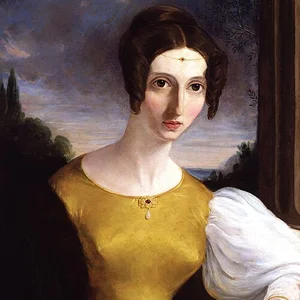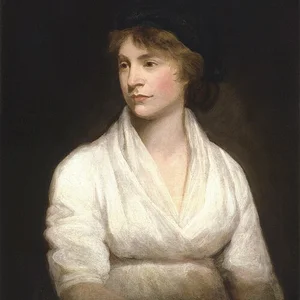

Mary Wollstonecraft was an 18th-century British philosopher and writer, a pioneer of feminism. Her landmark work, *A Vindication of the Rights of Woman* (1792), demands equal education and civil rights for women. She embodies Enlightenment thinking applied to the condition of women.
Mary Wollstonecraft(1759 — 1797)
Mary Wollstonecraft
royaume de Grande-Bretagne
8 min read
Frequently asked questions
Famous Quotes
« I do not wish women to have power over men; but over themselves.»
« Ignorance is a frail safeguard of virtue.»
Key Facts
- 1759: Born in Spitalfields, London, into a modest family
- 1787: Publication of *Thoughts on the Education of Daughters*, her first pedagogical work
- 1792: Publication of *A Vindication of the Rights of Woman*, a founding text of feminism
- 1793: Stay in Paris during the French Revolution; relationship with Gilbert Imlay
- 1797: Dies at 38 from complications following the birth of her daughter, the future **Mary Shelley**
Works & Achievements
Wollstonecraft's first essay, in which she advocates for a serious education for girls grounded in reason. It lays the foundations of her pedagogical and feminist thought.
A scathing response to Burke's Reflections on the Revolution in France. Her first publication signed under her own name, in which she defends natural rights against hereditary privilege.
Her masterwork, considered the first major text of modern feminism. Wollstonecraft demands for women equal access to education, reason, and citizenship on an equal footing with men.
An analysis of the French Revolution in which Mary expresses both her support for its revolutionary ideals and her reservations about the violence of the Terror.
An epistolary account of her solitary journey through Scandinavia, weaving together meditations on nature, love, and politics. It was the most successful work published during her lifetime.
An unfinished novel published by Godwin after her death. Mary denounces marriage as an oppressive institution and the condition of women imprisoned — both literally and figuratively — by society.
Anecdotes
At the age of nineteen, Mary Wollstonecraft left the family home to escape the authority of a violent and despotic father. This courageous break, rare for a woman of her time, forged her conviction that women should be able to live in an autonomous and independent manner.
In 1792, Mary travelled to Paris to observe the French Revolution up close, of which she was an enthusiastic supporter. She lived through the bloodiest hours of the Terror, watching carts carrying the condemned to the guillotine pass beneath her windows, which tempered her revolutionary idealism.
Mary Wollstonecraft fell desperately in love with the American traveller Gilbert Imlay, with whom she had a daughter, Fanny, in 1794, outside of marriage — a scandal for the time. Abandoned by Imlay, she attempted suicide twice, but survived and continued to write and campaign.
She married the anarchist philosopher William Godwin in 1797 after becoming pregnant with their daughter, who would become Mary Shelley, the author of Frankenstein. Neither of them believed in marriage, but they resolved to go through with it to protect their child. Mary died eleven days after giving birth at only 38 years old.
When William Godwin published his wife's Memoirs after her death, he honestly revealed her suicide attempts and her extramarital relationships. This book, written out of love, had the opposite effect to the one intended: it ruined Mary's reputation for a century, and her ideas were ignored until the twentieth century.
Primary Sources
I wish to persuade women to endeavour to acquire strength, both of mind and body, and to convince them that the soft phrases, susceptibility of heart, delicacy of sentiment, and refinement of taste, are almost synonymous with epithets of weakness.
It is necessary emphatically to repeat, that there are rights which men inherit at their birth, as rational creatures, who were raised above the brute creation by their improvable faculties.
With what ineffable pleasure have I not gazed — and gazed again, losing my breath through my eyes — my very soul diffused itself in the scene.
The mind must be strengthened before it can be truly virtuous; and till women have a more enlarged education, they will not be inspired with that respect for virtue which is the foundation of happiness.
Was not the world a vast prison, and women born slaves?
Key Places
A working-class neighbourhood in London where Mary was born in 1759. This modest and unstable environment shaped her awareness of social inequalities and her drive for independence.
An intellectual village on the outskirts of London where Mary opened her girls' school in 1784 and frequented the circle of radical minister Richard Price, who introduced her to Enlightenment ideas.
Mary lived in Paris from 1792 to 1795, observing the French Revolution from her apartment. There she met Gilbert Imlay and drafted a history of the Revolution that was never completed.
The first port of call on her solo journey through Scandinavia in 1795. This trip, undertaken on Imlay's business, gave rise to her Letters from Sweden, her most autobiographical work.
The neighbourhood where Mary settled with William Godwin after their marriage in 1797. It was here that she died on 10 September 1797, eleven days after giving birth to Mary Shelley.
The parish church where Mary Wollstonecraft was buried in 1797. Her daughter Mary Shelley and her future husband Percy Shelley regularly met at her graveside.
Typical Objects

Mary Wollstonecraft's daily writing tool, as she wrote essays and correspondence for several hours each day. Writing was for her both a livelihood and an intellectual weapon.

The periodical for which Mary wrote hundreds of reviews from 1788 to 1797. This journalistic work allowed her to earn a living by her pen and to sharpen her critical thinking.

Mary read and annotated Locke, Rousseau, and Price. She drew on their ideas about reason and natural rights while criticising them for their exclusion of women.

Out of philosophical conviction, Mary rejected corsets and ornamental clothing she considered degrading to women. Her plain dress was a deliberate political act.

During her stay in Paris, Mary collected images of the Revolution. These visual testimonies fed her reflections on freedom and political violence.

During her journey through Sweden, Norway, and Denmark in 1795, Mary kept a personal diary that would become her most intimate work and the most widely read of her lifetime.

Mary often wrote late at night by candlelight, after her daytime duties. In her letters she described these solitary working nights as her moments of greatest intellectual freedom.
School Curriculum
Vocabulary & Tags
Key Vocabulary
Tags
Daily Life
Morning
Mary rose early, often before dawn, and began her day with a long writing session before distractions could arise. She drafted her essays, reviews, or letters by candlelight in her study. She had a frugal breakfast — bread, butter, and tea — before taking up her pen again.
Afternoon
Afternoons were devoted to visits in London's intellectual circles, to exchanges at her publisher Joseph Johnson's or in the salons of Newington Green. There she engaged with the ideas of the radical philosophers of her time and debated politics and education. She also worked on her translations from German and French to supplement her income.
Evening
In the evenings, Mary sometimes received friends — philosophers, writers, radicals — for lively discussions over a simple supper. Alone, she read Locke, Price, and Rousseau, annotating them extensively. During her years in Paris, she sometimes attended political assemblies or revolutionary debates in the clubs of the French capital.
Food
Mary's diet was simple and inexpensive, a reflection of the modest means of a woman who lived by her pen. She ate bread, vegetables, cheese, porridge, and tea — a typical diet for London's middle classes in the 1780s–1790s. In Paris, she adapted to French cuisine but remained indifferent to culinary refinements.
Clothing
By philosophical choice as much as financial necessity, Mary dressed plainly: muslin or cotton dresses without a corset, wool shawls, a simple cap. She rejected crinolines, powders, and adornments she considered degrading to women — symbols of an ornamental femininity she opposed in her writings.
Housing
Mary lived in a succession of modest lodgings in London, Paris, and Scandinavia. In London, she generally occupied small furnished apartments in popular bourgeois neighbourhoods. Her Parisian lodging, on rue Meslay in the Marais, was a simple apartment from which she observed the revolutionary processions. With Godwin, she lived at Polygon House in Somers Town, where each kept a separate residence to preserve their intellectual independence.
Historical Timeline
Period Vocabulary
Visual Style
L'esthétique de Mary Wollstonecraft est celle du portrait géorgien éclairé à la bougie, sobre et intellectuel, entre le Londres bruineux et les paysages romantiques de Scandinavie.
Sound Ambience
L'univers sonore de Mary Wollstonecraft est celui du Londres géorgien intellectuel : plume sur papier, pluie sur les pavés, presses d'imprimerie et cloches de paroisse, ponctués par les rumeurs de la rue.
Liens externes & ressources
Références
Œuvres
Thoughts on the Education of Daughters
1787
A Vindication of the Rights of Men
1790
A Vindication of the Rights of Woman
1792
An Historical and Moral View of the Origin and Progress of the French Revolution
1794
Letters Written During a Short Residence in Sweden, Norway, and Denmark
1796
The Wrongs of Woman, or Maria (posthume)
1798