Imaginary dialogue between Alex Eskin and Maryam Mirzakhani
by Charactorium · Maryam Mirzakhani (1977 — 2017) · Sciences · 6 min read
It is in the sun-drenched Californian office of Stanford, at the end of winter 2016, that I meet Maryam again. Long rolls of paper covered in colorful diagrams still cover part of the floor, and the scent of Iranian tea lingers in the room. We have been working together for years on counting closed geodesics, and I know how much she hates talking about herself. But I come with the desire to understand, for once, what lies behind the mathematician I admire.
—Maryam, you who wanted to be a writer as a child, tell me: at what exact moment did mathematics steal you from literature?
You know, Alex, I never really left literature — I simply changed languages. As a child, I devoured novels, I dreamed of inventing characters, destinies. And then in middle school, I discovered that you could solve a difficult problem with a simple sheet of paper, by the sheer force of thought. It overwhelmed me. I fell in love with it, but it was not by design — it wasn't a plan, it was an encounter. For me, proving a theorem is still telling a story: there is a mystery at the beginning, characters that are geometric objects, and an ending you only guess at the last line. The beauty of a proof is its narrative. I did not betray the writer; I gave her a different alphabet.
I did not betray the writer; I gave her a different alphabet.
—When I come to see you, you're always on the floor, in the middle of your huge sheets. Your daughter calls you "the mommy who makes paintings" — explain this method to me.
It's true, Anahita thinks I paint, and deep down she's not wrong. I need to see big, to spread an entire surface before my eyes, to walk around it. An office sheet is too small to contain a moduli space. So I unroll these large white rolls on the floor, I kneel, and I cover everything with drawings, curves, colors that mark the paths. Geodesics become red lines, the edges of surfaces blue. I think with my hands and my knees as much as with my head. You, who receive my scribbled drafts, know that I never start from a formula: I start from an image. Rigor comes later, when it's time to convince. But intuition is always visual, almost childlike.
I think with my hands and my knees as much as with my head.
—Let's come back to our common work. Your 2004 thesis on Weil-Petersson volumes: how did you dare tackle a problem that so many believed impossible?
I think I didn't really "dare," Alex — I didn't gauge the depth of the chasm, and that was a stroke of luck. Under the supervision of McMullen at Harvard, I was trying to count simple geodesics on hyperbolic surfaces, and step by step I stumbled upon those volumes. Searching, for me, is like being lost in a jungle: you gather everything you know, and you try to invent new tricks to move forward. What saved me was connecting things that had been looked at separately — surface geometry, counting, recursion. The recursive formula that emerged surprised even me with its elegance. When we work together today, it's exactly the same feeling: we fumble, we make mistakes, and suddenly a path appears.
Searching is being lost in a jungle, and inventing new tricks to move forward.
—Our 2015 theorem with Amir, which they nicknamed the "queen theorem" — what did you feel when we finally held the proof?
An immense relief, and a happy fatigue. You remember all those years, our endless exchanges between Chicago and Stanford, the abandoned versions, the arguments that collapsed at the last moment? Describing the orbits of the action of SL(2,R) on moduli spaces was like mapping a territory that no one had a map of. I don't like the word "queen," it's too grandiose for what we did — we were mostly stubborn, the three of us. But I recognize that there was something rare there: a hidden rigidity, a structure that refused to show itself and suddenly let itself be seen. Those moments are so few in a mathematician's life. Living them with a friend like you doubles their value.
We were mostly stubborn, the three of us.
—Before Harvard, there was Tehran. Tell me about Farzanegan high school and those two gold medals at the Olympiads, in 1994 and 1995.
Farzanegan high school changed everything for me. It was a school for gifted girls, and for the first time I was surrounded by people who took seriously the fact that a young woman wanted to do mathematics. My friend Roya and I pushed each other, we wanted to solve problems that no one had asked us to solve. The Olympiads, in Hong Kong and then Toronto, were a vertigo: discovering that beyond the borders of an Iran still scarred by war, there existed a global community that spoke my language. The perfect score the second year, I didn't experience it as a personal victory, but as a door opening for the girls of my country. If an Iranian woman could do it, then others could. That was the real prize.
If an Iranian woman could do it, then others could.
—You live between two worlds: the veil that the law imposes on you in Iran, the simple clothes here in Palo Alto. How do you bear this double belonging?
I don't experience it as a tearing, Alex, but rather as two homes. When I go back to see my family in Tehran, I wear the veil, because that's the rule there, and I don't go to Iran to make politics but to hug my mother and eat her ghormeh sabzi. At Stanford, I'm in jeans and a sweater, like any colleague. But deep down, what never changes is what's in my head — a Riemann surface is the same whether you draw it in Tehran or California. Mathematics has no border, no flag, no dress code. That's perhaps why I felt free in it very early: it's the only country where I was always let in without being asked where I came from.
Mathematics is the only country where I was let in without being asked where I came from.
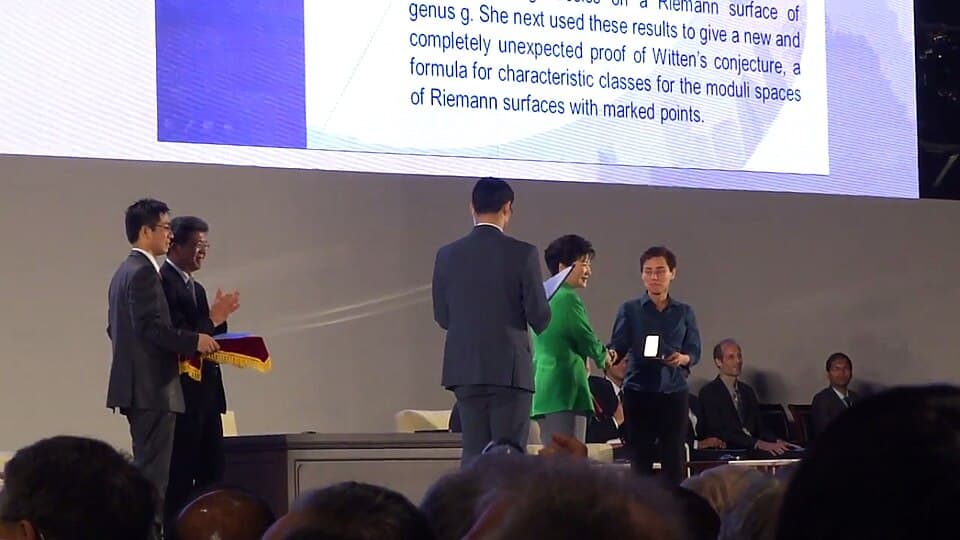
—Seoul, 2014. The first woman to receive the Fields Medal. Tell me honestly, as a friend: did you desire or fear this symbolic weight?
Feared, I think, more than desired. The Fields Medal is a magnificent distinction, and I would be dishonest to pretend it didn't move me. But from the moment they said "the first woman," I felt a burden I hadn't chosen. I would have liked them to talk about geodesics, volumes, the work — and they talked about my gender and my country. I understand why: for many young girls, seeing a woman receive this prize changes what they believe possible. That, I accept with gravity. But above all, I hope to be an ephemeral example — that one day, a woman receiving this medal will surprise no one, and they will stop counting. True progress will be when my medal is no longer "the first."
True progress will be when my medal is no longer "the first."
—On those big sheets, Riemann surfaces take on colors. For a layperson, what does what you see when you close your eyes really look like?
Imagine a flexible surface, like the skin of a donut or a multi-holed buoy, but that can be stretched, curved, deformed. Hyperbolic geometry is a world where triangles are skinny, where their angles fold, where lines you'd think are parallel end up avoiding each other. When I close my eyes, I don't see formulas: I see these surfaces breathing, I see paths — geodesics — snaking across them seeking the shortest route. And moduli space is even stranger: it's the land of all the shapes a single surface can take. I walk through it mentally as if in a landscape. My colors on paper are hiking trails. Without them, I'd be lost; with them, I find my way back.
I see these surfaces breathing, and paths snaking across them.
—You still work, despite the illness announced in 2013. Where does this stubbornness come from that I see you put into every proof?
You know me, Alex, I am slow — with a slowness I own. I can spend months on a single idea, turning it over in every direction, without publishing anything. This patience, I think, has saved me more than once, and it carries me still today. Illness does not change the nature of work: a theorem does not soften because one suffers. So I continue, not out of heroism, but because mathematics is the place where I feel whole. When I am bent over a surface, the rest fades for a moment. I would a thousand times rather spend my days understanding one deep question than chasing many small ones. Time, I no longer count in years — I count it in ideas I would still like to understand.
Time, I no longer count in years, but in ideas I would still like to understand.
—One last question, as a friend. If you had to tell Anahita, later, why you devoted your life to these surfaces, what would you write to her?
I would tell her never to believe that mathematics is cold or sad — it's quite the opposite. I would tell her that her mother spent her life marveling, kneeling on oversized sheets, seeking the hidden beauty in forms almost no one sees. I would want her to understand that you can fall in love with a question, as you fall in love with a person, and remain faithful to it for years. The most exciting thing is never the reward or the medal, but the moment when something obscure suddenly becomes clear. That moment is worth all the journeys. And if one day she feels lost in her own jungle, may she remember that it is precisely there, in the wandering, that the most beautiful discoveries are born. Her mommy, for her part, never stopped getting lost with joy.
You can fall in love with a question, like a person, and remain faithful to it for years.
This imaginary interview was generated by artificial intelligence from sources documented in Maryam Mirzakhani's profile. It dramatises what the figure might have said based on what we know about them, but does not constitute attested historical testimony. For primary sources and factual documentation, refer to the full profile.