Kids interview Maryam Mirzakhani
by Charactorium · Maryam Mirzakhani (1977 — 2017) · Sciences · 5 min read
Two middle-school students on a field trip pushed open the door of an office full of large rolls of paper. Colorful drawings were scattered all over the floor. Maryam Mirzakhani greets them with a smile and sits down on the floor with them.
—What are all those big papers on the floor? They look like drawings!
You have a good eye, my child! For me, doing mathematics is a bit like drawing. I would unroll long white sheets on the floor and cover them with scribbles in every color. Imagine an entire floor turned into a big painting full of curves. I would crawl over it, a colored pencil in my hand, following my shapes. My little girl Anahita would watch me. She told her friends that her mommy “did paintings”! She wasn't wrong. Numbers, for me, are images before they are numbers.
Numbers, for me, are images before they are numbers.
—Why did you need colors to do math?
Because my math deals with curved shapes, my child. Imagine the skin of a doughnut, all smooth and rounded: we call that a surface. On these shapes, I looked for the shortest paths, like an ant trying to cross without getting lost. With one color I traced one path, with another a second one. Otherwise, everything got mixed up in my head! Red, blue, green helped me not get confused. It was like coloring a map to better find your way.
—Is it true that when you were little, you didn't want to do math at all?
That's absolutely true! When I was little, in Tehran, I wanted to become a writer. I devoured novels and dreamed of telling stories. Mathematics? They didn't attract me at all. Then, in middle school, one day I tackled a really difficult problem. Just with a sheet of paper and a pencil, I found the solution all by myself. I felt an enormous joy, like when you finish a beautiful book. I understood that solving a problem is also telling a story. So I changed my path.
Solving a problem is also telling a story.
—How old were you when you won your medals at the big competition?
I was seventeen, my child! I was a student at Farzanegan High School, a school for girls passionate about science. In 1994, I left to represent Iran at the International Mathematical Olympiad, a big competition among high school students from over a hundred countries. I won a gold medal. And the next year, in 1995, I went back and got a perfect score: all the points! I was the first girl from my country to do that. Imagine my pride, and that of my teachers. It opened the door for many other young girls.
—When you were looking for a solution, what was going on in your head?
Ah, it was a strange adventure! One day, I said that doing research in mathematics is like being lost in a jungle. You don't see the way out. You move forward, you make mistakes, you go back. You gather everything you know to invent a new trick. Sometimes I spent months without making progress. But I wasn't afraid of feeling lost: that's exactly where beautiful ideas are born. You have to be patient, my child, and accept not understanding right away. Patience is my most precious tool.
Doing research is being lost in a jungle and inventing a path.
—Did you work with a friend on a super hard problem?
Yes! My friend's name was Alex Eskin. We wrote to each other, we talked for hours about our shapes and curved paths. Together, we tackled a problem that no one had managed to solve for a very long time. We worked on it for years, without giving up. And in 2015, we proved a great result. Other mathematicians admired it so much that they called it the “queen's theorem”. Working together is like walking in the jungle with a companion: when one stumbles, the other reaches out a hand.
—What was it like the day you received the Fields Medal?
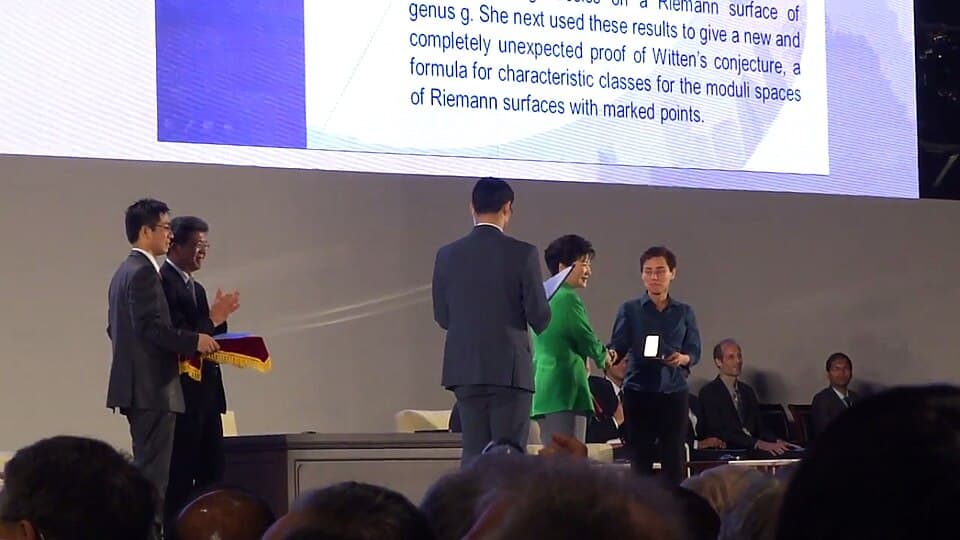
It was in Seoul, South Korea, in 2014, in front of all the great mathematicians of the world. The Fields Medal, my child, is the highest award for a mathematician, a bit like a gold star given only every four years. And that day, I was the very first woman to receive it. The first in almost eighty years! I was moved, and a little intimidated too. I said something very simple: the more time I spent with math, the happier I was. I fell in love with it without even deciding to.
I fell in love with mathematics without even deciding to.
—How did it feel to be the first woman to win this prize?
It touched me deeply, my child. For a very long time, girls were told that mathematics wasn't for them. What a strange idea! By receiving this medal, I carried a bit of the hope of all those young girls who doubted themselves. I wanted to tell them: if a little girl from Tehran who dreamed of writing could make it, then so can you. But I didn't really like honors and photos. What I liked was the work itself, my rolls of paper on the floor. The prize belongs to all those who will follow.
If a little girl who dreamed of writing could make it, then so can you.
—What did you eat at home in the evening with your family?
Oh, I loved the cuisine of my country! In the evening, I would meet my husband Jan and my daughter Anahita, and I would cook Iranian dishes. Fragrant saffron rice, all golden, called chelow. Or a slow-cooked herb stew, ghormeh sabzi. There were always dried fruits and nuts on the table. We shared the meal together, talking about our day. Even then, sometimes a math idea would cross my mind! I always kept a notebook nearby, so I wouldn't forget it before dessert.
—You lived in America, but did you go back to Iran sometimes?
Yes, my child. I lived in Palo Alto, California, near my university, Stanford. There I wore simple clothes, jeans, a sweater. But when I went back to see my family in Iran, I put a veil over my hair, because that was the law of my country. So I moved from one world to the other, with both in my heart. And you know, after my death, my country did a rare thing: it published my photo without a veil, to honor me. It was its way of saying it was proud of me.
—If we go on with math later, what would you like to tell us?
I would say: never be afraid to be slow. Beautiful things take time. I spent years on a single problem, lying on my big papers. Stay curious, and find beauty in what you study, like admiring a drawing. And above all, girls: don't let anyone tell you it's not for you. Today, in my name, a prize is given to young female mathematicians around the world. That makes me happier than all my medals. My true treasure is knowing that you will continue after me.
Never be afraid to be slow: beautiful things take time.
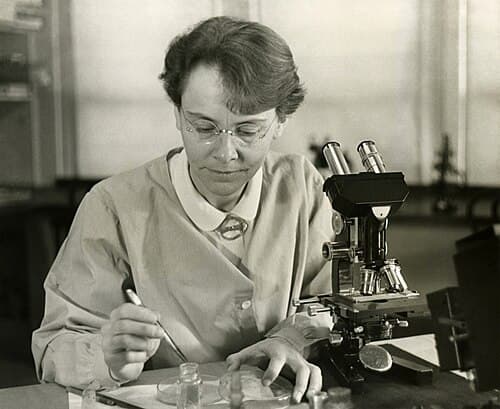
This imaginary interview was generated by artificial intelligence from sources documented in Maryam Mirzakhani's profile. It dramatises what the figure might have said based on what we know about them, but does not constitute attested historical testimony. For primary sources and factual documentation, refer to the full profile.