Imaginary interview with Maryam Mirzakhani
by Charactorium · Maryam Mirzakhani (1977 — 2017) · Sciences · 5 min read
A clear morning in Palo Alto, the California sun falls on the floor of an office where long rolls of paper spread out like explorer's maps. Maryam Mirzakhani receives us in socks, a colored pencil in her hand, her daughter Anahita having just left for school. She speaks softly, slowly, as if each sentence were first a drawing before being a word.
—As a child in Tehran, what did you dream of before mathematics entered your life?
I wanted to write. As a little girl, I devoured novels, invented lives for heroines I had never met, and I could easily see myself spending my days telling stories. Numbers meant nothing special to me; they seemed cold, without characters. It was later, in middle school, that I understood you could solve a difficult puzzle with a simple sheet of paper, in silence, with nothing but your own stubbornness. That day, I felt the same thrill as when turning the last page of a great book. Mathematics did not replace my desire to write—it disguised it. For me, proving a theorem is still holding a narrative thread to its end.
Mathematics did not replace my desire to write—it disguised it.
—How would you describe that turning point, that moment when you knew it would be your path?
Nothing was planned, and perhaps that is why it remained alive. I once said, in Seoul in 2014: "The more I spent time on maths, the more excited I became. I think I'm quite lucky that I fell in love with it, but it was not by design." Falling in love—that's the right word: you don't decide to do it. I simply spent more and more time with problems, and the longer I stayed, the more curious they made me. At the Farzanegan High School, my friend Roya and I would set endless challenges for each other. What could have been just another school subject became a private, almost clandestine passion.
Falling in love—that's the right word: you don't decide to do it.
—What did this path of excellence in Tehran represent for a young girl of your generation?
I grew up in a country that had just emerged from a long war with Iraq, which ended in 1988, and whose society had closed in deeply after the 1979 revolution. And yet, doors were opened for me: the Farzanegan High School, reserved for gifted girls, then the Sharif University of Technology, which trains the country's scientific elite. In 1994 and 1995, I won two gold medals at the International Olympiads, the second time with a perfect score. I think many little Iranian girls saw it as a signal: that a locked door can sometimes crack open. I never thought I was an exception; I thought I was proof, among others, that we had been underestimated.
I never thought I was an exception; I thought I was proof.
—How did you experience the move from Tehran to Harvard, then to California?
Leaving Iran for Harvard in 1999 meant leaving a language, a cuisine, a family, to enter a mathematical language common to all. There, under the guidance of Curtis McMullen, himself a Fields medalist, I learned to ask better questions more than to give good answers. Then Stanford, Palo Alto, in 2008. At home, I keep Persian rugs, Persian books next to English books, and I still cook my mother's ghormeh sabzi. I wear the veil when I go back to see my family, because the law requires it, and jeans the rest of the time. People often ask me where my country is; I answer that it is on the floor of my office, where my sheets are spread out.
—Let's talk about your very unique working method. Why these large rolls of paper laid directly on the floor?
Because I can't think in a small box. I need space, literally. I unroll long white sheets on the floor, I kneel over them and start drawing surfaces, loops, paths that curl. I move around, I walk inside my own figures like one walks in a landscape. My daughter Anahita, who has seen me do this since she was very little, tells her friends that I am "the mom who makes paintings." She's not wrong. To an untrained eye, they are just colorful scribbles. To me, they are Riemann surfaces caught in the act of existing.
They are Riemann surfaces caught in the act of existing.
—What role do color and drawing play in a discipline one imagines as purely abstract?
A central role, even if it surprises. I always keep my colored pencils and markers within reach, because I don't separate seeing from understanding. A geodesic, that shortest path traced on a curved surface, I have to be able to follow it with my eyes, give it a color, distinguish it from its neighbors. Pure abstraction, the language of formulas, always comes later, when the image is already clear in my head. I formalize at the keyboard only once I have seen. Many of my colleagues think first in symbols; I think in shapes, and I translate afterward. It's probably the writer I could have been who still draws.
—Your first major works deal with hyperbolic surfaces. How does one enter such an unknown mathematical territory?
My thesis, defended at Harvard in 2004, dealt with simple geodesics on hyperbolic surfaces, and I found a formula for what are called Weil-Petersson volumes. That sounds hermetic, but the experience I retain is very concrete. Doing research is, as I confided to the Clay Institute: "like being lost in a jungle and trying to use all the knowledge that you can gather to come up with some new tricks." You move forward without a map, you stumble, you retrace your steps. And suddenly a clearing opens: a recursive formula, simple, elegant, connecting things you thought were unrelated. That moment is worth all the years of wandering.
You move forward without a map, you stumble, you retrace your steps—and suddenly a clearing opens.
—How does one work on a problem that has remained open for a long time, like counting closed geodesics?
With a patience that resembles stubbornness, and rarely alone. The counting of closed geodesics in moduli spaces, I carried out with Alex Eskin, whom I called constantly in Chicago. A moduli space is the set of all possible shapes of a given surface; imagine an infinite library where each book would be a different geometry. We spent years taming this object, turning it over from every angle. I don't believe in isolated flashes of genius. I believe in long conversations, in drafts abandoned and taken up again, in that slow way of letting a question get used to you before it consents to be solved.
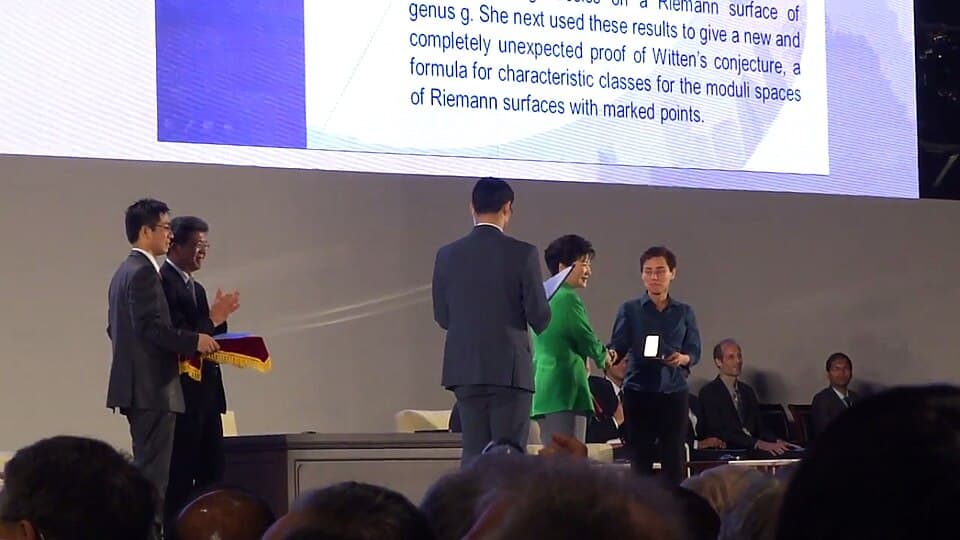
—Do you remember the ceremony in Seoul, in 2014, where you received the Fields Medal?
I remember above all the strangeness of the moment. The International Congress of Mathematicians, in Seoul, a huge hall, and this Fields Medal awarded every four years to researchers under forty—often called the "Nobel of mathematics." I was the first woman to receive it, and the first Iranian. I never liked the idea of being a symbol; I simply wanted to do good mathematics. But I understood that day that my name would mean something to young girls who might not otherwise dare to raise their hands in class. If my share of chance could serve as permission for them, then the medal had a meaning beyond me.
If my share of chance could serve as permission for them, then the medal had a meaning beyond me.
—What would you say about the weight of being perceived as a pioneer, while the disease was already accompanying you?
Cancer was diagnosed in 2013, a year before Seoul. I chose to continue working, because my paper rolls on the floor were also a refuge from fear. Being perceived as a pioneer is a heavy honor: you are expected to embody a cause, while you mostly want to finish a proof. What touches me is knowing that in my country, where the law imposes the veil, they speak of me directly to little girls. I did not seek this role, but I accept it. I only hope that the work will be remembered as much as the symbol—the patience, the color, the long sheets, and that stubborn joy of staying lost in the jungle until it opens.
This imaginary interview was generated by artificial intelligence from sources documented in Maryam Mirzakhani's profile. It dramatises what the figure might have said based on what we know about them, but does not constitute attested historical testimony. For primary sources and factual documentation, refer to the full profile.