Kids interview Moses
by Charactorium · Moses · Spirituality · 5 min read
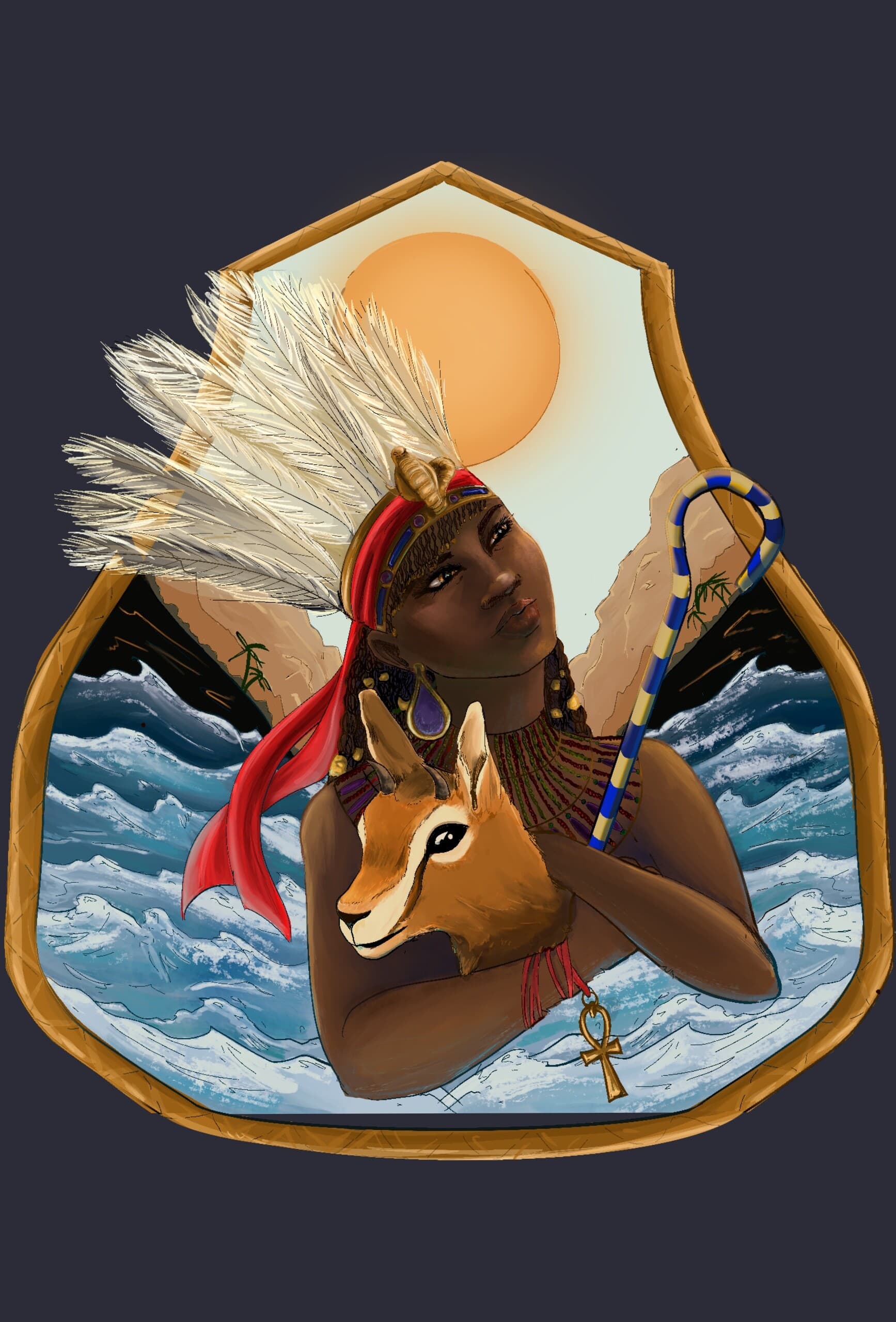
That morning, two young visitors stepped forward into the warm desert sand. An old man with a staff awaited them, his face still radiant. He sat down, smiled, and invited them to ask all their questions.
—Is it true that when you were little you traveled in a basket on the river?
Yes, my child, and it was my mother who saved me that way. Imagine: the Pharaoh had ordered all Hebrew baby boys to be killed. My mother hid me for three months. Then she wove a basket of papyrus, coated it with pitch so the water wouldn't enter, and placed me on the Nile. You see, it was like entrusting one's life to the current. Pharaoh's daughter found me there among the reeds. She adopted me and called me Moses, which means “drawn from the waters.” My name is already my whole story.
My name means “drawn from the waters”: it is already my whole story.
—And the burning bush, did you really see it with your own eyes?
With my own two eyes, yes. That day, I was tending a flock on Mount Horeb. Suddenly, a bush burst into flames. But listen closely to the strangest part: the fire did not consume it. The flames danced, yet the branches remained green. My heart pounded hard. It was from that fire that a voice spoke to me. It told me its name, YHWH, and entrusted me with an immense mission: to go free my people. You know, I was just a shepherd who stammered. I was afraid. But when the fire calls you, you don't plug your ears.
The flames danced, yet the branches remained green.
—Did your staff really do magic?
It wasn't my magic, little one. That staff was just a piece of shepherd's wood. But in my hands, it became the sign of a greater power. Before Pharaoh, I threw it to the ground: it turned into a serpent! Imagine the courtiers' faces. Later, that same staff struck a rock in the desert, and water gushed out like a spring — they call that place the Waters of Meribah. The people were thirsty and grumbled against me. The wood has no power, my child. It is the one who guides it that you must listen to.
The wood has no power: it is the one who guides it that you must listen to.
—How did the sea part in two?
Ah, the Sea of Reeds... That was the greatest day of my life. Pharaoh had unleashed his chariots behind us. Ahead, the water; behind, the spears. The people cried out in fear. I raised my staff, and a great wind parted the waters. Imagine two liquid walls, and in the middle a dry path to walk on. We all crossed, down to the last child. When the army tried to follow us, the waters fell back. On the other side, I sang. That is what is called the Song of Moses, a song of joy to thank God for being alive.
Ahead, the water; behind, the spears. And suddenly, a path through the sea.
—Did you really stay alone on the mountain for forty days?
Forty days and forty nights, yes, on top of Mount Sinai. Without eating, without drinking — so the tradition says. Imagine the silence up there, just the wind and the clouds. That is where I received the Tablets of the Law, two stones engraved with the Ten Commandments, also called the Decalogue, the “ten words.” These laws told how to live justly: do not kill, do not steal, honor your parents. It was like a treasure I was bringing back to my people. But as I descended, my child, my heart was about to break.
I was bringing back a treasure of stone engraved with ten words for living justly.
—Why did you break the Tablets? Were you angry?
Very angry, yes, and very sad too. As I came down from Sinai, what did I see? My people dancing around a golden calf, as if they had already forgotten everything. While I was receiving God's Law, they were making a false idol! Grief seized me. I threw the Tablets, and they shattered on the ground. You know, sometimes disappointment is so strong it breaks what you hold most precious. But I did not give up. I went back up and engraved new Tablets. We are always entitled to a second beginning.
We are always entitled to a second beginning.
—What was your daily life like in the desert with everyone?
My afternoons, my child, I spent administering justice. Imagine a long line of people: one accuses his neighbor, another claims a lost goat. And everyone came to see me, from morning till night. I was exhausted! Fortunately, my father-in-law Jethro gave me wise advice. He said: you cannot do everything alone. Choose trustworthy men, let them judge the small matters, and keep the great ones for yourself. That is what I did. Leading a people is not carrying everything on your shoulders. It is knowing how to share the burden.
Leading a people is not carrying everything: it is knowing how to share the burden.
—What did you eat during all that time in the desert?
A very strange food, little one: the manna. Every morning, the ground was covered with it, like a fine white dew. The first time, people asked: “man hu?” that is, “what is it?” — and that became its name! We gathered it at dawn and made cakes from it. In the evening, sometimes quails fell to feed us. With a few dates and water from the oases, we survived. You see, in the desert, each morning was a gift. We learned not to ask for more than the bread of the day.
We learned not to ask for more than the bread of the day.
—And at night, where did you sleep? Were you ever afraid?
I lived in a tent, like all my people. But I had another one apart: the Tent of Meeting. That is where I withdrew in the evening to speak with God, in the quiet. Imagine a vast encampment, hundreds of fires crackling in the night, and children falling asleep. Afraid? Yes, sometimes. When you guide thousands of people into the unknown, you doubt. You wonder if you are choosing the right path. But in the evening, before the Tent, I found my peace. A leader too needs a place to lay down his weariness.
A leader too needs a place to lay down his weariness.
—It's sad: you never entered the Promised Land?
It is true, my child, and for a long time it weighed on my heart. At the end of my life, I climbed Mount Nebo. From up there, I saw Canaan, that land toward which I had marched for forty years. So beautiful, so green in the distance. But I knew I would not set foot there. I was 120 years old. I understood one thing: you do not always sow for yourself. Sometimes you prepare a path that others will finish. That is not a failure. That is what it means to pass on. My people entered without me, and it was well so.
You do not always sow for yourself: sometimes you prepare a path that others will finish.
—Was your tomb ever found? Can we go see it?
No, little one, and that is one of the great mysteries that follow me. I died there, on Mount Nebo, facing the Promised Land. But no one ever knew where my tomb was. It remains unfound. You know, this gave rise to a thousand stories among those who came after me, among Jews, Christians, and Muslims. Perhaps it is better this way. If my tomb were known, people would come to pray before stones. Yet what I left is not in the earth. It is in the Law, and in the memory of a people on the move.
What I left is not in the earth: it is in the Law and the memory of a people.
Read further
This imaginary interview was generated by artificial intelligence from sources documented in Moses's profile. It dramatises what the figure might have said based on what we know about them, but does not constitute attested historical testimony. For primary sources and factual documentation, refer to the full profile.