Imaginary interview with Nebuchadnezzar II
by Charactorium · Nebuchadnezzar II (641 av. J.-C. — 561 av. J.-C.) · Politics · 7 min read
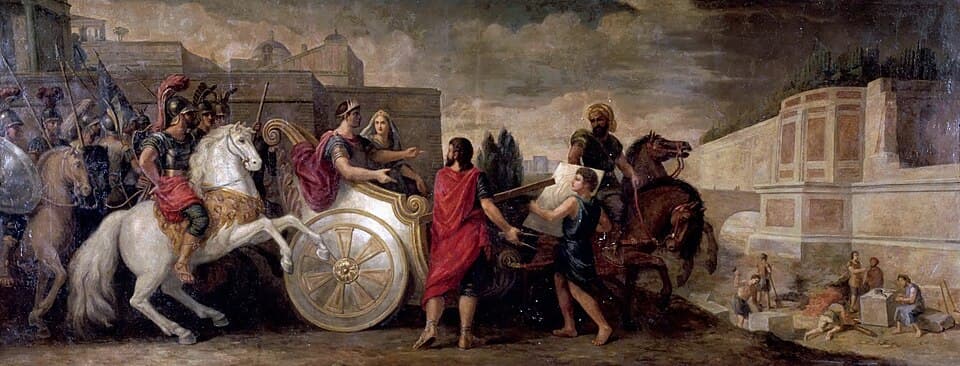
Babylon, a night in spring 573 BCE. Beneath the blue glazed bricks of the Ishtar Gate, the king has just performed the evening rites at the Esagila. He agrees to speak, his beard still fragrant with oil, his gaze turned toward the processional way that his workers are finishing paving.
—On what, in your view, does the legitimacy of a king of Babylon rest?
A king of Babylon is nothing without Marduk. Every dawn, before the day rises over the plain, I go down to the Esagila, the sanctuary that they say holds its head high. The priests wash and clothe the statue of the god, and I pour the first libations. My day begins thus, under the sign of the sacred, for I do not reign on my own authority: I reign because Marduk has deigned to place in my hand the scepter and the ring. At the great New Year, at the festival of the Akitu, I grasp his hand before all the people, and it is there, in that gesture, that my mandate is renewed. A sovereign who forgot this would be but a man wearing a high horned tiara — an empty headdress.
I do not reign on my own authority: I reign because Marduk has placed the scepter in my hand.
—Do you remember the day when you became, in everyone's eyes, a great captain?
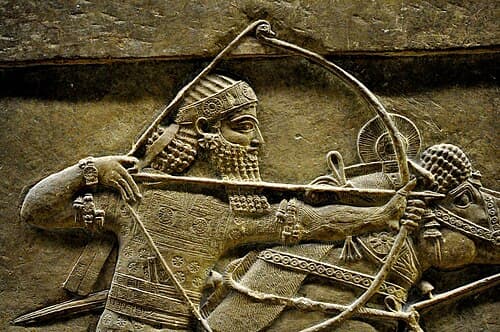
At Carchemish, in the year you call 605 BCE. I was not yet king, only the son of Nabopolassar, sent north to face the Egyptian Necho. We broke his army against the river. I saw the pharaonic chariots shatter against ours, and all of Syria, as far as the sea, fall under my spear. I myself drove my two-wheeled chariot, the composite bow in hand, as befits a warrior. That day, the Fertile Crescent changed masters. Then my father died, and I rushed to the throne of Babylon. People think a crown is received in a palace; mine was decided on a battlefield, in the dust and blood of the Egyptians.
People think a crown is received in a palace; mine was decided in the dust of Carchemish.
—How would you describe what happened at Jerusalem during the first capture, in 597?
The king of Judah, Jehoiachin, closed his gates; I opened them. I did not content myself with taking the treasures of the house of his god. I carried off the man himself, and with him what makes a kingdom's strength: the craftsmen, the priests, the smiths, the warriors. You call this a deportation; I call it removing a country's hands and head, so that it may never rise again. Know that I did not let Jehoiachin starve: in my palace, my scribes noted on clay the rations of oil and barley issued to the king of Judah and his five sons. A captive king remains a king; I feed him, but I keep him. That is how Babylon treats those it breaks without killing.
I removed that country's hands and head, so that it may never rise again.
—Why did you destroy the Temple of Jerusalem in 586, after such a long siege?
Zedekiah, the one I had made king, perjured himself and turned to Egypt. A city is not forgiven twice. My army besieged it for eighteen months, until famine did what my battering rams could not finish. Then I consigned to fire the house of their god, the house of their king, and the dwellings of the nobles. A city that thinks itself impregnable behind its walls must learn that walls burn. I know that over there, among the vanquished, men have composed dirges over those ashes — lamentations that, they say, are still passed from mouth to mouth. Let them weep. A king does not only build gates: he also teaches, by the sword, what it costs to betray one's word given to Babylon.
A city that thinks itself impregnable behind its walls must learn that walls burn.
—There is one place you never subdued. What would you say about Tyre?
Tyre, yes. The city of the Phoenicians, perched on its rock amid the waves. I besieged it for thirteen years — thirteen! — and my soldiers could never set foot on its quays. Against a land city, a king of Babylon is invincible: I open its gates, I take its granaries. But against a city that the sea feeds and protects, my war chariot stops at the water's edge like a horse before a precipice. I learned there that the spear does not go where the ship goes. People may one day think I subdued everything from the Nile to the Euphrates; the truth is that a rock surrounded by foam held out against the greatest empire in the world. A wise man remembers his limits better than his triumphs.
The spear does not go where the ship goes: a rock surrounded by foam held out against my empire.
—You are above all, they say, a builder. What did you want to make of Babylon?
The greatest city that men have ever seen. I girded Babylon with a double wall of brick, raised the South Palace and the North Palace, and laid out a processional way as long as two hundred and fifty cubits, so that Marduk might parade each spring in splendor. Look at my bricks: on each one, my name is stamped in the clay. Not out of vanity — or not only — but so that in a thousand years, when a poor man digs this soil, he may know who did this. I also raised the Etemenanki, the great stepped tower that rises toward heaven to offer the god a dwelling worthy of him. The canals I dug water the plain and fill the granaries. A king who leaves only victories leaves ruins; I leave a city.
On each of my bricks, my name is engraved — so that in a thousand years, they may know who did this.
—Before this Ishtar Gate where we stand, what do you see that we do not see?
You see blue, beasts, an entrance. I see the work of thousands of hands. These glazed bricks the color of lapis — they had to be fired, glazed, and laid one by one, without a single one breaking the design. The lions march for Ishtar, the sirrush dragons watch for Marduk, the bulls for Adad. This gate is not a wall: it is an oath in color, the announcement that whoever crosses this threshold enters the house of the god. I had it engraved in stone that it is I, Nebuchadnezzar, king of Babylon, who paved this way for the procession of the great lord Marduk, so that he might grant me life. A warrior terrifies for a season; a gate of glazed bricks amazes the centuries. I believe more in the gate.
A warrior terrifies for a season; a gate of glazed bricks amazes the centuries.
—It is said that you had terraced gardens built for your wife. Is this true?
Amytis. I took her from distant Media, with its green and cool mountains, and brought her here, to the flat and burning plain between the two rivers. She pined for her hills. What does a king do, who can divert rivers and raise towers to the sky, when a woman misses mountains? He builds her a mountain. They say I had terraced gardens erected, tree above tree, watered by water that was endlessly hoisted from the Euphrates, so that she might find again, in the heart of Babylon, the green shade of her youth. Is it true? I leave you to judge. What I know is that a king conquers kingdoms for history, but sometimes he moves hills for the smile of one woman.
What does a king do, when a woman misses her mountains? He builds her a mountain.
—These gardens — no trace of them has ever been found. Does that trouble you?
That men doubt? It amuses me more than it troubles me. See what I build that is solid: the Ishtar Gate stands, the Etemenanki rises toward Marduk, my stamped bricks litter the ground by the thousands — those will be touched for a long time. But a garden is a fragile thing. Water that ceases to be hoisted stops, the terraces dry out, mud returns to mud and the wind erases everything. What is most tender is also most mortal. Perhaps these gardens lived only for Amytis, and faded with her; perhaps they will live on mainly in the mouths of storytellers. I have learned from my diviners, the barû, that some things are read neither in entrails nor in stone. So let them doubt. Doubt, too, makes a name endure.
What is most tender is also most mortal: mud returns to mud.
—What weight do omens and diviners have in your decisions?
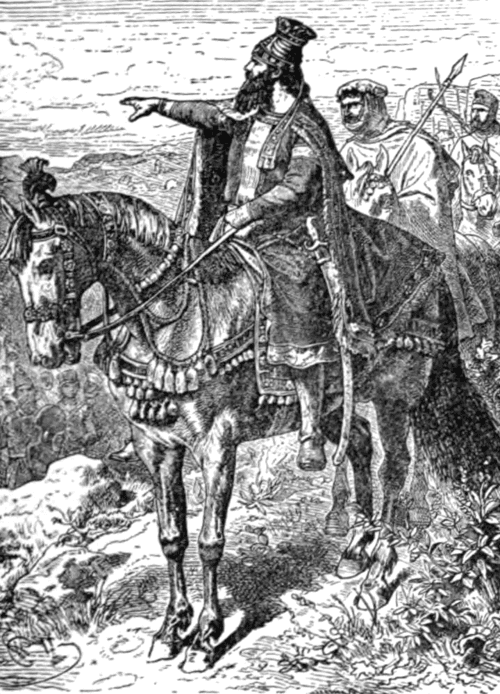
A weight you would hardly believe. In the evening, when the banquets end and the harps fall silent, my barû come to read the sky and the entrails of sacrificed animals for me. No campaign is decided, no foundation stone laid without first consulting the stars. Marduk speaks through signs, and the diviner is the one who knows how to hear. People think me all-powerful; in truth, before launching my war chariot toward Carchemish or the Levant, I await the word of the omens as the farmer awaits the flood of the Euphrates. A king who listens only to his own will marches toward his ruin. I prefer to listen to the gods, even when their answer displeases me — for they see what the high tiara on my head prevents me from seeing.
A king who listens only to his own will marches toward his ruin.
—After you, what do you think will remain of the name Nebuchadnezzar?
Two memories, I sense, that will never agree. Among my own people, in the Chronicles of Babylon, they will preserve the builder, the king whom Marduk loved, the one who made his city the wonder of the world. Among the vanquished of Judah, deported along the canals of Babylonia, they will preserve the man who burned their Temple and carried off their king captive. If I could imagine being read in a century or two, I think this second account would be the more tenacious — for pain writes deeper than pride. People remember better the one who took your house than the one who built his own. What matter: a name that crosses the centuries, even burdened with hatred, is worth more than oblivion. I have engraved mine in clay; the rest belongs to men.
Pain writes deeper than pride: people remember better the one who took your house.
Read further
This imaginary interview was generated by artificial intelligence from sources documented in Nebuchadnezzar II's profile. It dramatises what the figure might have said based on what we know about them, but does not constitute attested historical testimony. For primary sources and factual documentation, refer to the full profile.