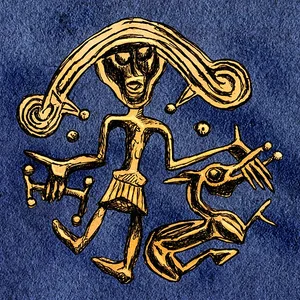

Týr is the Germanic god of war and justice in Norse mythology. He is famous for having sacrificed his right hand during the binding of the wolf Fenrir, a symbol of courage and martial honor. His name gave rise to “Tuesday” in English and “Dienstag” in German.
Tyr
Týr
9 min read
Frequently asked questions
Key Facts
- Týr is one of the Æsir, the principal gods of the Norse pantheon mentioned in the Prose Edda by Snorri Sturluson (13th c.)
- He sacrificed his right hand in the mouth of the wolf Fenrir to allow his binding, a founding act of his status as god of honor
- His name derives from Proto-Germanic *Tīwaz, cognate with Greek Zeus and Latin Deus, revealing a common Indo-European origin
- Týr presides over Scandinavian legal assemblies (thing), making him the guarantor of law and oaths
- His name gave rise to the third day of the week in Germanic languages: Tuesday (English), Dienstag (German)
Works & Achievements
The founding act of Týrian mythology: by agreeing to place his hand in Fenrir's mouth as a pledge, Týr allowed the gods to protect the cosmos. This voluntary sacrifice is considered the noblest gesture in Norse mythology.
As god of justice, Týr symbolically presided over the Thing assemblies where free men settled their disputes. His name is etymologically linked to the Germanic word *Thing*, attesting to this essential judicial function.
According to the Poetic Edda (*Völuspá*), at Ragnarök (the end of the Norse world), Týr will fight Garm, the hellish hound who guards the underworld. They will slay each other — a heroic death befitting his nature as a war god.
The Tiwaz rune (ᛏ), bearing his name, was carved on hundreds of archaeological objects across Northern Europe. This material diffusion testifies to Týr's importance in Norse warrior ritual practices.
The persistence of Týr's name in the days of the week — Tuesday in English, *tisdag* in Swedish, *tirsdag* in Danish/Norwegian — represents his most tangible cultural legacy, passed down over 2,000 years.
Anecdotes
When the Norse gods decided to chain the giant wolf Fenrir — fearing the prophecy of Ragnarök — none of them dared place a hand in the monster's jaws as a pledge of good faith. None, that is, except Týr. He willingly slid his hand between Fenrir's fangs. When the wolf realized he had been trapped by the magical ribbon Gleipnir, he bit down and tore the god's hand off. Týr did not cry out: the act became the ultimate symbol of willing sacrifice for the common good.
Týr's name survives every week in several European languages. In English, 'Tuesday' literally means 'Týr's day.' In Old Norse it was *Týsdagr*, in modern Swedish *tisdag*, and even the German *Dienstag* derives from the Germanic *Thingesdag* — the day of the assembly (the Thing) presided over by Tyr. This linguistic persistence shows just how central this god was to Germanic culture.
The Tiwaz rune (ᛏ), shaped like an arrow pointing skyward, is directly associated with Týr. Viking warriors carved it onto their swords, their shields, and even their skin before battle, believing it would grant them victory and divine protection. Blades bearing this rune have been uncovered in archaeological excavations across Scandinavia and England.
Roman soldiers stationed on Hadrian's Wall in Roman Britain during the 3rd century left votive inscriptions to 'Mars Thingsus' — a Romanized form of Tyr, equated with the god Mars. These inscriptions prove that the cult of Tyr was practiced not only by Germanic peoples but also adopted by military auxiliaries in the Roman provinces, a rare testament to religious syncretism between the Roman and Germanic worlds.
In Norse mythology, Týr is one of the very few gods considered wiser than Odin on matters of law and justice. At the assemblies known as Things, his name was invoked to guarantee oaths and judgments. Unlike Odin, the god of cunning, Týr embodied a straightforward, unflinching justice — which is why he was the only one among the Aesir with enough courage and integrity to face Fenrir.
Primary Sources
Týr is the most courageous and valiant, and it is he who decides victory in battles. Brave men must invoke him. It is said that a man is "as valiant as Tyr" when he surpasses others.
Loki said to Tyr: "You cannot be the right hand of justice, for your right hand, Fenrir tore from you." And Tyr answered: "I lack a hand, but you lack Hymir's wife."
Deo Marti Thincso et duabus Alaisiagis Bede et Fimmilene et Numini Augusti Germani cives Tuihanti v.s.l.m. — "To the god Mars Thingsus and to the two Alaisiagae Bede and Fimmilene, the Germanic citizens of the tribe of the Tuihanti have fulfilled their vow."
Carve victory runes if you desire victory, and carve them on your sword's guard, some on the fuller, some on the plates, and invoke Tyr twice.
Tyr then gave his word: "Let us go to Hymir, my father — he possesses an immense cauldron. Perhaps he will let us take it to brew the ale of the gods."
Key Places
Celestial realm where the Æsir dwell, among them Týr. It was on one of its plains that the binding of Fenrir was staged — the ordeal in which Týr lost his hand.
Island at the center of Lake Ámsvartnir where Fenrir was permanently bound following Týr's sacrifice. A symbolic site of the gods' ultimate victory over chaos — deferred until Ragnarök.
The chief sanctuary of Norse paganism until Christianization (c. 1090), where Týr was venerated alongside Odin and Thor. Adam of Bremen described its ritual sacrifices around 1070.
Roman fort on Hadrian's Wall where Germanic auxiliary soldiers left the earliest epigraphic inscriptions attesting to the cult of Týr under the name Mars Thingsus, dating to the 3rd century.
Medieval Iceland, settled in the 9th century by Vikings who brought their culture with them, is where the myths of Týr were committed to writing — most notably by Snorri Sturluson in the Eddas.
Typical Objects
Crafted by the Svartálves dwarves from six impossible ingredients (the sound of a cat's footstep, the beard of a woman, the roots of a mountain, the sinews of a bear, the breath of a fish, the spittle of a bird), Gleipnir is the binding that chained Fenrir. It was to allow its use that Týr sacrificed his hand.

A runic symbol shaped like an arrow pointing skyward, named directly after Týr. Viking warriors carved it on their weapons to invoke the god's protection and victory before battle.
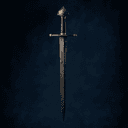
After the loss of his right hand, Týr was depicted fighting with a single hand, which made his bravery all the more remarkable. The one-handed sword is his primary warrior attribute in Norse iconography.

Symbol of Týr's judicial function, as he presides over the Things (Germanic judicial assemblies). The scales represent his role as an impartial arbiter between gods and men.
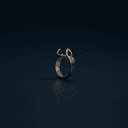
In Norse Germanic assemblies, solemn oaths were sworn on a sacred ring consecrated to Týr. Breaking such an oath was considered a direct offense against the god.
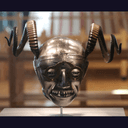
Although Vikings did not actually wear horned helmets in battle, later depictions of Týr associate him with this symbolic warrior attribute, particularly in 13th-century Icelandic manuscripts.
📷 CC BY-SA 4.0 · Wikimedia Commons ↗School Curriculum
Vocabulary & Tags
Key Vocabulary
Daily Life
Morning
In Norse belief, Týr begins his divine day by presiding over the deliberations of the Aesir in Asgard's great halls. He is said to be consulted by the gods on matters of justice before any important decision. His presence inspires the calm and rigor needed for sound judgments.
Afternoon
Týr's mythological afternoon is devoted to preparing for battle: he grants his favor to warriors who have honored him and carved his rune onto their weapons. On earthly battlefields, the Vikings believed they could feel him guiding their sword arm in single combat, where honor was at stake.
Evening
In the evening, Týr feasts in Asgard's great halls alongside the other Aesir. Despite his missing arm — a permanent reminder of his sacrifice — he takes part in the banquets with dignity. Skalds (Norse poets) sing of his deeds, and warriors who fell in battle join him in the afterlife.
Food
Like all Norse gods, Týr feeds on Asgard's divine fare: boar meat (notably Sæhrímnir, the ever-reborn boar), mead brewed in giant cauldrons, and fish from mythical rivers. This divine food grants the Aesir conditional strength and immortality.
Clothing
Týr is depicted as a high-ranking Norse warrior: a chainmail tunic (brynja) worn over a wool garment, an iron helmet, and a wool cloak clasped at one shoulder — the other left free for combat. His right arm stump, often shown wrapped in cloth, is his defining mark.
Housing
As god of war and justice, Týr dwells in a magnificent hall in Asgard, its beams adorned with shields and captured weapons. The Eddas describe vast communal halls where the gods gather, built by giants in exchange for promised rewards — later refused.
Historical Timeline
Period Vocabulary
Liens externes & ressources
Références
Œuvres
Sacrifice de la main pour enchaîner Fenrir
Temps mythiques (in illo tempore)
Présidence du Thing — l'assemblée judiciaire germanique
Ère viking (VIIIe-XIe siècles)
Combat contre le chien Garm au Ragnarök
Fin des temps (prophétie)
Transmission runique — diffusion de la rune Tiwaz
IIe-Xe siècles
Héritage toponymique et linguistique — 'Tuesday'
Ier-IVe siècles (romanisation), en usage continu