Imaginary interview with Nelson Mandela
by Charactorium · Nelson Mandela (1918 — 2013) · Politics · 6 min read
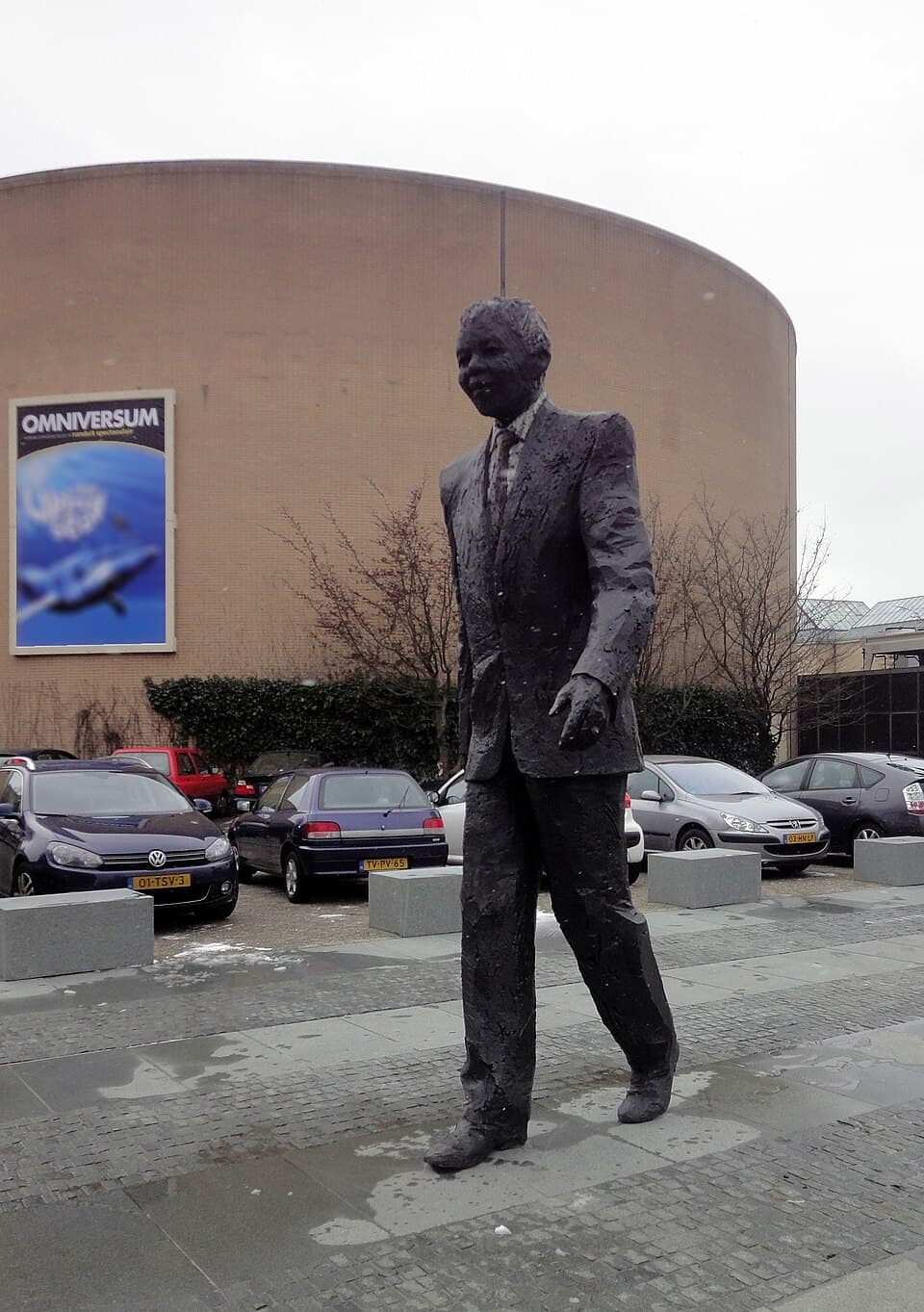
Qunu, late afternoon. Old Madiba receives us in the shade of a low wall, his gaze turned toward the green hills of the Transkei where he herded cattle as a child. His voice is slow, measured, without a trace of bitterness; he speaks as one unfolds a very long road.
—Before the prisoner and the president, who was the child of these hills?
I was born in 1918 at Mvezo, but it was here, in Qunu, that I was a child — herding cattle, sliding on rocks, listening to the elders tell of the time before the arrival of the whites. They call me Madiba, from my clan name, among the Thembu. This is not a genealogical detail: before being a prison number or a head of state, I am the son of a lineage. During great ceremonies, I still carry the chief's staff, the knobkerrie, and I happily eat umngqusho, that stew of corn and beans from my childhood. It is in Qunu that I have asked to rest one day. One can travel the whole earth, one always returns to the hill that saw us born.
One can travel the whole earth, one always returns to the hill that saw us born.
—How does a lawyer trained in non-violence come to found an armed wing?
For years, we believed in peaceful demonstrations, petitions, the defiance campaign inspired by Gandhi. Then came Sharpeville, in 1960: police fired into the backs of an unarmed crowd, sixty-nine dead. The regime banned us, imprisoned us, killed us, and we answered with prayers. A cornered man eventually must choose his weapons. In 1961, we founded Umkhonto we Sizwe, the Spear of the Nation. We targeted pylons, railways, government buildings — sabotage, not bloodshed; I did not want a war where civilians would fall. This was not a renunciation of peace, but an admission that non-violence requires an adversary who also refrains from shooting.
Non-violence requires an adversary who also refrains from shooting.
—At the Rivonia Trial, you faced the death penalty. Why did you choose to speak rather than defend yourself?
In 1964, at the Rivonia trial, my lawyers urged me to be cautious. I chose not to stand there as an accused man pleading, but as a man who knows why he is on that bench. I said what I still believe today: “I have fought against white domination, and I have fought against black domination. I have cherished the ideal of a democratic and free society in which all persons live together in harmony and with equal opportunities. It is an ideal which I hope to live for and to achieve. But if needs be, it is an ideal for which I am prepared to die.” The court sentenced me to life imprisonment. Yet I left that room strangely free, for you cannot chain a man who has already made peace with his own death.
—Twenty-seven years of detention. What, on Robben Island, kept you from sinking?
When I was taken to Robben Island, I thought I had lost everything. Then the administration granted me a patch of earth along the courtyard wall. I planted tomatoes, peppers, onions. You see, in an existence where you decide nothing — neither the hour of waking, nor what you eat, nor whom you see — that patch of earth was the only place where my will still mattered. I watered, I weeded, I watched over every sprout as one watches over a fragile idea. And when the plants yielded, I shared the harvest with my comrades. A man learns patience from a garden better than from a sermon: you must sow, wait, accept that a season is lost, and begin again.
A man learns patience from a garden better than from a sermon.
—It's said that this prison became a kind of school. What did you mean by that?
They wanted us idle, stupefied by the limestone quarry where dust burned our eyes from morning to night. We did the opposite. Between pickaxe blows, we discussed law, history, strategy — the more educated taught the others. We called it, with a smile, our university. In the evening, in my cell two meters by two, I secretly wrote the pages of what would become Long Walk to Freedom, on notebooks that I then had buried in the garden. The guards dug up part of them in 1977; I thought the manuscript lost forever. But an idea, like a seed, sometimes survives underground much longer than one imagines.
—In 1985, Botha offered you freedom. Why did you refuse it?
In 1985, President Botha made me an offer: freedom, if I publicly renounced armed struggle. Twenty-three years in a cell, and they handed me the key. But what freedom does one buy at the price of one's people? I dictated my reply and my daughter Zindzi read it before the crowd in Soweto: a prisoner cannot make contracts, and what freedom were they offering me as long as the people's organization remained banned? Your freedom and mine cannot be separated. Refusing was harder than staying imprisoned; but some refusals are the only way to remain standing, and a man who bends once on the essential never quite rises again.
Some refusals are the only way to remain standing.
—Do you remember that February 11, 1990, the day the doors finally opened?
On February 11, 1990, the gates of Victor Verster prison opened. I was seventy-one years old and had not seen a free street in nearly thirty years. I took Winnie's hand and raised my fist — not in triumph, but to tell those who had struggled outside that we had made it together. The world's cameras filmed an old man relearning to walk as a free man. A few days later, in Cape Town, I told the crowd that our march to freedom would never retreat, that no obstacle would make us give up. But leaving prison was not the end of the road: after a great hill, one always discovers others to climb.
—Once president, you could punish. Why did you choose reconciliation over revenge?
We finally held our former oppressors, and the temptation of vengeance was immense — it would even have been legitimate. But a nation is not built on a graveyard of reprisals. I drew on an old wisdom of ours, ubuntu: a human being is only fully human through others. That is why we created, in 1995, the Truth and Reconciliation Commission. We offered amnesty to anyone who confessed publicly, in detail, the crimes committed under apartheid. Many criticized me for this leniency. But I wanted the victims to finally be heard and the perpetrators to face themselves — not to forget, never to forget, but so that the truth spoken aloud becomes the cement of a rainbow nation.
—That Springboks jersey you put on in 1995 stunned the country. What was on your mind?
In 1995, the Rugby World Cup was held in our country. Rugby, for my people, was the oppressor's game; many of my people hoped to see the Springboks lose, that green and gold jersey they hated. I understood that we had to do exactly the opposite of what resentment commanded. I walked onto the field before sixty thousand people, wearing that jersey, number six on my back — that of captain François Pienaar, an Afrikaner. When I handed him the cup, it was no longer a Black man and a White man face to face; it was two South Africans. You do not disarm a former enemy by humiliating him; you disarm him by showing him that he now has a homeland to share.
You do not disarm a former enemy by humiliating him; you disarm him by showing him that he now has a homeland to share.
—Among heads of state, you stood out with your colorful shirts. Was it simply personal taste?
For twenty-seven years, I was dressed in an orange jumpsuit, thinner than that of white prisoners — even in the fabric, apartheid ranked skins. On the day of my release, I vowed never again to wear another's uniform. The world's heads of state dress in dark suits and ties; I chose these loose patterned shirts, which came to be called Madiba shirts. This is not an old man's vanity. When an African enters the palaces of power dressed as an African, he says without a word that we no longer ask permission to exist. Clothing, sometimes, is a speech one does not even need to utter.
Clothing, sometimes, is a speech one does not even need to utter.
This imaginary interview was generated by artificial intelligence from sources documented in Nelson Mandela's profile. It dramatises what the figure might have said based on what we know about them, but does not constitute attested historical testimony. For primary sources and factual documentation, refer to the full profile.