Imaginary interview with Oedipus
by Charactorium · Oedipus · Mythology · 6 min read
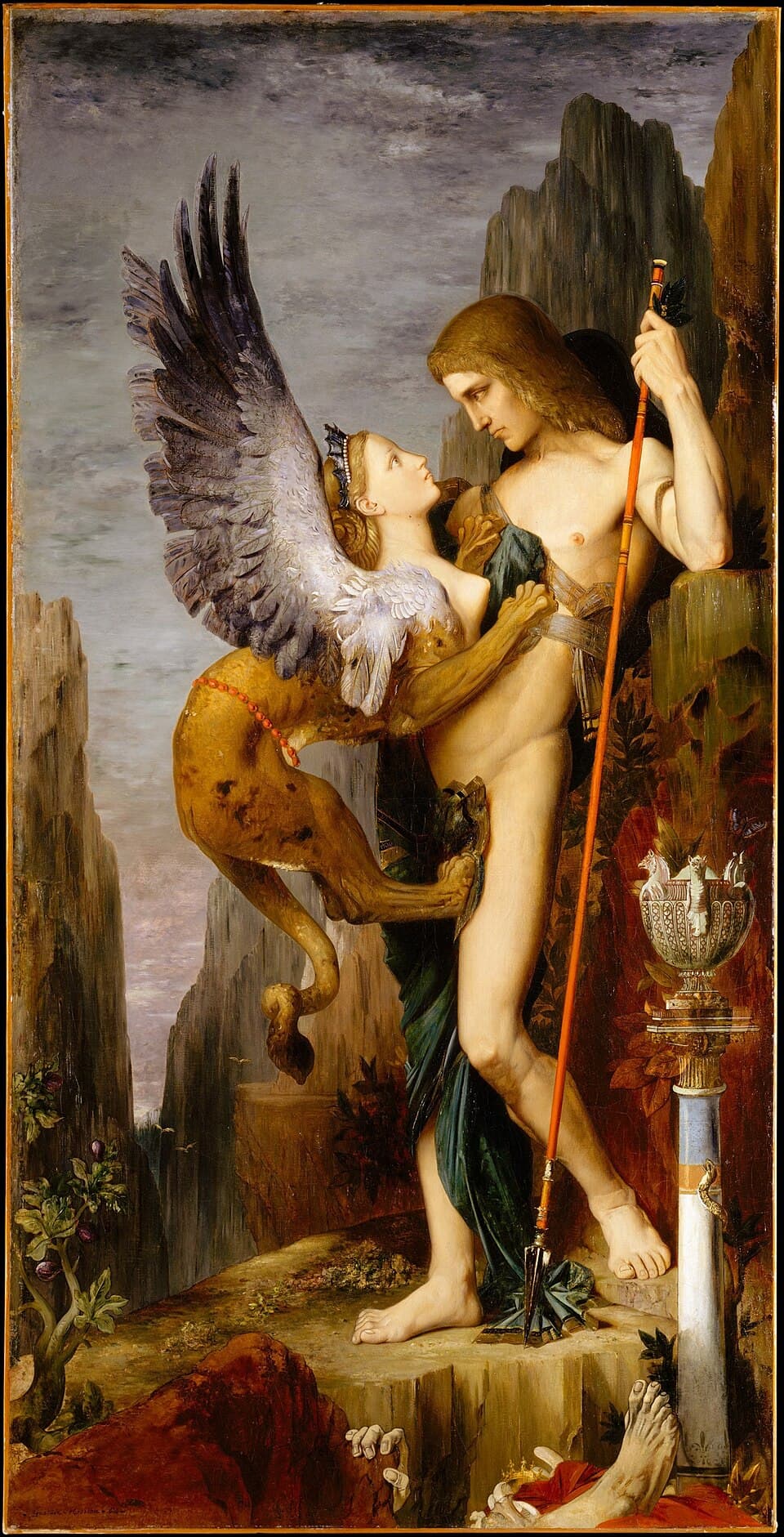
The path that leads from Thebes to the sacred grove of Colonus ends under olive trees that no one prunes. There, a blind old man, his hand resting on a smooth staff, waits for someone to sit beside him. His voice is low, but each word weighs like a stone slab.
—Everything in your story seems written in advance. How did you learn what the gods had decided for you?
You don't learn it, you receive it as you receive a lightning bolt. As a young man at Corinth, doubt gnawed at me about my origins, and I went up to Delphi to consult the god. The priestess did not answer my question: she spat the oracle at my feet, that I would kill my father and share my mother's bed. You may think one can flee such a word. I believed so too. I turned my back on Corinth never to see those I called my parents again. But the Moira is not a road you choose: it is the road itself, and you walk on it even when you think you are leaving it. The gods knew. They let me run.
The Moira is not a road you choose: it is the road itself.
—You were fleeing that very oracle when an event precipitated everything. What happened on the road?
A narrow crossroads, near Daulis, where three paths meet. A chariot came from the opposite direction, driven by an old man surrounded by his retinue. I was ordered to give way, brutally, and the old man struck me with his goad as one drives away a dog. Blood rushed to my eyes. I had my sword at my side, a bronze blade such as every traveler carries, and I used it. They all fell, or nearly. I left without a look back, proud to have avenged the insult. I did not know I had just cut down Laius, king of Thebes, and that the insolent old man was the father whose murder I had sought to avoid. The first half of the oracle had been fulfilled on a few feet of dust.
I did not know I had just cut down the father whose murder I had sought to avoid.
—Soon after, Thebes was terrorized by the Sphinx. How did you succeed where so many others had failed?
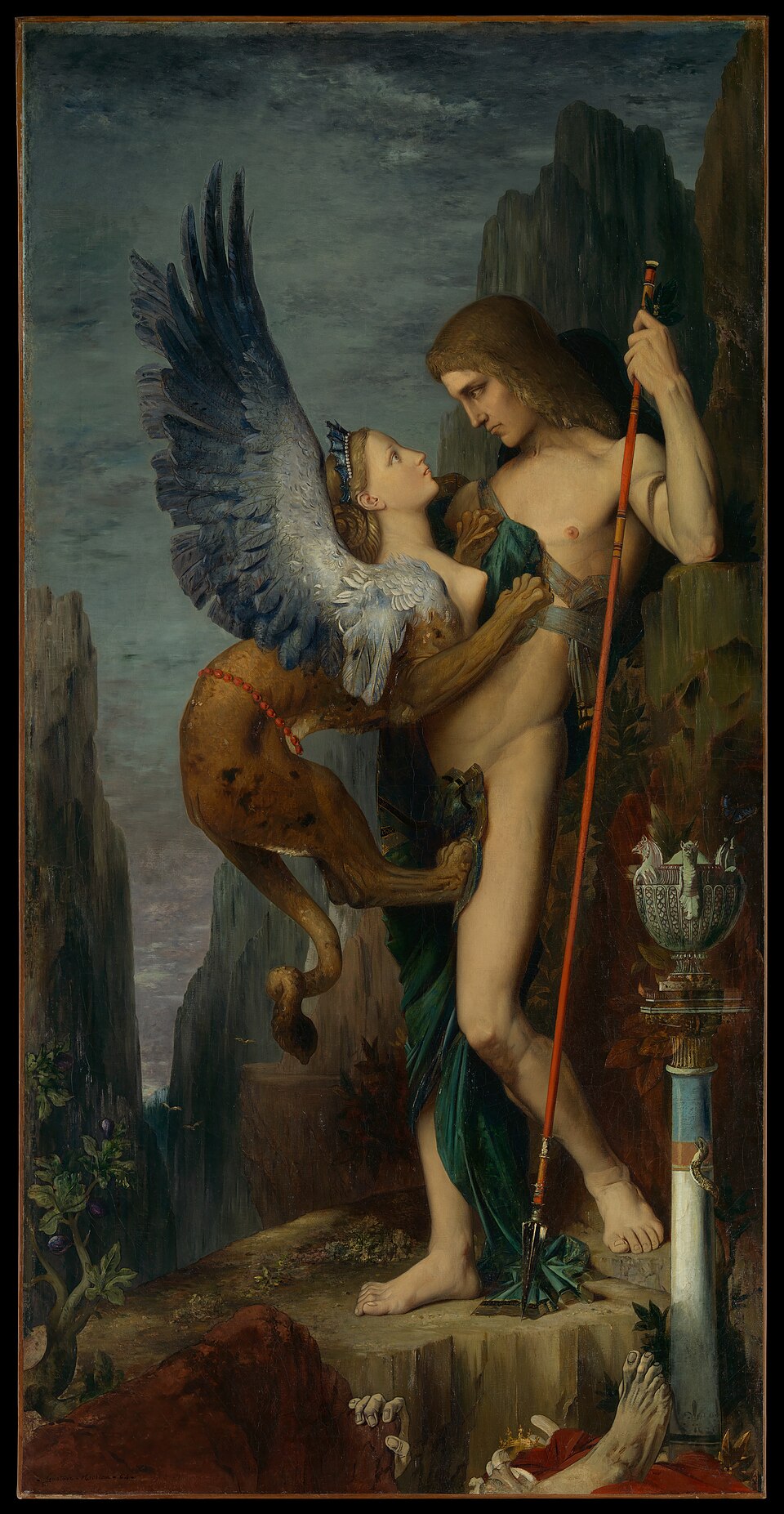
The monster stood at the gates of Thebes and devoured anyone who failed to solve its riddle: what being walks on four legs in the morning, two at noon, and three in the evening? Men looked for beasts, gods, wonders. I answered what was before us all, and which no one wanted to see: man. The child who crawls, the adult who stands upright, the old man leaning on his staff. The Sphinx hurled itself into the void, and the city carried me in triumph. I was given the crown of Thebes and the hand of the widowed queen, Jocasta. What irony: I had read the riddle of all human life, and I was blind to my own. I answered "man" without understanding that I was describing my own end, that old man with a staff that I have become.
I had read the riddle of all human life, and I was blind to my own.
—Now you are king. What kind of ruler were you at first to the city you had saved?
A beloved king, and I say it without shame, for those years were the only straight ones of my life. Thebes had emerged from terror, and I governed it with a concern for justice. I presided over assemblies, settled disputes, ensured that the weak were not crushed by the strong. The people looked at me as a savior, almost as an equal of the gods — and that is the trap, you see. When you have solved the riddle that vanquished all others, you believe your intelligence is limitless. That confidence, the Greeks give it a name: hubris. I held the Theban scepter with a firm hand, I thought myself master of my kingdom. I was only the husband of my mother, seated on a throne built on a corpse.
I was only the husband of my mother, seated on a throne built on a corpse.
—Then the plague came. How did the truth begin to rise up to you?
The plague fell upon Thebes like a divine hand, the flocks rotted, women gave birth to death. I sent to consult the god, and the oracle was clear: the city harbored the murderer of Laius, and as long as he remained, the stain would stay. I, the king, swore to hunt down that criminal and drive him out. Understand the horror: I launched the hunt against myself without knowing it, I cursed my own head with the mouth of my own oath. Every witness I questioned tightened the knot: the shepherd of Cithaeron, the messenger from Corinth, the scars on my pierced ankles. The truth did not fall on me all at once. It rose, slow, relentless, like water in a leaking boat, until I could no longer breathe.
I launched the hunt against myself without knowing it, I cursed my own head.
—The moment of total revelation was also one of terrible loss. Can you speak of it?
When the last veil fell, Jocasta had already understood before me. She entered the bridal chamber, that chamber where she had borne me and then married me, and she closed the doors. I arrived too late: she had hanged herself. I loosened her body, and from her clothes I tore the golden brooches that fastened them. You know what I did with them. I raised them against my own eyes, again and again, because those eyes had looked upon what no man should see. I no longer wanted to see my children who were my brothers, nor the city I had defiled, nor the light that shone on my parricide and my incest. People speak of punishment. I say: it was the only purification left to me, to tear the world from my eyes.
Those eyes had looked upon what no man should see.
—Many judge you guilty. Do you consider yourself responsible for what you did unknowingly?
That is the question that has torn me ever since I walk in the dark. Did I want to kill my father? No: I struck an insolent stranger at a crossroads. Did I want to marry my mother? No: I took as wife a queen who was offered to me. My hand acted, my heart was ignorant. And yet the stain is there, real, and the plague does not lie. The gods had said everything at Delphi before my birth; how could I be guilty of fulfilling what they had decreed? But how could I be innocent, I whose hands shed the blood of Laius? I do not decide. I carry both at once, guilt and innocence, like two stones sewn to my sides. Perhaps that is the lot of man: to answer for deeds that others, up there, have decided for him.
My hand acted, my heart was ignorant — and yet the stain is there.
—After exile, you wandered for a long time. What becomes of a king when he has nothing left?
He becomes what he had guessed in the riddle: the three-legged being, the old man leaning on a staff. I left the throne to my sons, Eteocles and Polyneices, and took to the road as a beggar, my hand on the shoulder of my daughter Antigone, who served as my eyes. No more purple, no more crown, no more megaron where the nobles dined — only the dust of the roads and the bread given to a blind man out of pity. It is a strange lesson, you know: I have known both extremes of human life, the summit and the void, and I tell you, man is nothing but a breath that passes from one state to the other. The same staff that answers the riddle supports me today. The loop has closed on me.
I have known both extremes of human life, the summit and the void.
—And here you are at Colonus, at the end of your road. What have you come to seek under these olive trees?
Peace, at last — and perhaps more. Colonus, this sacred grove at the gates of Athens, is the place where the oracle told me I would find rest. Strange fate: the defiled one that every city drove out would become, by dying here, a blessing for the land that welcomes him. King Theseus received me without spitting in my face; he saw in the wandering blind man a suppliant to protect, not a plague to flee. My sons, for their part, did not lift a finger to help their father in his misery, and I have not forgotten it. I feel the end approaching, and for the first time I do not fear it. I have walked all my life toward a fate I was fleeing; here, under these trees, I finally walk toward it without turning my head.
I have walked all my life toward a fate I was fleeing; here, I walk toward it without turning my head.
—If you imagined that your story would still be told centuries later, what meaning would you wish it to have?
I do not know what men will read me, nor in what languages. But if my memory is preserved, let it not be for the thrill of blood and incest — the bards already make too much of it at their evening feasts. Let them rather remember this: a man can be wise among all, savior of a city, conqueror of the Sphinx, and yet walk straight toward his ruin without seeing it. Knowledge protects against nothing when the Moira has spoken. If I am read one day, may they learn humility before what surpasses us, and pity for one who errs without meaning to. I was not a wicked man. I was a man — and that, I believe, is the most terrible and most worthy thing one can say of anyone.
I was a man — and that is the most terrible and most worthy thing one can say of anyone.
This imaginary interview was generated by artificial intelligence from sources documented in Oedipus's profile. It dramatises what the figure might have said based on what we know about them, but does not constitute attested historical testimony. For primary sources and factual documentation, refer to the full profile.