Imaginary dialogue between Antigone and Oedipus
by Charactorium · Oedipus · Mythology · 6 min read
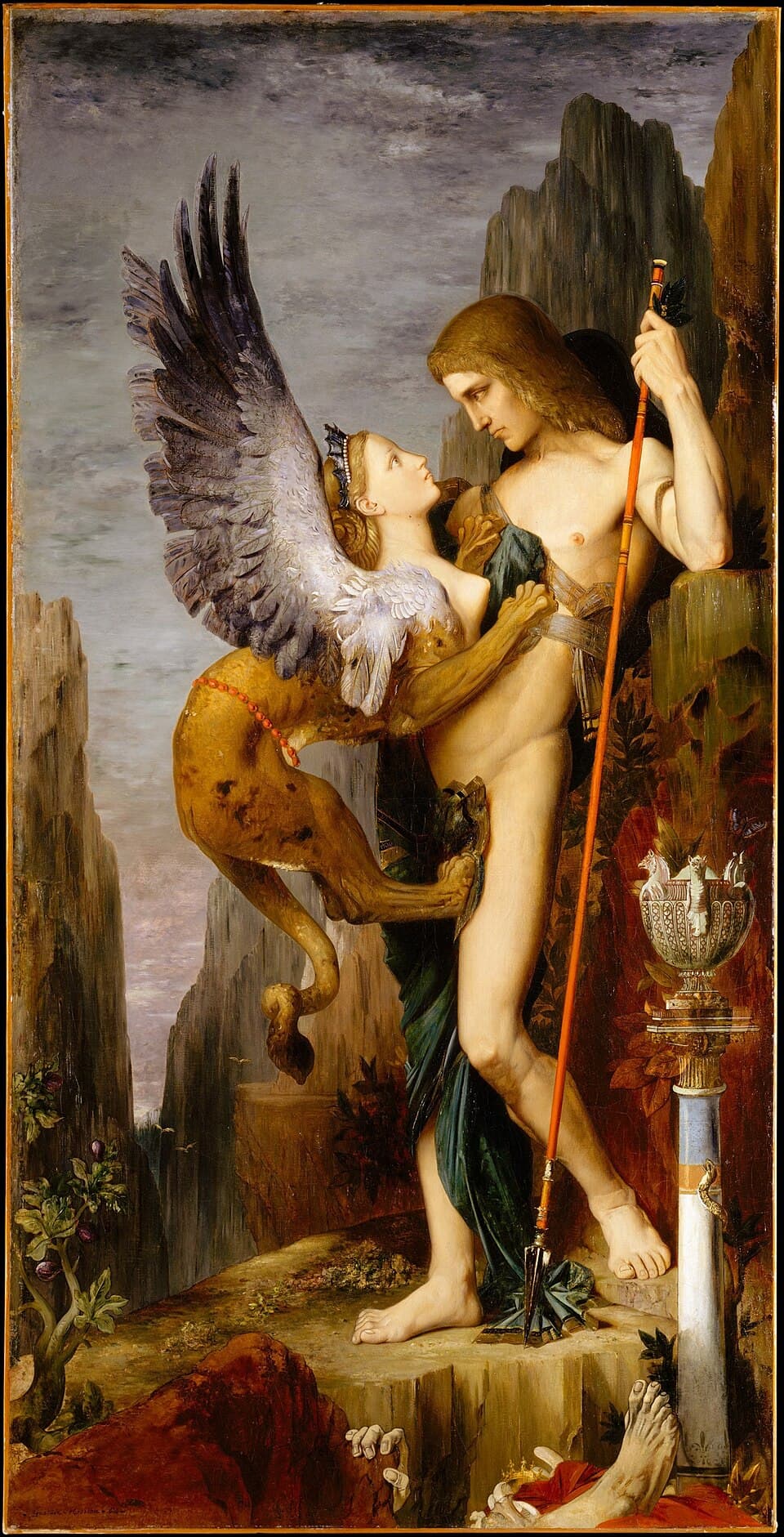
It is at the gates of Colonus, in a sacred grove of Attica, that the old Oedipus rests, blind and covered in the dust of the roads. His daughter Antigone, who for years has guided his steps and lent him her eyes, has led him to the cool shade of the olive trees. The distant song of birds and the smell of dry earth fill the silence. She sits beside him and, in a low voice, finally dares to ask what she had never dared on the roads.
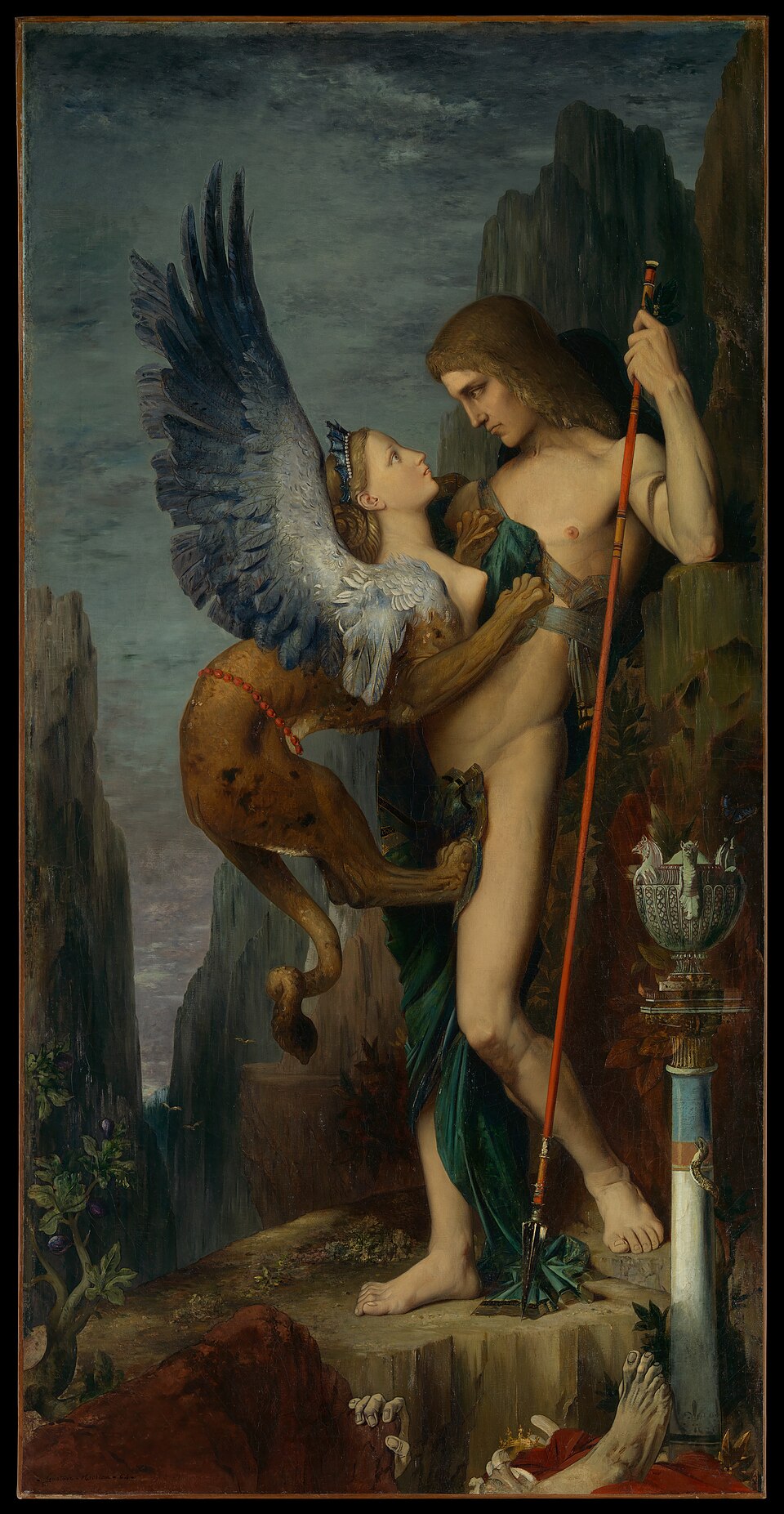
—Father, before I was born, you saved Thebes from the Sphinx. What word saved you from that monster that was devouring the city?
A single word, my daughter: man. The Sphinx asked what being walks on four legs in the morning, on two at noon, and on three in the evening. Others died from not understanding; I answered without trembling. Man crawls as a child, stands upright as an adult, leans on a staff in old age. Do you see the irony? Today I am that old man with the third leg, the staff that remains. Thebes crowned me, they gave me Queen Jocasta as my wife. I was the wisest man in Greece, the one who had solved the riddle of all men. And yet I had not solved my own. You who guide me, remember this: one can unlock the secret of the whole world and remain blind to oneself.
I solved the riddle of all men, and I had not solved my own.
—They whisper that it all began long before, at a crossroads. What happened on that road, near Delphi, that you never speak of?
I had fled Corinth, my child, because the oracle of Apollo had hurled a monstrous prophecy in my face: I would kill my father and marry my mother. I thought I was protecting those I loved by running away. On the narrow road, at the crossroads of Daulis, a chariot tried to force me aside. The old man driving it struck me. Blood rushed to my head, I drew my sword, and I killed him, him and almost all his retinue. I thought my honor was offended. I did not know. How could I know that that arrogant traveler was Laius, my true father? Fate, Moira, was waiting for me precisely on the road I had chosen to escape it. The gods do not lie; they only let us run toward what we think we are avoiding.
Moira was waiting for me on the very road I had chosen to escape it.
—When you entered Thebes as a victor, how did you feel receiving the crown and the queen's hand?
Pride, I admit. A liberated city hailed its savior; they placed the scepter in my hand, they made me king. Jocasta was beautiful, grave, older than me, and I married her as one marries a deserved reward. We ruled together, and you know the rest — you and your brothers, Eteocles and Polynices, your sister Ismene, you were born from that union I thought blessed. I dispensed justice, I wanted to be a righteous king. For years, Thebes prospered under my hand. And all that time, under the palace roof, slept the horror I never suspected. A man's happiness, you see, can rest entirely on something he does not know.
A man's happiness can rest entirely on something he does not know.
—And then the plague came to ravage the city. Father, how did you discover the unbearable truth that you yourself carried?
The plague was rotting Thebes, children were dying, cattle were perishing. I swore before the people to find the murderer of Laius, whose unavenged blood polluted the city. I searched, I interrogated, I threatened. What arrogance! I was conducting the investigation against myself without knowing it. The seer Tiresias, the blind man, saw clearly while I, who had my two eyes, saw nothing. Thread by thread, the shepherd of Cithaeron, the messenger from Corinth, everything came together. I understood that the old man at the crossroads was my father, and that Jocasta, my wife, my queen, the mother of my children, was also the one who had brought me into the world. The prophecy I had fled to the very end, I had fulfilled with my own hands, in my own bed.
I was conducting the investigation against myself without knowing it.
—Mother took her own life that day. Father, I must ask you: why did you gouge out your eyes rather than die as well?
Your mother took a fibula, one of those golden brooches that held her dress, and she hanged herself in the bridal chamber. When I found her, I tore off those same brooches and pierced my eyes with them until black blood streamed down. Dying would have been too gentle, my daughter. With what face would I have looked upon my father and mother among the dead, in the Underworld? How could I have borne the light of the sun after that? My eyes had seen without understanding; I punished them. Incest, parricide: two stains that no lustral water could wash away. I made myself a supplicant, a beggar, exiled from my own city. You followed me on the roads, you who had committed no fault. It is my shame that you carry with me.
My eyes had seen without understanding; I punished them.
—Father, your very name, Oedipus, I have always found strange. Where does it come from, and what does it hide about your childhood?
Oedipus — 'swollen feet'. Touch my ankles, my child: these scars have never left me. At my birth, the oracle had already spoken to Laius and Jocasta. Terrified, my parents had my feet pierced and bound, then they exposed me on Mount Cithaeron for the beasts to devour. A newborn, their own son, abandoned on the mountain! A shepherd took me in, and King Polybus of Corinth raised me as his child. I grew up a prince, knowing nothing, believing Polybus and Merope were my true parents. My name already carried my story: these wounded feet said that from the very first day, they had wanted to cut me off from the world of men. Fate had marked my flesh even before I could walk.
My name already carried my story: from the very first day, they had wanted to cut me off from the world.
—You who were abandoned as a child, and then had me as your guide on the roads—what do you think of this bond between fathers and their children?
Ah, Antigone, that is the cruelest of questions. My father wanted my death out of fear of an oracle; I killed him without knowing him. My own sons, Eteocles and Polynices, drove me out of Thebes and now quarrel over my throne without helping me in my misery. My whole lineage seems cursed in the very bond that should unite. And yet, look at yourself. You were bound to nothing; a dutiful daughter could have stayed safe within the walls. You chose the dust, the hunger, the insults of passersby, to guide a blind and defiled old man. When everything was taken from me, it was from my own blood that the only comfort came. The gods gave me a destiny to destroy me, but they gave me you to make it bearable.
The gods gave me a destiny to destroy me, but they gave me you to make it bearable.
—Do you truly believe, father, that nothing could have been different? Was there no moment when your hand was free?
That is the question I turn over every night. I believed I was free at every step: free to flee Corinth, free to strike at the crossroads, free to answer the Sphinx, free to marry the queen. Each of those acts I willed. And each brought me closer to the abyss that the oracle had named. Was it I who acted, or Moira acting through me? I cannot decide, and perhaps no man can. What I know is that I never intended evil. I did not know, and the gods knew it. They will call me guilty; I call myself stricken. Remember this, my daughter: a man can be innocent in his heart and damned in his deeds.
A man can be innocent in his heart and damned in his deeds.
—Father, here we are at the gates of Colonus, far from everything. When you are gone, what do you want them to say about you around the hearths?
I do not ask to be loved, Antigone, nor even pitied. But let them not forget my story, for it tells something that men refuse to hear: no one is safe. The wisest, the most powerful, the happiest of kings can fall in a single day into horror, without having sinned through excessive pride, without hubris. Let them tell of Oedipus not to shudder, but to learn measure and fear of the gods. They say that here, at Colonus, the earth will receive me and make my tomb a protection for those who welcomed me. A strange grace: the cursed man become a blessing. If I am to be remembered, let it be thus—as a man whom misfortune taught.
Let them tell my story not to shudder, but to learn measure and fear of the gods.
—One last thing, father. You who have lost everything—the throne, your eyes, your honored name—does anything remain that no one could take from you?
I still have the truth, my child, the truth I paid so dearly for. As long as I was king and clear-sighted, I lived in lies; blind and a beggar, I finally see what is. I also have your hand in mine on these roads, and the strange peace that comes over me as I approach my end. I was the man of the riddle, the man of the crossroads, the man with gouged eyes—and here I am, an old man leaning on his staff, the third leg of my own riddle. The circle closes at Colonus. Let the gods receive me as they will; I flee nothing anymore. For the first time since Cithaeron, I no longer run to escape my destiny. I sit down inside it, and I wait.
For the first time, I no longer run to escape my destiny: I sit down inside it, and I wait.
This imaginary interview was generated by artificial intelligence from sources documented in Oedipus's profile. It dramatises what the figure might have said based on what we know about them, but does not constitute attested historical testimony. For primary sources and factual documentation, refer to the full profile.