Kids interview Oedipus
by Charactorium · Oedipus · Mythology · 5 min read
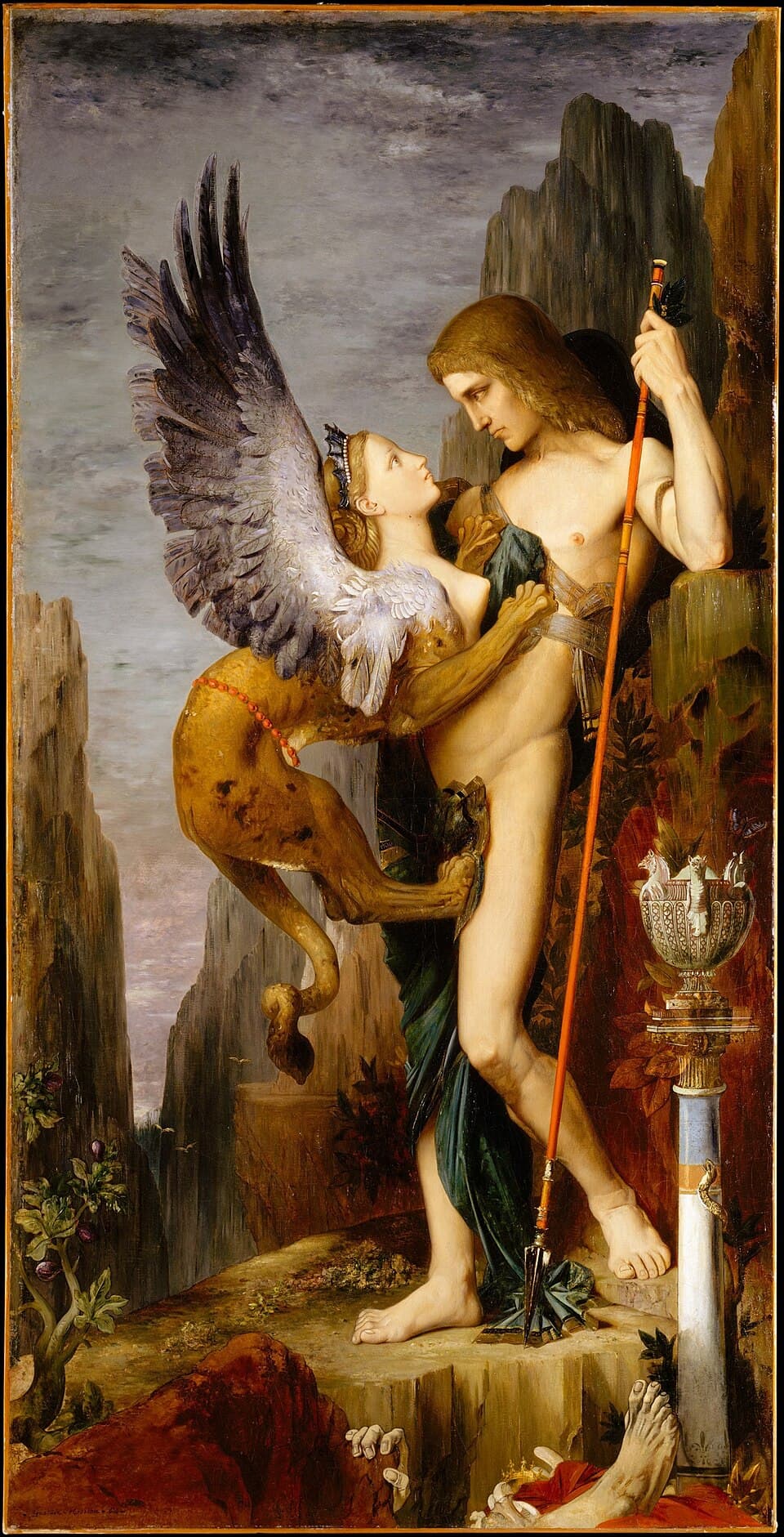
Two young visitors of twelve stop before an old man with closed eyes, seated near a sacred grove. They say he was king of Thebes. Gently, they dare to ask him their questions.
—Is it true you saved an entire city with just one right answer?
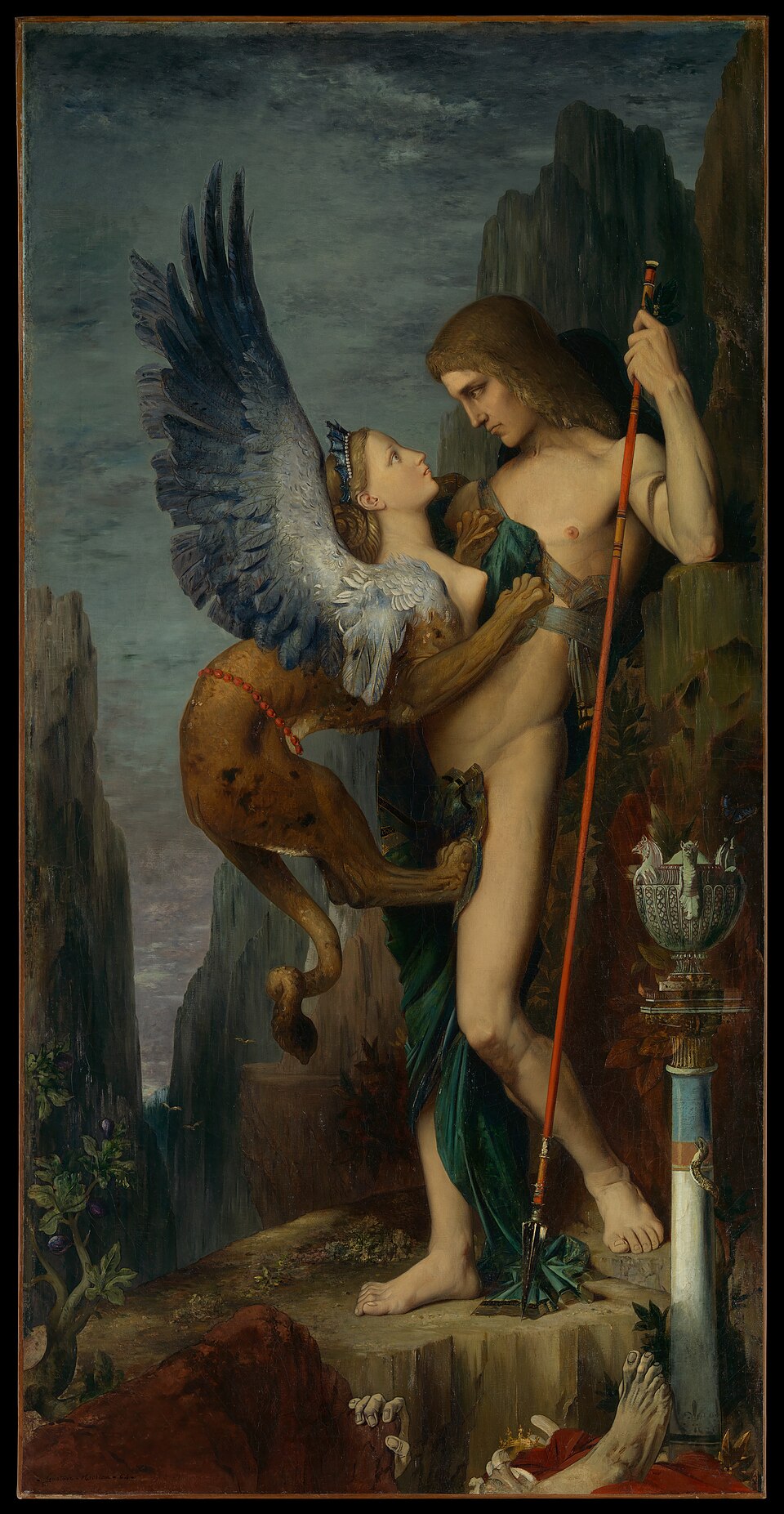
Yes, my child, and it is my only true pride. Imagine a monster posted at the gate of Thebes, with a lion's body and a woman's face: the Sphinx. It devoured anyone who failed its riddle. No one dared pass anymore. I stepped forward. It asked me what being walks on four legs in the morning, two at noon, three in the evening. I thought, then said: it is man. The baby crawls, the adult stands upright, the old man leans on a staff. The Sphinx fell. Thebes was free. They gave me the crown for that.
In the morning it crawls, at noon it walks, in the evening it leans: it is man.
—Were you proud when the people made you king?
Very proud, yes. You know, I had solved what the wisest had not guessed. The people of Thebes looked at me as a hero—a man born of humans, but capable of a feat thought reserved for sons of the gods. They offered me the hand of Queen Jocasta and the throne. That day, I believed my intelligence had made me stronger than anything. That was precisely my mistake. I forgot one thing: guessing a riddle does not mean knowing your own life. The Sphinx defeated, I was already walking toward my misfortune without seeing it.
Guessing others' riddles did not teach me to read my own.
—What happened at the crossroads? They tell serious things.
Very serious things, yes, and I must tell you honestly. On a narrow road near Daulis, an old man in a chariot tried to force me to yield the way. We quarreled. He struck me. In anger, I drew my bronze sword and killed him. I did not know who he was. I learned much later: he was Laius, my true father, the king of Thebes. A prophecy had said I would kill my father. I had done everything to flee it. And it was in fleeing it that I fell straight into it.
I fled my prophecy, and every step brought me closer to it.
—But how could you kill your daddy without knowing it?
Because I had never known him, my child. When I was born, I was taken away from my parents—I will tell you why. I grew up far away, in Corinth, believing other people were my father and mother. So that traveler on the road, that angry old king, was just a stranger to me. Imagine you meet a stranger who jostles you: you do not think for a second it is your own family. That is what the Greek destiny, the Moira, is: a force that even the gods do not circumvent. It made me commit, with open eyes, a blind crime.
—Who predicted all that to you? A magician?
Not a magician, no. At Delphi, on a mountainside, there was the greatest sanctuary of the god Apollo. People went there to hear the oracle: a sacred voice revealing what the gods had decided. My father Laius had gone there before my birth. The answer was terrible: his own son would kill him. Later, I too consulted Delphi, and I heard the same threat. Imagine being told, as a young man: you will one day do a great evil. What do you do? You flee. But one does not flee a word engraved in advance in destiny.
—Why didn't you just decide not to do it, then?
Ah, that is the question every wise child should ask. I tried, precisely! When the oracle announced that I would kill my father and marry my mother, I left Corinth never to harm them. I thought thus to break the prophecy. But you see, I was fleeing the wrong people: those in Corinth were not my real parents. By running away from them, I ran toward Thebes, toward Laius, toward Jocasta. For us Greeks, destiny is not a threat one avoids by cunning. It is a river. You can swim hard—it still carries you to the sea.
You can swim with all your strength: destiny is a river, it carries us.
—What was a day as king like, in your palace?
Beautiful and solemn at once. In the morning, in the megaron—the great stone hall of the palace—I received my counselors. They brought me the city's news. In the afternoon, I dispensed justice: the Thebans came to submit their disputes, and I judged. I wore the diadem and a cloak dyed purple, that color so rare that it told the people: here is your king. In the evening, we shared a meal, barley bread, olives, wine mixed with water. I was loved, my child. And all that time, I did not know that my happiness rested on two hidden crimes.
—Why was there a disease that killed many people in your city?
A plague, yes, terrible. The crops died, the animals died, the children too. The people came to beg me: you who defeated the Sphinx, save us again. So I sought the cause of this scourge. The oracle answered: a crime stains Thebes, and as long as the guilty remains unpunished, the evil will continue. I swore to find that guilty one and drive him out. Imagine my relentless hunt, day after day, clue after clue. And then, slowly, the horrible truth stared me in the face. The guilty one I hunted with such anger… was me.
I hunted the guilty with all my might, and the guilty was me.
—Why did you hurt your eyes? That must have hurt so much.
It hurt, yes, but less than what I had seen. When all the truth was there—that Laius was my father, that Jocasta, my wife, was my mother—she killed herself. I could not bear to look at the world anymore. With a golden brooch, I gouged out my own eyes. It was my punishment, my way to pay for the parricide and incest I had committed without meaning to. You see, I thought myself the most clear-sighted of men—he who sees riddles. And I had seen nothing of my own life. My open eyes had lied to me.
I had eyes to guess riddles, and none to see my life.
—And after, you left all alone? Weren't you afraid outside?
I was afraid, and I was alone, it's true. I left Thebes, blind, leaning on a beggar's staff. Can you imagine? Yesterday a crowned king, today an old man wandering the roads, groping. I walked a long time, despised, until a sacred grove near Athens: Colonus. That is where you find me. There, finally, I was welcomed without being driven away. I found a little peace there before dying. Destiny had taken everything from me—but it left me one last thing, my child: the peace of one who has accepted his lot without lying anymore.
—Do you think it's fair to be punished for things done without meaning to?
What a beautiful question, and difficult. No, it was not fair, and yes, I accepted it. That is the whole mystery of my story. I did not choose to kill Laius nor to marry Jocasta: I did it in ignorance. Yet the misfortune was real, and someone had to bear it. For us Greeks, one can be innocent in heart and guilty in deeds. That is tragedy: a good man crushed by a force greater than himself. I do not ask you to pity me, my child. I only ask you to remember that a man can fall without having intended evil.
One can be innocent in heart and guilty in deeds.
This imaginary interview was generated by artificial intelligence from sources documented in Oedipus's profile. It dramatises what the figure might have said based on what we know about them, but does not constitute attested historical testimony. For primary sources and factual documentation, refer to the full profile.