
Legendary king of Thebes in Greek mythology, Oedipus is the hero of a classic tragedy exploring inevitable fate and destiny. Having unknowingly killed his father Laius and married his mother Jocasta, he embodies the archetype of a character caught in forces beyond his control.
Oedipus
Oedipus
Thèbes
8 min read
Frequently asked questions
Key Facts
- Abandoned at birth to escape a prophecy foretelling that he would kill his father and marry his mother
- Kills Laius (his biological father) without recognizing him on the road to Thebes
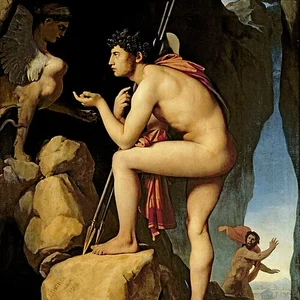
- Solves the riddle of the Sphinx and becomes king of Thebes, marrying Jocasta (his mother)
- Gradually uncovers the horrifying truth of his fate through a plague and a series of revelations
- Blinds himself upon discovering the truth; Jocasta takes her own life
Works & Achievements
Oedipus solves the riddle posed by the Sphinx, which had been terrorizing Thebes. By guessing that the answer is man, he frees the city and is rewarded with the hand of Jocasta and the crown of Thebes.
Oedipus rules Thebes and establishes just reforms, consolidating the city's stability following the defeat of the Sphinx. His early reign is marked by prosperity and the people's admiration.
Faced with a plague ravaging Thebes, Oedipus gradually discovers that he has unwittingly killed his father Laius and married his mother Jocasta, thereby fulfilling the prophecy he believed he had escaped.
After the revelation of his tragic destiny, Oedipus blinds himself as an act of atonement and goes into exile from Thebes, accepting the consequences of the inescapable fate that has befallen him despite his innocence.
Oedipus becomes the classic model of the ancient tragic hero, embodying the conflict between moral responsibility and fate — a central theme of Greek tragedy.
Anecdotes
According to mythological tradition as recorded by Homer and Sophocles, Oedipus received a prophecy from the oracle at Delphi foretelling that he would kill his father and marry his mother. His parents, Laius and Jocasta, terrified by this prediction, abandoned the newborn on Mount Cithaeron with his feet pierced. However, the child was taken in and raised by the king of Corinth, unaware of his true origins.
The name 'Oedipus' itself means 'swollen feet' in ancient Greek (oîdos = swollen, poûs = foot), referring to the wounds caused by the bindings on his pierced feet when he was left on the mountain. This linguistic detail shows how Greek mythology wove in symbolic elements to reinforce the tragic nature of the character.
The tragedy of Oedipus inspired the greatest Greek dramatists: Sophocles made him the central hero of three major works (Oedipus Rex, Oedipus at Colonus, and Antigone). Performed at the festivals of Athens in the 5th century BCE, these plays explored human destiny and moral responsibility in the face of the inevitable.
Once the truth was revealed — that he had indeed killed his father and married his mother — Oedipus gouged out his own eyes as an act of penance and went into exile from Thebes. This version of the myth, popularized by Sophocles, illustrates the Greek concept of catharsis, in which the recognition of truth leads to purification and acceptance of fate.
The myth of Oedipus has endured in Western culture far beyond antiquity: in the 20th century, psychoanalyst Sigmund Freud drew upon it to develop the concept of the 'Oedipus complex,' demonstrating how this legendary Greek figure continues to shape our modern understanding of human psychology.
Primary Sources
O my child, child of Laius, why do you question me? I will tell you the whole truth. An oracle told Laius that he would perish at the hand of his own son.
I am Oedipus, son of Laius. Wretched creatures, do you not know me? I am the one whose name is on every tongue, the one who committed the most horrible crimes.
Oedipus, blind and exiled from Thebes, curses his own sons who refuse to come to his aid in his misery.
Oedipus, son of Laius, who unknowingly fulfilled the oracle pronounced upon him by the gods.
Oedipus, once king of Thebes, blinded after discovering the horrible truth of his unwitting crimes, wanders in exile.
Key Places
The capital of the kingdom where Oedipus rules after solving the riddle of the Sphinx. It is in Thebes that he discovers his terrible fate, learning that he has killed his father Laius and married his mother Jocasta.
The place where Oedipus unknowingly encounters and kills his father Laius during a road dispute, fulfilling the first part of the Apollonian prophecy.
The sanctuary of Apollo where both Oedipus and Laius consult the oracle to learn their fate. The god reveals the terrible prophecy that shapes the entire tragedy of the Theban hero.
The place of refuge and death for the exiled Oedipus, where the aged hero finally finds peace. It is the setting of Sophocles' tragedy 'Oedipus at Colonus'.
The mountain where the infant Oedipus is abandoned on Laius's orders to escape the prophecy, and where he is eventually found and saved.
The city where Oedipus is raised by King Polybus after his rescue, unaware of his true origins until the truth gradually comes to light.
Typical Objects

Symbol of Oedipus's royal power as king of Thebes. This object represents his legitimate authority, gained by marrying Queen Jocasta and saving the city from the Sphinx.

A typical Bronze Age weapon used during the fateful encounter at the crossroads where Oedipus unknowingly kills his father Laius, triggering the fulfillment of the prophecy.

The Sphinx of Thebes posed a famous riddle that only Oedipus was able to solve, thereby saving the city and winning the hand of Jocasta. This riddle symbolizes his wisdom and his fate.

Symbol of Oedipus's royal status in Thebes. This crown represents his rise to power and the paradox of his position: a respected king, unaware that he has committed incest and patricide.

A common Greek garment fastener used to pin clothing. Jocasta uses a brooch to take her own life after the horrifying discovery of the truth about her relationship with Oedipus.

The medium of the fateful prophecy delivered to Laius: that Oedipus would kill his father and marry his mother. This object represents the inevitable destiny written in advance, which neither gods nor men can circumvent.

An object associated with the condition of the blind and exiled Oedipus at the end of his life. This staff symbolizes his fall from king to wandering suppliant, punished by fate.

A common object of antiquity; in some versions of the myth, the infant Oedipus may have been placed in such a vessel before being exposed on Mount Cithaeron, illustrating the practices of the era.
School Curriculum
Vocabulary & Tags
Key Vocabulary
Daily Life
Morning
As king of Thebes, Oedipus begins his day by consulting his advisors and generals in the royal palace. Dressed in his royal regalia, he receives reports on the administration of the city and military affairs. Like any high-ranking Greek man, he performs his morning ablutions before taking a light meal.
Afternoon
The afternoon is devoted to exercising judicial power: Oedipus presides over assemblies where he dispenses justice and arbitrates disputes among his subjects. He may also attend theatrical performances or take part in sacrifices to the gods — practices central to ancient Greek religious life.
Evening
In the evening, Oedipus shares a formal meal with his court and family in the megaron (the great hall of the palace). The evening continues with political discussions, exchanges with Theban notables, and possibly listening to poets or bards reciting Greek epics.
Food
As king, Oedipus enjoys a rich diet including beef, lamb, and fish, complemented by barley bread, vegetables, fruits, and cheese. Wine, diluted with water according to Greek custom, accompanies his meals. Honey and olives are regular features at his table.
Clothing
Oedipus wears the himation and chiton, typical Greek garments made of wool or linen. As king, he also bears a crown, a diadem, and garments dyed purple — the color of prestige. His appearance is that of a distinguished, mature man, a symbol of his royal authority.
Housing
King Oedipus resides in the royal palace of Thebes, a monumental structure of stone and wood organized around a central courtyard. The palace includes private apartments, reception halls, kitchens, and outbuildings. Mycenaean architecture defines this seat of power, with its thick walls and massive gates.
Historical Timeline
Period Vocabulary
Visual Style
Un style visuel puisant dans l'esthétique de la poterie grecque antique et de la Renaissance, combinant la noble simplicité des figures grecques classiques avec un dramatisme baroque. L'atmosphère est sombre et introspective, marquée par des contrastes d'ombre et de lumière mettant en avant la tragédie inévitable et la fatalité qui pèse sur le héros.
Sound Ambience
Une ambiance sonore de tragédie antique grecque, mêlant les échos des salles de marbre du palais de Thèbes à des cordes résonnantes et des instruments traditionnels grecs, traversée par les voix chuchotées d'un chœur exprimant la fatalité inévitable et le destin implacable du roi maudit.
Liens externes & ressources
Références
Œuvres
Résolution de l'énigme du Sphinx
inconnue
Règne et réformes de Thèbes
inconnue
Découverte de la vérité sur sa destinée
inconnue
Actes de pénitence et exil
inconnue
Archétype littéraire du tragique
inconnue