
A monster from Greek mythology with the body of a lion and the head of a woman, the Sphinx guarded the gates of Thebes. It posed a deadly riddle to travelers and devoured those who failed to answer. Defeated by Oedipus, it threw itself off a cliff.
Sphinx
Sphinx
Grèce antique
7 min read
Frequently asked questions
Key Facts
- The Sphinx is a hybrid creature: the head of a woman, the body of a lion, and sometimes the wings of an eagle
- It posed the riddle: 'What creature walks on four legs in the morning, two at noon, and three in the evening?'
- Oedipus answered 'man,' which broke the Sphinx's power
- Defeated, the creature threw itself from the top of its rock near Thebes
- The myth is most famously told in the tragedy Oedipus Rex by Sophocles (5th century BC)
Works & Achievements
A masterpiece of Greek tragedy in which the Sphinx serves as the dramatic starting point: her defeat by Oedipus is the founding act that sets the royal catastrophe in motion.
The first text to place the Sphinx within the genealogy of Greek monsters, born of Typhon and Echidna, rooting the character in primordial cosmogony.
A tragedy recounting the aftermath of the Oedipus myth, in which the Sphinx is evoked as the winged plague that ravaged Thebes before being defeated.
A mythological compendium that provides the most detailed physical description of the Sphinx and recounts in full the episode of the riddle and the monster's downfall.
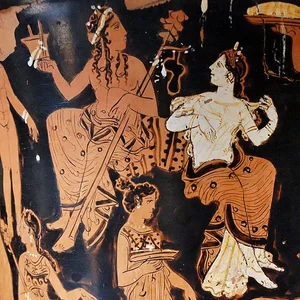
Numerous Greek ceramics depict the Sphinx perched on a column or swooping down on a man, attesting to the myth's popularity in figurative art.
Anecdotes
The Sphinx posed one and the same riddle to every traveler who tried to enter Thebes: "What creature walks on four legs in the morning, two legs at noon, and three legs in the evening?" The answer was man, who crawls as a child, walks upright as an adult, and leans on a cane in old age. No one before Oedipus had ever answered correctly.
According to Hesiod, the Sphinx was the daughter of Typhon and Echidna, two primordial monsters of Greek mythology. Other traditions make her the offspring of Orthrus, the two-headed dog, and the Chimera. Her monstrous origins explain her role as a fearsome guardian at the gates of the city.
When Oedipus answered the riddle correctly, the Sphinx was so overwhelmed by shame and defeat that she hurled herself from the top of her rock. This self-destruction of the monster freed Thebes from a curse that had lasted for years, and earned Oedipus the hand of Queen Jocasta.
The word "sphinx" most likely comes from the Greek "sphingein," meaning "to strangle" — a reference to the way the monster killed its victims. Some mythographers specify that it strangled or devoured them after they failed, making the Sphinx a figure of inevitable death for anyone who lacked wisdom.
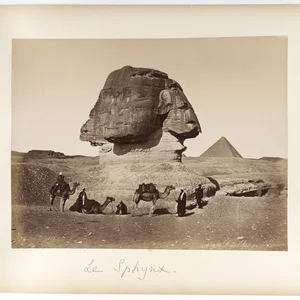
The Sphinx is not exclusively Greek: in Egypt, the Great Sphinx of Giza depicts a lion with a human male head, a symbol of royal power. The Greeks borrowed this Eastern motif but gave it a female head and an ominous character, transforming a symbol of protection into a figure of menace.
Primary Sources
"It was the Sphinx with her dark songs that forced us to let pass what we could not fathom."
"She [Echidna] also bore the deadly Sphinx, the bane of the Cadmeans, and Cerberus who devours raw flesh."
"The Sphinx had the face of a woman, the breast, paws, and tail of a lion, and the wings of a bird. She had learned a riddle from the Muses, and seated herself on Mount Phicium."
"The winged Sphinx, scourge of this land, snatched our citizens in her cruel talons and carried them up into the heights of the heavens."
Key Places
A rocky hill overlooking the roads leading to Thebes, where the Sphinx had made its lair. It was here that it posed its riddle and hurled its victims into the void.
The city terrorized by the Sphinx, which blocked all access to it. The liberation of Thebes by Oedipus is one of the founding episodes of Theban mythology.
The Oracle of Apollo where Laius had learned the prophecy foretelling his death at the hands of his own son. The Sphinx's sending by the gods is tied to this oracular curse.
The city where Oedipus grew up with his adoptive parents before fleeing to escape the prophecy. His journey toward Thebes led him to face the Sphinx.
Typical Objects

The Sphinx perched on a rock overlooking the roads leading to Thebes. This rocky promontory was her lookout post and the place of torment for ignorant travelers.

The Sphinx possessed powerful wings that allowed her to swoop down on her victims or carry them off into the air. They symbolize her supernatural nature, at the crossroads of the animal and the divine.

The Sphinx's leonine body gave her animal strength and power. In Greek symbolism, the lion represents savage royalty and violent death.

In some artistic depictions, the Sphinx holds or displays a tablet or scroll bearing the riddle of the three ages of man, a symbol of knowledge forbidden to ordinary mortals.

The remains of victims devoured or hurled into the void littered the base of the Sphinx's rock. These bones reminded travelers of the fate awaiting them should they fail.
School Curriculum
Vocabulary & Tags
Key Vocabulary
Tags
Daily Life
Morning
At dawn, the Sphinx spreads its wings on the rock of Mount Phicium, surveying the roads of Boeotia from its promontory. The first rays of sunlight reveal the bones of the night's victims at the foot of the cliff. It waits, impassive, for new travelers to venture toward Thebes.
Afternoon
In the midday heat, travelers grow scarcer, but the Sphinx remains on the prowl. When an unfortunate soul draws near, it descends in silent flight to intercept them on the road, posing its riddle in a melodious voice that belies its violent nature.
Evening
At sunset, having devoured or hurled its daily victims from the cliff, the Sphinx retreats in absolute silence to its rock. By night, its ghostly presence haunts the people of Thebes, who avoid all travel and mourn their missing.
Food
The Sphinx feeds on the flesh of travelers unable to solve its riddle — a carnivorous diet that reflects its leonine nature. It consumes only those who have failed, making intelligence the sole protection against death.
Clothing
The Sphinx wears no clothing in any human sense: its hybrid nature serves as its own adornment. Its head crowned with long dark hair, its body covered in the tawny fur of a lion, its wings bearing the feathers of a dark eagle — its feminine beauty stands in stark contrast to its murderous bestiality.
Housing
The Sphinx dwells on Mount Phicium, a rocky spur commanding the approach roads to Thebes. Its 'domain' is a bare, wind-swept clifftop strewn with the remains of its victims — a territory of death that serves both as a barrier and as a merciless tribunal for mortals.
Historical Timeline
Period Vocabulary
Visual Style
Esthétique céramique grecque antique à figures noires et rouges, mêlant influences égyptiennes et style archaïque grec — monumentale, menaçante et stylisée.
Sound Ambience
Ambiance rocheuse et venteuse d'un col de montagne grec dominé par une présence menaçante : vent sur la pierre, battements d'ailes, silence lourd et voix énigmatique.
Liens externes & ressources
Références
Œuvres
Œdipe Roi — Sophocle
vers 429 av. J.-C.
Théogonie — Hésiode
vers 700 av. J.-C.
Les Phéniciennes — Euripide
vers 409 av. J.-C.
Bibliothèque — Pseudo-Apollodore
Ier-IIe siècle ap. J.-C.
Vase à figures noires (amphore attique au Sphinx)
VIe siècle av. J.-C.