Imaginary dialogue between Federico García Lorca and Pablo Neruda
by Charactorium · Pablo Neruda (1904 — 1973) · Literature · 6 min read
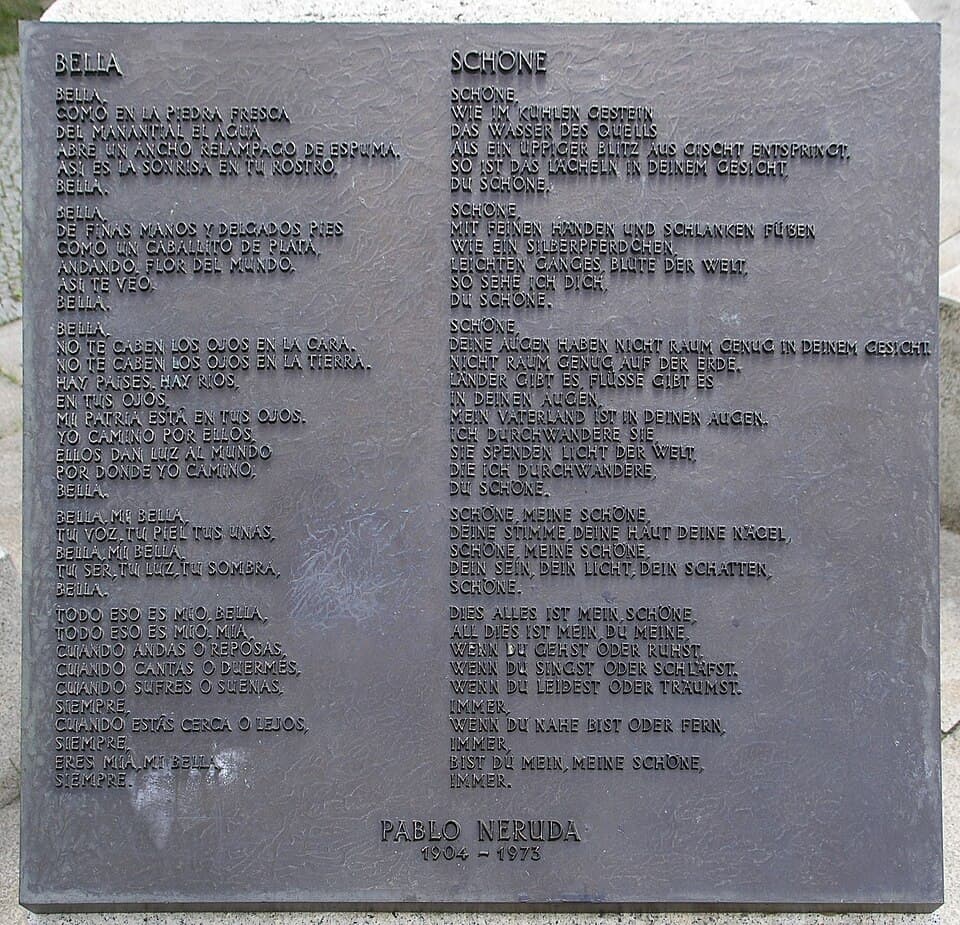
It is in the warm dimness of a taberna in Madrid, one evening in the winter of 1935, that Federico García Lorca meets Pablo Neruda over a pitcher of red wine. The street still echoes with the cries of merchants and the smell of hot oil comes through the half-open door. The two poets have known each other since the Chilean arrived as consul, and Federico, who welcomed him into the circles of the Generation of '27, comes tonight to get him to talk about his art as much as his torments. Between them, the complicity of laughter and the gravity of the times that are darkening.
—Pablo, you who get up when I am still going to bed, tell me: how are your verses born, in the morning, over there, facing your sea?
Federico, you know me, I'm good for nothing after midnight for writing — it's in the morning that the hand obeys. At my home, on the edge of the Pacific, I always write with a pen, never with a machine, and always in green ink: for me it's the color of hope, the color of leaves and the sea when the sun shines through it. I sit down in front of the window, the ocean crashes against the rocks, and the words come like the tide, without me forcing them. Here, in Madrid, I don't have my sea, but I've kept the notebook and the ink. Poetry is not a matter of sudden genius, it's a patient craftsman's work that gets up early.
I write in green ink: for me it's the color of hope, the color of leaves and the sea.
—When you arrived among us, in Madrid, you had just come from your years in Asia. What did you find here that the solitude of the East had denied you?
You who opened the doors of your circles to me, Federico, you know what I found: brothers. In Burma, Ceylon, Java, I was consul of a country that forgot me, alone with my anxieties — that's where my Residencia en la Tierra came from, those dark poems where I struggled like a drowning man. In Madrid, I found again the light, the table, the wine, your voices. You, the poets of this generation, you taught me again that poetry could be a shared celebration and not a solitary lament. With you especially, I laugh for the first time in years. This city brought me back to life, and my poetry changed color along with my heart.
In Asia I was a drowning man; Madrid gave me back the light and brothers.
—We hear Spain rumbling, my friend. If war came knocking at our doors, would the poet you are take sides, or would he remain silent?
Federico, how can a man be silent when his people are being slaughtered? I am a diplomat, I should remain neutral, but my poetry knows no neutrality. If this land I love — your streets, your olive trees — were bloodied, I would write with that blood. A poet who turns his eyes from the suffering of his own people is nothing but a maker of pretty phrases. I would bring aid to my people, I would open my house, I would cry out in my verses what the rifles would want to silence. Beauty alone no longer suffices for me: I want a poetry that takes the hand of the fallen man. And you, Federico, you already know which side your own heart beats for — don't tell me otherwise.
A poet who turns his eyes from the suffering of his own people is nothing but a maker of pretty phrases.
—You who sing of great things, tell me: can a poet really make a poem out of an onion or an artichoke without debasing himself?
But Federico, it's the very opposite of debasement! Who decided that the poem should speak only of gods and heroes? An onion, when you peel it, is a cathedral of translucent layers; an artichoke is a warrior clad in scales. I dream of a poetry as vast as a chant that would embrace all of America, its mountains, its rivers, its forgotten peoples — an epic of the entire continent. But this same breath, I want to be able to place it on the poor man's table, on his bread, on his socks. The great and the humble are the two hands of the same poet. He who knows only how to sing of summits has understood nothing of the earth that bears them.
An onion, when you peel it, is a cathedral of translucent layers.
—When you received me in your home, I thought I had entered a cabinet of curiosities. Where does this fever for collecting these strange objects come from?
Ah, you noticed it, Federico! I am a child who never stopped having full pockets. My father was a railway worker, and since I was very young, trains have fascinated me — I collect miniature locomotives like others collect medals. But there are also the seashells that the sea gives me, the figureheads torn from old ships, the masks, the bottles of all colors. My houses are not cold museums: they are living beasts that I inhabit and feed with found objects. Each thing tells a journey, a meeting, a wave. I love to show all this to my friends, to put a seashell in their hand and tell them to listen to the ocean. Possessing these objects is possessing a little bit of the whole world.
My houses are not cold museums, they are living beasts that I inhabit.
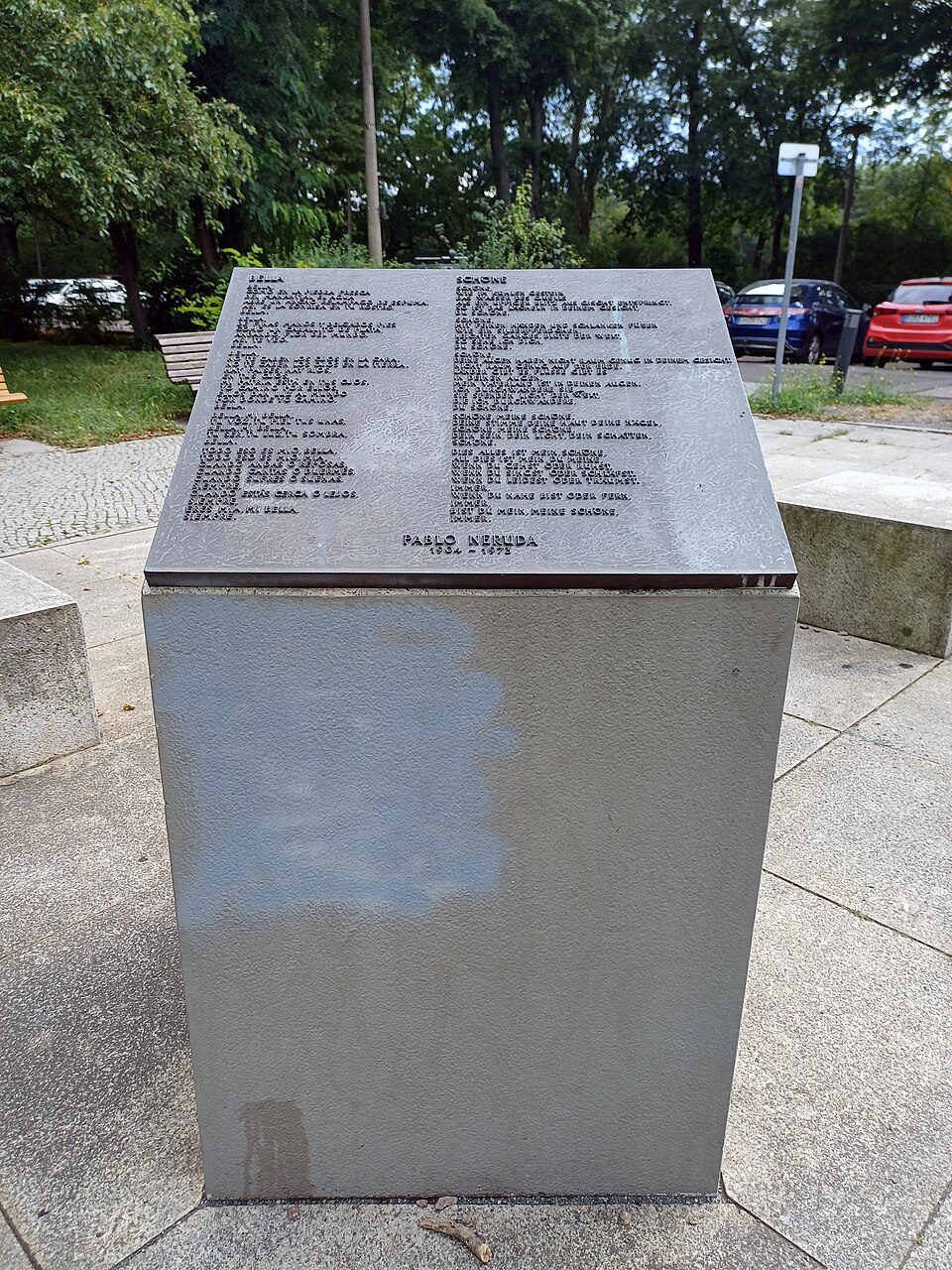
—In the evening, when you entertain, you uncork the wine and recite standing up. For you, should the poem sound aloud or remain on the page?
Aloud, always, Federico — you who sing at the piano, you know that better than anyone! A silent poem on paper is only half-born. In the evening, at my place, I cook a conger eel myself, I open a bottle from my country, and when friends are full, I get up and speak my verses like sharing bread. Poetry is made for the mouth and the ear, for the breath of a man in a room full of warmth. I sleep little, I prolong the nights in discussions until dawn. What I write alone in the morning, I give back to the community in the evening. The poem lives twice: once in the silence of the green ink, once in the voice that gives it to others.
A silent poem on paper is only half-born.
—Your country is so far, behind that wall of mountains. What does this Andes mountain range you sometimes speak of at night represent for you?
The mountain range, Federico, is the back of my country, a beast of stone and snow that separates Chile from the rest of the world. When I was little, in the rainy south of Parral and Temuco, these mountains were the horizon of all my dreams. They are magnificent and terrible: you only cross them on horseback, along frozen trails, and man is very small there. I don't know what life has in store for me, but something tells me that a Chilean poet always ends up having to face his mountain range, one way or another. It is my border and my pride. When I speak of it at night, it's because homesickness grips me — a Chilean far from his mountains is a tree uprooted.
The mountain range is the back of my country, a beast of stone and snow.
—You serve a state whose masters you do not always share. How far can a man go, in your opinion, to remain faithful to his conscience?
To exile if necessary, Federico, to losing everything. I wear the consul's suit, but my loyalty is not to the powerful, it is to those who suffer. If one day a man in power betrayed the people who brought him there, I would say it to his face, even at the cost of my freedom. I saw in Asia how money and empires crush the humble, and that is not forgotten. A poet has only one true homeland: justice. I would rather cross the mountains as a fugitive, sleep in the cold, than bow my back before lies. My conscience is the only house that can never be ransacked. You who know me know that I do not say this to play the brave man: it is the very core of my character.
A poet has only one true homeland: justice.
—In your Residencia, your voice was dark, almost despairing. Do you feel it is changing, since you have lived among us, in Madrid?
Yes, Federico, and I owe it to all of you. The Residencia en la Tierra was born from my Oriental solitude, from that anguish that gnawed at me when I was alone at the end of the world — a poetry of a drowning man, full of shadows and decaying matter. Today I feel something else rising in me: a need for clarity, for fraternity, for shared song. I no longer want only to groan, I want to name the world and reach out. Your laughter, your arguments, the wine we share, all of this pushes me out of my own night. My poetry now wants to embrace, not just suffer. You have been, my brother, one of those who tore me from my darkness.
I no longer want only to groan, I want to name the world and reach out.
—One last one, Pablo: if you had to save only one of your objects from a shipwreck, just one, which one would you take, and why that one?
What a cruel question, Federico! You ask me to choose among my children. But if the sea were to take everything, I think I would save a figurehead, one of those wooden women who have cut through the oceans at the front of ships. They have seen more storms than I have, they carry the salt of all voyages. And then, perhaps, a simple seashell, because it holds the entire sea in the hollow of the hand. The rest — the locomotives, the bottles, the masks — the sea can take them back, they are toys. But a figurehead and a seashell, that is the voyage and the ocean: everything I am. Keep that in memory for me, my friend, if ever misfortune should befall me.
A seashell holds the entire sea in the hollow of the hand.
This imaginary interview was generated by artificial intelligence from sources documented in Pablo Neruda's profile. It dramatises what the figure might have said based on what we know about them, but does not constitute attested historical testimony. For primary sources and factual documentation, refer to the full profile.