Imaginary dialogue between Aspasie de Milet and Pericles
by Charactorium · Pericles (493 av. J.-C. — 428 av. J.-C.) · Politics · 5 min read
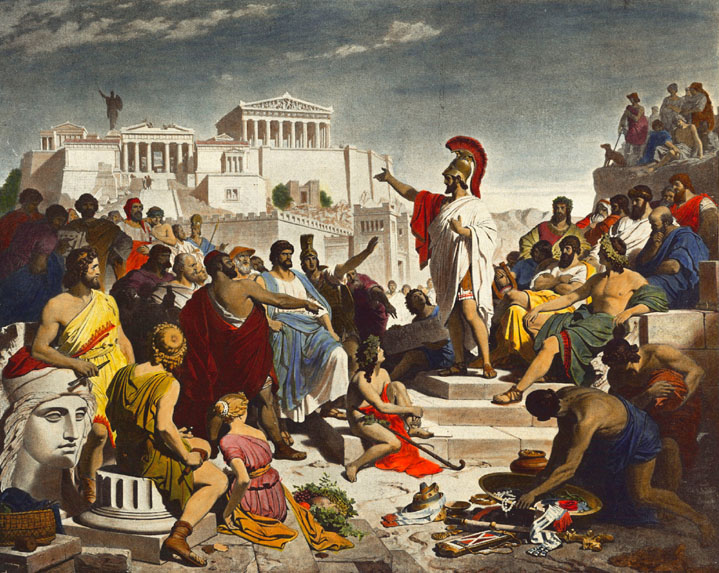
It is under the portico of their Athenian home, one evening in the summer of 431 BC, that Aspasia of Miletus finds Pericles as the war against Sparta has just broken out. The oil lamp flickers on the beaten earth floor, the scent of watered wine rises from the kylix placed beside him. They have shared their life for years, these evenings of symposia where Anaxagoras and Phidias mingle. Tonight, Aspasia does not come as hostess, but as a witness who wants to hear the man behind the general.
—You who receive me every evening bare-headed, tell me: why do you keep your helmet on in public, even when no enemy threatens you?
You know my vanity better than anyone, Aspasia. The comedians call me 'onion head' because of the elongated shape of my skull — the bronze helmet spares me that, I admit. But there is more to it. A general who is seen too much loses his authority; I show myself rarely, and always helmeted, so that my image remains that of the leader and not the man. The people need a face that inspires, not a head that is mocked at the Pnyx. Under this bronze, I remain the same you see here, unadorned — but that, Athens does not need to know.
A general who is seen too much loses his authority.
—Pericles, when you instituted the misthos, many cried that you were buying the people. What did you truly want?
I wanted poverty to cease being a wall. What use is an Ecclesia open to all if the poor citizen must choose between his day's work and his duty as a juror? So I had a stipend voted for those who sit on the courts and magistracies. From now on, the potter, the rower, the farmer can climb to the Pnyx without starving their children. My opponents say I corrupt the people; I say I make them free to govern. Democracy is not a word carved in marble — it is that bronze token a poor man clutches in his hand as he leaves the court.
Democracy is not a word carved in marble.
—My friend, it is whispered that you adorn Athens with the allies' gold like a vain woman with jewels. Does this accusation still wound you?
Thucydides son of Melesias launched it before his ostracism, and it still circulates. Yes, I had the treasury of the Delian League transferred to Athens; yes, the phoros of the allies paid for the Parthenon. But think: the allies pay us this tribute for their security, and we control the sea. If we protect them, by what right do they reproach us for building? I told the Assembly that if they blamed me for the expense, I would inscribe my own name on the monuments and pay from my purse. The people then wanted to pay for everything themselves. What we raise on the Acropolis does not adorn Athens — it makes her immortal in the eyes of the centuries.
What we raise on the Acropolis makes Athens immortal.
—You have often taken me to the construction site at dawn. What keeps you up there, amid the dust and stonecutters?
You remember those mornings when we climbed the Acropolis before the sun struck the Pentelic marble? Phidias awaits me there, his sketches in hand, and we discuss proportions as others discuss strategy. Ictinus and Callicrates bring me their clay models; I want to understand every column. This is not a prince's whim: I believe a city is judged by what it leaves standing. Battles fade, decrees yellow, but this temple will speak when we are nothing but names. That is why I go up there: to build something that war cannot destroy.
A city is judged by what it leaves standing.
—Anaxagoras has shared our evenings for so long. Why did you risk your credit to save him from an impiety trial?
Because Anaxagoras taught me to look at the world without trembling. He teaches that the sun is not a god but a mass of fire, and that is enough for devotees to demand his head. When he was accused of impiety, I used all my influence before the Assembly to snatch him from danger — a friend is not denied out of prudence. You who listen to him in the evening beside me know what I owe him: if I keep my calm in the storm, it is he who taught me. The city may fear reason; I hold it as the highest piety.
A friend is not denied out of prudence.
—Last year, when the eclipse seized the fleet with panic, I was told of your gesture with the cloak. What were you trying to show?
My helmsman was trembling, convinced the gods were condemning us by veiling the sun. Rather than scold him, I took my himation and placed it before his eyes: could he still see? No. Was it harming him? No more. The only difference between my cloak and the eclipse, I told him, is the size of what hides the light. A man who commands thousands of sailors cannot let fear govern in his place. Nature has its laws, and understanding them is better than conjuring them. Anaxagoras would have smiled to see me give a lesson with a piece of wool.
The only difference is the size of what hides the light.
—From your rostrum on the Pnyx, you seem to hold the people in your hand. How do you bend the Assembly to your will?
They think I am master of the Ecclesia, but I bend no one — I persuade. Before each session, I prepare my words on my wax tablets until no flaw remains. I never mount the rostrum for the pleasure of speaking; I remain silent for months and only speak on great occasions, so that my voice retains its weight. The people are sovereign, and it is they who vote; my art is only to show them where their interest lies with enough clarity that they choose it freely. You have seen me rewrite the same sentence ten times in the evening at this table: that is my secret, and it is nothing magical.
I bend no one — I persuade.
—Pericles, it is your own law of 451 that excludes our son from the city. How do you live with having built this wall with your own hands?
This is the wound I carry in silence, Aspasia, and you are the only one before whom I admit it. In 451, I restricted citizenship to children of two Athenian parents; I wanted to preserve the civic body, and I still believe it just for the city. But this law strikes our child, you who are from Miletus. I did not foresee that the justice of a people could one day turn against my own blood. A statesman must accept that his laws make no exception for him; that is the price of their authority. Yet some nights, I measure what my rigor has cost you, and him.
I did not foresee that justice would turn against my own blood.
—The plague took your two legitimate sons. You were seen weeping at the funeral, you who were said to be marble. What remains of that man?
They thought me incapable of tears; I placed a wreath on my sons' bodies and wept before all Athens, unable to stop myself. The plague spares neither the poor nor the general; it took my heirs as it takes a third of the city. I have left our son, the one my law of 451 had excluded — and I had to beg the Assembly to grant him the name of Athenian. What a reversal: I who raised the barrier came to beg for its opening. A man's strength, Aspasia, is not never to bend; it is to remain standing when everything inside him wants to collapse.
Strength is not never to bend, but to remain standing.
—Now that the war begins and your face grows grave, do you fear for what you will leave of Athens after you?
The war against Sparta will be long, I know, and I may not see its end. But what we have made of Athens does not depend on my life alone. I wanted a city where power belongs to the greatest number, where the poor vote, where marble rises for the gods and for men. If I fall, the Acropolis will remain, the misthos will remain, and the idea that a people can govern itself will remain. You have often told me in the evening that I was building for eyes I would never know. It is true. Athens is the school of Greece, and a school does not die with its master.
Athens is the school of Greece, and a school does not die with its master.
Read further
This imaginary interview was generated by artificial intelligence from sources documented in Pericles's profile. It dramatises what the figure might have said based on what we know about them, but does not constitute attested historical testimony. For primary sources and factual documentation, refer to the full profile.