Imaginary interview with Pericles
by Charactorium · Pericles (493 av. J.-C. — 428 av. J.-C.) · Politics · 5 min read
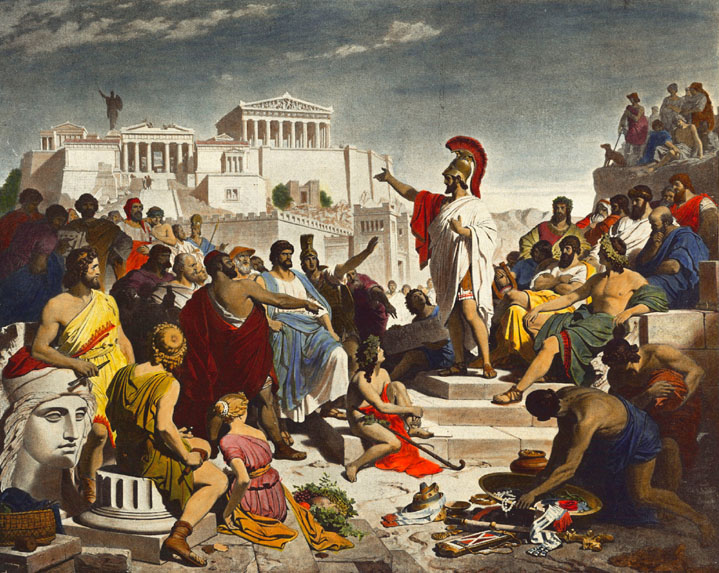
Athens, an evening in late spring. The sun sets over the Acropolis, its scaffolding still silhouetted against the sky, and Pericles, his cloak thrown over his shoulder, agrees to talk at the foot of the Pnyx, where he so often harangued the people. His voice is calm, his eye attentive; the man speaks little, but every word seems weighed.
—You have been much criticized for introducing a stipend for citizens serving on the courts. Why did you insist on it?
I have often been accused of paying the people to govern. But consider: a potter, a rower from Piraeus, how could he serve on a jury if he loses a day's bread? I instituted the misthos, a few obols, for jurors and magistrates, the price of attendance. The rich cried corruption. I say that a city where only the idle can judge is but a disguised oligarchy. On the Pnyx, I repeated tirelessly: our regime is called democracy because it places decision in the hands of the many, not a few. The bronze token a poor man clutches as he leaves the court is worth, in my eyes, as much as a golden statue.
A city where only the idle can judge is but a disguised oligarchy.
—How did you manage to convince, time after time, an assembly of several thousand men?
Nothing is more daunting than mounting the speaker's platform on the Pnyx before that sea of faces that is the Ecclesia. Before each speech, I prayed to the gods that no word might escape me that exceeded my thought. I prepared everything on my wax tablets, weighing each phrase as a goldsmith weighs gold. My opponents thought me cold, distant — but I was rarely seen outside public affairs, and that rarity was my strength: authority is worn out by constant display. Anaxagoras taught me that the mind, the nous, orders the chaos of things; I tried to order by speech alone a crowd that, without a pilot, is but a swell.
—What does the great project you launched on the Acropolis represent for you?
Go up there at sunrise and you will understand. Where the Persian flame had reduced everything to ashes, I wanted a city of marble that would defy the centuries. The Parthenon, we built it from 447 to 438 for Athena, and believe me, I climbed that hill a hundred times to watch the columns rise one by one. Old men like Thucydides son of Melesias accused me of adorning Athens like a coquettish woman covered in jewels. I replied that if the money was spent, it was our stonecutters, our carpenters, our painters who received it — the whole city gained glory and wages. A temple, you see, does not only feed the gods.
Where the Persian flame had reduced everything to ashes, I wanted a city of marble that would defy the centuries.
—You entrusted the entire project to your friend Phidias. What can you say about this collaboration?
Phidias was far more than a sculptor: he was my friend and the eye of the entire worksite. The architects Ictinus and Callicrates brought me their plans in clay models that I turned in my hands like a child with a toy. But it was to Phidias that I entrusted the whole — the great Athena of gold and ivory, the friezes, the harmony of it all. He was envied, accused of embezzling gold, and it was even claimed he had carved his face and mine on the goddess's shield. To strike Phidias was to try to reach me. That day I learned that building wonders attracts as many enemies as admiring eyes.
—The alliance born to repel Persia became, under your leadership, something quite different. How do you own that?
The Delian League was born to repel the Persians, each city paying its phoros, its tribute, into the common treasury. But times had changed: the threat had receded, and our allies now paid for the peace that Athens guaranteed them on the seas. Our fleet held the Aegean as a hand holds a cup. Had it become an empire? My enemies shouted it. I saw a city that had become the school of Greece, able to be flexible and accomplished in everything. He who enjoys security must pay its price; I merely demanded the fair share.
—The transfer of the Delian treasury to Athens caused a scandal. What do you say about it today?
Around 454, we transferred the league's treasury from the sacred island of Delos to the Acropolis. Officially, to keep it safe from the Great King; in truth, because Athens had become the beating heart of the alliance. With that gold the columns of the Parthenon rose. I know what is whispered: that I took the allies' property to adorn my city like a courtesan. But who defended those allies when Persia threatened? Our triremes. Who paid our rowers? That same treasury. One cannot separate a city's splendor from its power; one is the face, the other the arm.
—Your friendship with the philosopher Anaxagoras brought you trouble. Why did you defend him so firmly?
Anaxagoras of Clazomenae was my teacher and dearest friend. He taught that the sun is not a god but a mass of fire larger than the Peloponnese — words that made the devout shudder. When he was dragged before the judges for impiety, I used all my influence, then had him leave Athens before he could be condemned. To strike the teacher is often a roundabout way to reach the disciple: through him, they targeted my own closeness to such free minds. I regret nothing. A man who seeks to understand the course of the stars deserves better than an ostracism shard or hemlock.
A man who seeks to understand the course of the stars deserves better than an ostracism shard.
—A famous scene is told, during an eclipse, where you reassured an entire crew. What happened?
It was in 431, at the beginning of the war, as our fleet was about to set sail. Suddenly the day darkened at noon: an eclipse. My helmsman, though a seasoned sailor, was seized with terror, and the whole crew with him, reading it as a dire omen from the gods. I took my cloak, spread it before his eyes, and asked him if he saw anything terrible in that. He laughed. Then I told him that the eclipse was nothing other than the object hiding the sun being larger than my cloak. Anaxagoras had taught me not to tremble before the sky. Fear always retreats before one who knows how to name things.
Fear always retreats before one who knows how to name things.
—The plague struck Athens at the height of the war. How did you endure this ordeal?
The plague entered Athens in 430, behind those Long Walls where I had packed the farmers of Attica to shield them from Spartan spears. Cruel irony: in saving them from iron, I delivered them to the scourge. It carried off a third of the city — and it took my two legitimate sons. At the funeral, I, who was said to be made of marble, who had not shed a tear in public for thirty years, wept before all as I placed the wreath on my child's body. There is no strategy, no eloquence, no marble of the Acropolis that consoles a father. That day, I ceased to be Pericles and became nothing but a man.
That day, I ceased to be Pericles and became nothing but a man.
—You had to ask the Assembly to suspend, for your own son, a law you yourself had passed. How did you feel?
In 451, it was I who had passed the law restricting citizenship to children born of two Athenian parents. I believed it just, a guardian of the civic body. Then the plague took my legitimate sons, and I was left only with the child born of Aspasia, a foreigner from Miletus — thus excluded by my own hand. I had to appear before the Ecclesia and beg them to make an exception for him. What a spectacle, is it not: the lawgiver begging to suspend his own rule. The Assembly consented, perhaps out of pity. That day I understood that no law, however wise, ever foresees the grief of its author.
Read further
This imaginary interview was generated by artificial intelligence from sources documented in Pericles's profile. It dramatises what the figure might have said based on what we know about them, but does not constitute attested historical testimony. For primary sources and factual documentation, refer to the full profile.