Imaginary interview with Persephone
by Charactorium · Persephone · Mythology · 7 min read
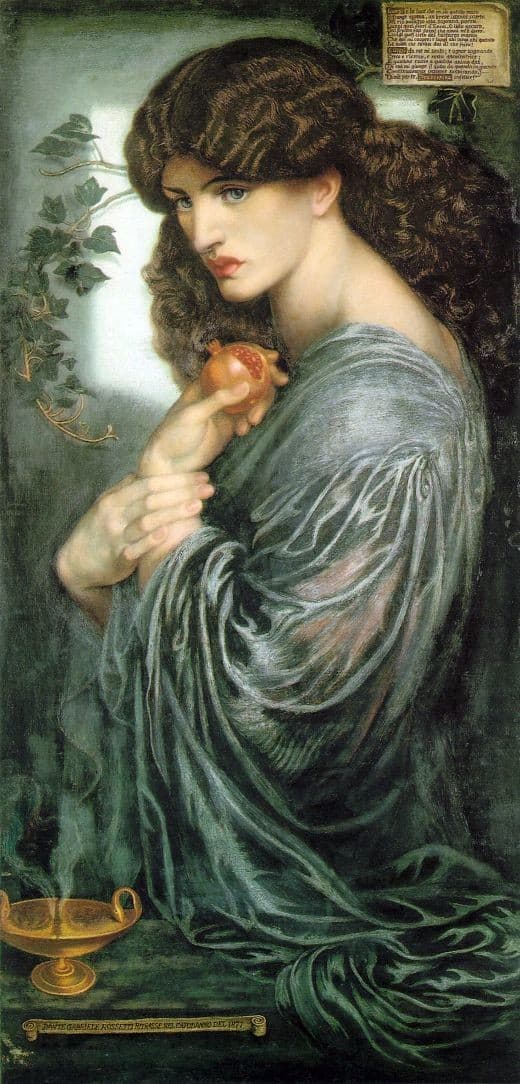
No one descends here without paying passage, yet she consented to the interview, seated on a throne of black marble veined with gold, an opened pomegranate resting on her knees. Above us, the distant murmur of souls; outside, somewhere, the spring that her mother prepares. Persephone speaks with a double voice — that of the maiden of the meadows and that of the queen of the dead.
—Do you remember the day Hades carried you off?
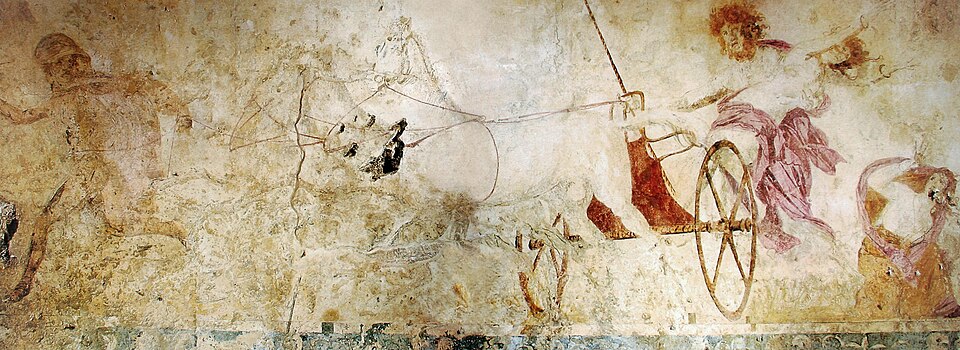
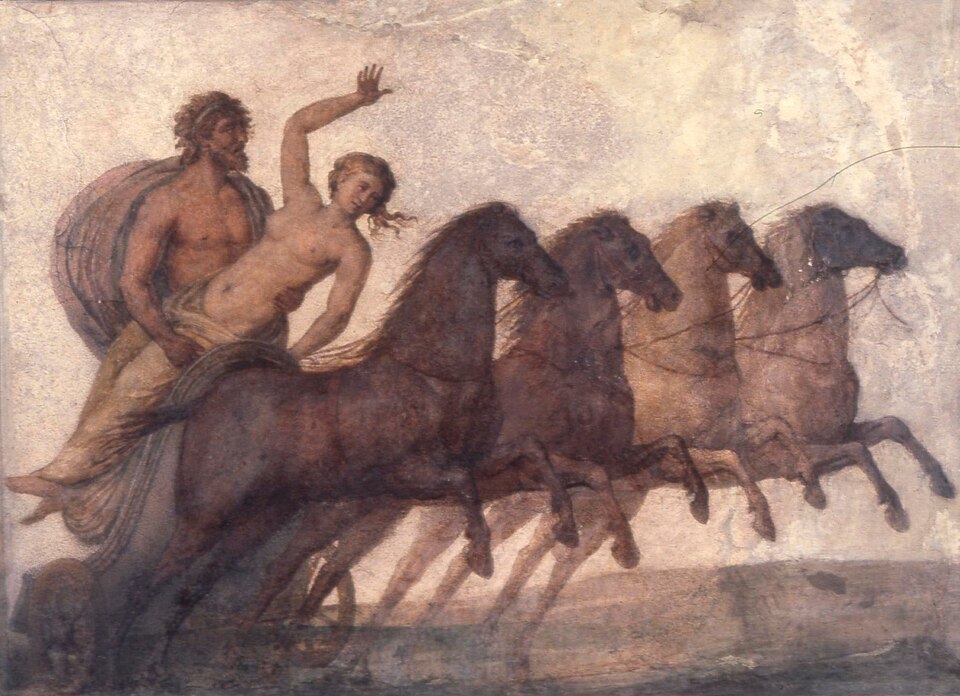
The ground split open without warning. I was picking flowers with my companions in the Fields of Nysa, my fingers closed around a narcissus larger than the others — the very one that Earth had caused to grow to trap me. Then the sound: a chariot pulled by black horses, bursting from the rift in the world. Hades seized me before I understood what was happening. I let out a cry that my mother alone, far away, felt pass like a blade. They say it happened in the plains of Sicily, near Enna; I remember only the smell of crushed petals and the sudden cold rising under my feet. The girl who played never came back: it was already the other one that the depths claimed.
I remember only the smell of crushed petals and the sudden cold rising under my feet.
—How would you describe that descent to the underworld kingdom?
Imagine the light closing above you like black water. Hades' horses do not gallop, they dive; the gates of the world slam shut behind the chariot and day becomes a memory. The Homeric Hymn to Demeter says that my piercing cry no one could hear — and it's true, except for my mother, who already wandered torch in hand searching for me from meadow to meadow. During the descent, I did not cry right away. I watched. I saw the rivers below, the shadows parting before us, and at the bottom that palace with walls of dark marble where they awaited me as a bride. People think a rape is only a moment of violence; mine was a long tipping, the exact moment when a child ceases to belong to the surface of the world.
—Let's talk about the pomegranate. Why did that fruit seal your fate?
It all comes down to a few seeds. In the Underworld, one does not eat the food of the dead with impunity: whoever tastes it belongs to the kingdom. Hades knew that when he offered me the pomegranate, that red fruit swollen like a heart, and I tasted it — out of hunger, through endured cunning, it matters little now. Those seeds bound me forever to his world. That is why my father Zeus himself could not return me whole to my mother. According to Apollodorus, I remain here six months of the year; the Latin poet Ovid, in his Metamorphoses, speaks of only three months among the shades. Men quarrel over the count; I only know that at a fixed date one half of me descends again. One fruit is enough to share a goddess between two worlds — that is the lesson I carry in my flesh.
—What happens up there when you leave your mother to descend again?
My mother Demeter stops nourishing the earth. She who makes the wheat ears rise lets the fields fall silent, the harvests wither, the cold settle in; that is what you call autumn and winter, and it is nothing other than her grief made visible. As long as I reign underground, she walks in mourning. Then comes the day of my return: as soon as I reappear, she raises the wheat, swells the seeds, calls back the flowers — and the fair season is reborn with me. Mortals have made my coming and going their calendar. Every spring they celebrate is my ascent; every barren field is my absence. They say my story explains the seasons; I would rather say it inhabits them, that no season turns without a mother weeping or rejoicing over her daughter.
—You are often portrayed as a mere victim. How do you see your reign?
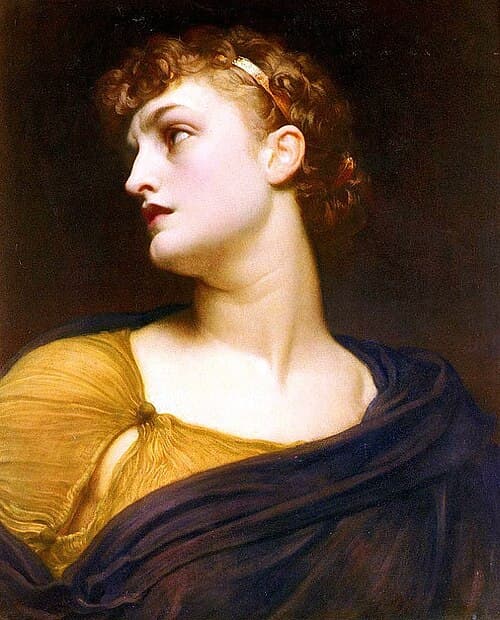
The maiden of the meadows did not survive, but the one who wears the gold crown was born. I am not a captive to be pitied: I am queen. Alongside Hades, the scepter in hand, I preside over the fate of the souls that pass through our gates. The living think I weep for my mother; they forget that I judge, that I decide, that the dead implore me as a sovereign and not as a stolen child. The rape tore me from the surface, yes — but it also gave me a kingdom that no other god of Olympus possesses outright. I learned the patience of darkness, the justice rendered without sun. Let them stop painting me trembling in a corner of the chariot: look instead at the diadem on my brow, and ask yourselves who now trembles before me.
The maiden of the meadows did not survive, but the one who wears the gold crown was born.
—What does a typical day look like for you in Hades' palace?
The subterranean morning — for there is one, even without dawn — I wake between walls of black marble studded with gold. I first listen to Hades telling me the affairs of the kingdom, then I receive the newly arrived souls, still dazed from crossing. The afternoon is spent judging: the complaints of the dead, the observance of eternal laws, the councils we hold with my husband and the Furies beside us. Nothing escapes the tribunal of the depths. In the evening, when the night below thickens further, I share the sacred meal in the great halls, surrounded by the nymphs and creatures that populate my domain. They think me idle in the shadows; in truth, I work for the balance of a world as populous as yours. Ruling the dead requires more vigilance than ruling the living: mine, after all, never sleep.
—What takes place at Eleusis, that sanctuary where your name is celebrated?
At Eleusis, in Attica, mortals reenact my story to forge a hope from it. For over a thousand years, crowds of pilgrims go up there each year, the torch in hand — that same torch with which my mother Demeter lit her way to search for me across the world. These are the Mysteries, rites that initiates swear never to reveal; I will therefore not betray what is murmured in the dark. But I can say this: one does not come there only for good harvests. One comes to tame death, to hear that descending underground is not merely to perish. This initiation rite promises the living that after their last breath, something awaits them that is not nothingness. My coming and going has become their consolation: if a goddess returns, perhaps the soul too knows a return.
—Why do men seek in your fate a promise for their own death?
Because I am living proof that one can cross my gates and reappear. All other dead remain; I alone return, each year, toward the light and toward my mother Demeter. The initiates of the Eleusinian Mysteries understood this: by following my descent and return, torch lit, they repeat within themselves the path they hope to take after the tomb. It is no coincidence that I am prayed to for the salvation of the soul as much as for the harvests. The pomegranate that binds me to the depths also binds me to the promise of renewal: what goes down can come up, what dies can sprout. Mortals do not have the luck of the gods, they do not return in person — but they cling to the idea that my cycle is a sign, and that the earth that will swallow them is the same that, in spring, blooms again.
—You are the only one who moves between three worlds. What do you see that the other gods ignore?
The gods of Olympus live in the light and rarely leave it; Hades never leaves his darkness. I pass through. I know the summit where my father Zeus thrones, the earth where my mother makes the wheat rise, and Tartarus where the shades reign. This crossing, no other makes. It has taught me something that the immortals above refuse to see: that the three worlds are not separate, that they communicate through me as through a living bridge. The grain that rots in the earth feeds the ear; the soul that descends to me was a breath up above. I am the seam between what shines and what is buried. That is why my importance goes beyond my rape: without this back-and-forth, the cosmos would be cut into watertight pieces. I see death and life as a single taut thread, and I am the one who holds it.
I am the seam between what shines and what is buried.
—What would you say to those who see you only as the queen of darkness?
That they have seen only one half of me. Yes, I rule over the dead, the scepter in hand, among the shadows and black marble. But the same goddess who judges souls makes the buds burst when she returns. I am the open pomegranate: blood and seed, end and beginning in the same fruit. The Greeks understood this by linking me to fertility as much as to the Underworld — for who better than I knows that dying and being reborn are the two sides of the same slope? Every winter, my descent withers the fields of my mother Demeter; every spring, my return resurrects them. They think me dark because they fear the place I rule. But ask the farmers, the initiates of Eleusis: they know that the queen of the dead is also the one who brings back the green season. I am not the darkness — I am its passage toward the light.
This imaginary interview was generated by artificial intelligence from sources documented in Persephone's profile. It dramatises what the figure might have said based on what we know about them, but does not constitute attested historical testimony. For primary sources and factual documentation, refer to the full profile.