Imaginary dialogue between Blaise Pascal and Pierre de Fermat
by Charactorium · Pierre de Fermat (1607 — 1665) · Sciences · 5 min read
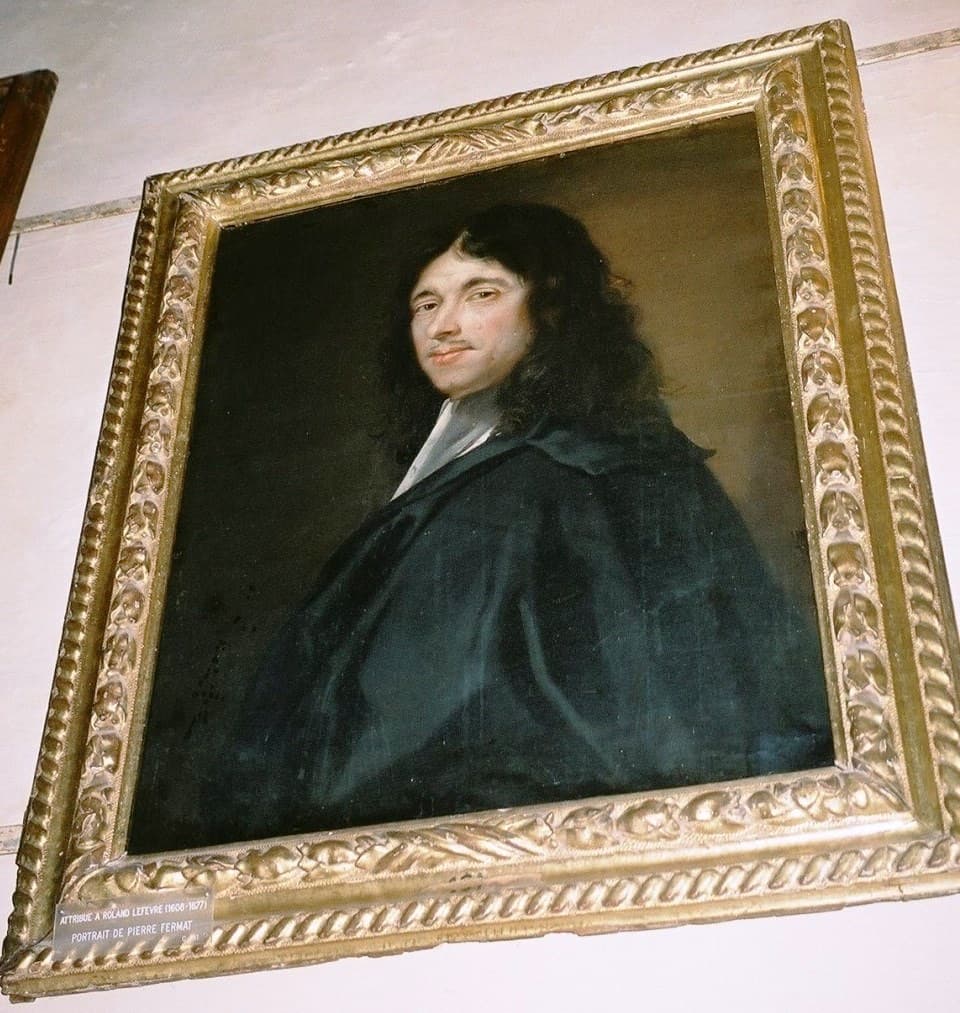
It is in Fermat's study, in Toulouse, on an autumn evening in 1660, that Blaise Pascal finally meets the man with whom, six years earlier, he exchanged those letters that changed their view of chance. A tallow candle lights the table cluttered with bundles and a worn copy of Diophantus's Arithmetica. The two men know each other by pen before knowing each other by face, and Pascal, frail in health but sharp in mind, comes to seek behind the discreet magistrate the mathematician that all learned Europe vies for. Outside, the Toulouse night is silent; inside, two kindred spirits are about to speak to each other at last.
—My dear Fermat, I find you amidst your Parlement dossiers. How do you manage to balance the magistrate's robe and the science of numbers?
You touch there, Blaise, on the division that rules my life. The day belongs to the Parlement: I instruct, I deliberate, I render judgments with my fellow councilors, and this office I purchased gives me rank and income. But do not be mistaken, it is not mathematics that relaxes me from the law—it is almost the reverse. When evening comes, when the house falls silent and I have only this candle, I become free again. Numbers command nothing from me; they invite me. I have never sought to make this art a profession or a title; it is my secret garden, and I enter it as one enters a forbidden pleasure.
When evening comes, when the house falls silent, I become free again.
—They say you are jealous of your rest, shunning honors and disputes. Is it modesty, or fear of seeing your leisure become a second burden?
Neither entirely, my friend. Honors do not cost me to refuse: I have enough from my office not to beg for others. As for priority quarrels, they are odious to me because they turn a joy into a lawsuit—and I have enough lawsuits by day. If I published, I would have to defend, respond, polish, chase after the recognition of men. Yet what I seek in a theorem is not applause, but that it be true. I infinitely prefer to send you a discovery by letter and let you savor it, than to print it and throw it to the disputers.
What I seek in a theorem is not applause, but that it be true.
—Remember, Fermat, that summer of 1654: we were writing to each other about the problem of points. What did you feel when you saw our two paths lead to the same number?
A rare joy, Blaise, and you know which one. We each started from our own side—you by your combinations, I by my enumeration of chances—and we arrived at the same division. In my letter of July twenty-ninth, I told you that if the first player is short two games and the second three, the first should take eleven-sixteenths of the stake. What struck me was not being right, but that two minds could, by different paths, meet at the same point like two travelers at a crossroads. We together gave a measure to what men believed was left to pure caprice of fate. Chance itself obeys calculation.
Chance itself obeys calculation.
—Precisely, you count the chances while I count the paths. Do you believe, as I do, that this calculation of points touches on graver questions than gambling?
I believe so, without going as far as you, my friend—you who carry these questions to the soul and to God. For me, the player who interrupts his game is a clear case: the stake must be divided according to what each could reasonably expect to win, no more, no less. But I see that the same rule applies wherever the future is uncertain: a merchant risking his cargo, an heir waiting. We have forged an instrument to weigh expectation, that thing that seemed to have neither weight nor number. That you draw lessons for the conduct of life is like you; I already marvel that we could quantify it.
We have forged an instrument to weigh expectation.
—You will not mind if I bring up a name that rankles: Descartes. His Géométrie appeared in 1637, the very year you were working on your own loci. Which of the two was ahead?
That is the question that cost me my worst evenings, Blaise. I was working on my Ad locos planos et solidos isagoge before ever reading a line of him; I was already representing curves by equations when his Géométrie came out. We had arrived at the same country through two doors, without consulting each other. But the man could not bear it: he sought faults in my method of tangents, he tried to catch me out, and our good father Mersenne had to arbitrate this war of pens. I never wanted to dispute glory with him—I only wanted not to be taken for his pupil. Ahead or behind: truth does not walk, it is.
We had arrived at the same country through two doors, without consulting each other.
—You mention your method for tangents and maxima. How does it differ from Descartes's, so much as to irritate him?
My way is simple, almost too simple, and perhaps that is what annoyed him. To find the greatest or smallest of a quantity, I replace the sought quantity by itself increased by a small quantity, I equate the two expressions, I strike out the terms that carry this small quantity as a factor, then I set it equal to zero. What remains gives me the sought point. Descartes saw some sleight of hand because I made that quantity vanish after using it. But it works, Blaise, it works on tangents as on maxima, and it opens a path that others after us will widen. A method that yields truth does not have to justify being convenient.
A method that yields truth does not have to justify being convenient.
—You are known to love prime numbers more than anything else. Where does this passion for such an austere subject come from?
Austere, you say? To me it is the most beautiful garden in the world. Whole numbers have hidden laws, and primes are their guardians—those numbers that no other divides except unity and themselves. I have found, for example, that if you take a prime number and an integer it does not divide, raising that integer to the power of one less than the prime always leaves a remainder of one when divided by the prime. That seems a curiosity; it is a door. I spend nights interrogating these numbers as one interrogates witnesses in Parlement: patiently, until they confess their rule. And always, beneath the apparent disorder, I discover order. That is what holds me.
I interrogate these numbers like witnesses in Parlement, until they confess their rule.
—You once told me about a weapon of yours, this infinite descent you speak of. Explain to me, Pierre, how one proves by descending.
It is my favorite procedure, and I use it like a lever. Suppose a certain equation has a solution in whole numbers. I then show that one could derive another solution, made of smaller numbers; then from that, an even smaller one, and so on without end. But one cannot descend indefinitely in whole numbers: they have a floor, they stop. Therefore the initial assumption destroys itself—there was no solution. It is proof by contradiction, but by rolling the impossible downward, step by step. With this tool I have established results that others thought out of reach. A proof, you see, does not need to be long to be unshakable: it suffices to be flawless.
I roll the impossible downward, step by step.
—It is whispered that you keep proofs to yourself that you reveal to no one. Is it true, Fermat, that your margins hide more than your letters?
You have heard correctly, Blaise, and I do not hide it from you. This copy of Diophantus you see there is my real notebook: I jot down in the margins the propositions as they come to me. There is one that is dear to my heart—I assert that beyond the square, no power can be split into two powers of the same name in whole numbers. I have discovered a truly marvelous demonstration of this. But the margin was too narrow to contain it, and I moved on to other things. I am reproached for this silence; I consider it a form of modesty. Not all my truths need to shout their proof from the rooftops.
I have discovered a truly marvelous demonstration—but the margin was too narrow.
—Do you not fear, Pierre, that by keeping so many proofs to yourself, you will one day take them away with you, and no one will be able to find them again?
The fear is just, and you express it as a friend who wishes me well. Yes, it may be that when I depart I take things that no one will rediscover for a long time. But I reason thus: a truth I have found exists, whether printed or not. If it is beautiful and solid, another mind will encounter it sooner or later, just as you and I met on the points without having arranged a rendezvous. I sow more than I reap, I know. My son will keep my papers, and whoever wishes will search. At bottom, Blaise, I trust truth to defend itself—it does not need my vanity to survive.
A truth I have found exists, whether printed or not.
Read further
This imaginary interview was generated by artificial intelligence from sources documented in Pierre de Fermat's profile. It dramatises what the figure might have said based on what we know about them, but does not constitute attested historical testimony. For primary sources and factual documentation, refer to the full profile.